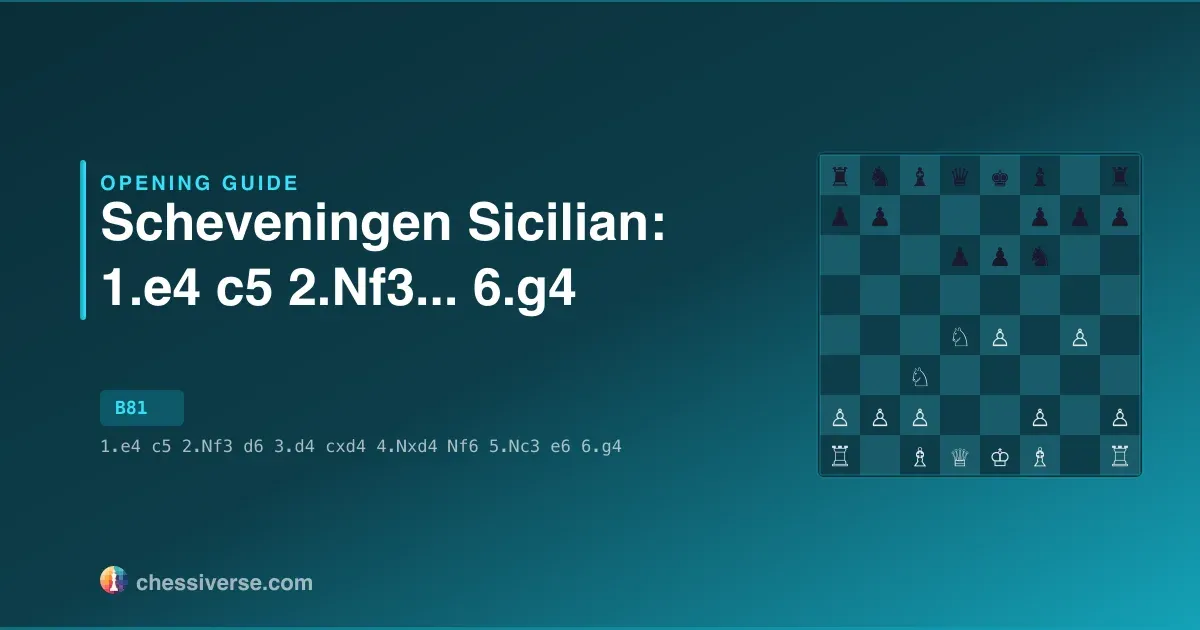
1.e4 c5 2.Nf3 d6 3.d4 cxd4 4.Nxd4 Nf6 5.Nc3 e6 6.g4 opens the Sicilian Defense: Scheveningen Variation, Keres Attack, ECO B81. White launches the Keres Attack on move six. The g-pawn is already advancing toward Black's kingside, and Black has to react instantly or get steamrolled.
Strategic Overview
The Keres Attack is one of the sharpest weapons against the Scheveningen and the reason many players prefer to reach the Scheveningen via a Najdorf move order. White's idea is direct: push g5 next, kick the f6-knight back into passive squares, and use the open lines on the kingside to launch a fast attack — exactly the kind of pawn storm the English Attack is built on. Black's e6 pawn has already weakened g4 control and boxed in the c8-bishop, so White is doubling down on a structural concession Black has already made. Black's only serious answer is 6...h6, putting the brakes on g5. Moves like 6...Nc6 don't address the threat and after 7.g5 Nd7 Black's knight is parked passively while White's pawns are within a move or two of breaking open the kingside. After 6...h6 castling kingside becomes risky — Black often plays for queenside development and waits to see where the king can safely live. The 6...e5 counter is naive and gets refuted by 7.Bb5+ Bd7 8.Bxd7+ Qxd7 9.Nb3, with White trading off the light-squared bishops and setting up a standard English Attack structure. The Keres Attack is uncomfortable to face without preparation and the reason Najdorf-first move orders exist.
Key Ideas
When players succeed in this line, they usually do so by leaning on the following themes:
- g4 prepares g5 — The push isn't an attack on its own — it's setup. The real threat is g5, which kicks the f6-knight to passive squares and opens lines toward Black's kingside king position.
- 6...h6 is the main answer — Stopping g5 with ...h6 is the principled reply. Anything else lets White roll the pawns forward, and the knight gets parked on a bad square while the attack accelerates.
- Don't castle kingside fast — With White's pawns already advancing on the kingside, walking into the storm with an early castle is asking for trouble. Black often delays castling or chooses queenside, depending on the position.
- ...e5 is naive — Trying to counterattack in the center with 6...e5 runs into 7.Bb5+ and a clean trade of light-squared bishops. White then sets up the English Attack with no obstacles.
- Najdorf move order avoids this — Many Scheveningen players reach the structure via a Najdorf first with ...a6. The pawn on a6 prevents Bb5+ and turns the g4 line into the Perenyi rather than the Keres — a different, less critical position.
History and Notable Players
It arises from the Sicilian Defense: Scheveningen Variation. Among the most prolific White practitioners are Ljubomir Ljubojevic (25 games), John D M Nunn (20 games), Nigel D Short (20 games). Black-side regulars include Gyula Sax (51 games), Mihai Suba (44 games), Andrei Sokolov (43 games).
Performance Across Rating Levels
Popularity and results vary sharply by rating level. Among 1200-rated players, it appears in 0.00% of games — 441 of them on record — with White winning 69.8% and Black 28.1%. At 1800 the opening surfaces in 0.00% of games; White wins 58%, Black 38.3%, draws 3.7%. Among 2500-rated players the line appears in 0.05% of games and draws spike to 7.8%, indicating tight preparation. White's edge erodes by 19.6pp from 1200 to 2500 Elo, suggesting Black's counterplay is easier to find with experience.
Move Diversity and Theory Depth
What players actually play after the opening moves depends heavily on rating. At 1200 Elo (441 games), the top reply is h6, played 27.3% of the time. Four other moves each take at least 5% of games, and the top three moves account for 71.1% of games. Entropy: 2.66. By 2500 (7,078 games), h6 dominates at 55.3% of replies; four other moves reach 5% and the top three moves account for 78.9% of games. Entropy drops to 1.97. The narrowing is significant — strong players consolidate around a small set of best moves, while amateurs scatter across many plausible-looking options.
Common Mistakes
- Playing outside main lines — At 1000 Elo, only 73.2% of games stay with the three most-played moves; at 2000 that climbs to 79.9%. Most of the gap is players who pick a reasonable-looking move over the best one, and the position quietly drifts.
- Neglecting development — It can feel productive to make extra pawn moves early, but falling behind in piece development is what loses most amateur games — especially in open positions where active pieces find squares fast.
- Ignoring the kingside attack — In sharp Sicilian lines, White typically castles long and pushes the h-pawn. Without your own counterplay on the queenside or in the centre, White's attack lands first.
Practice on Chessiverse
Ready to try the Sicilian Defense: Scheveningen Variation, Keres Attack against a bot? Pick an opponent at your level and play a game.