



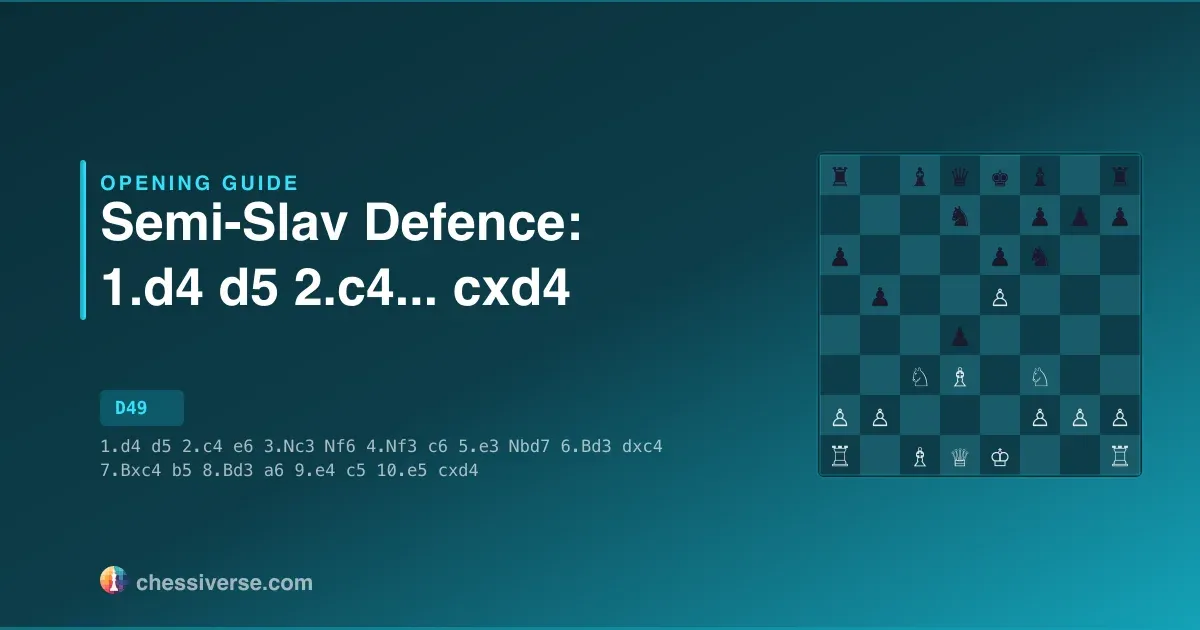
The Semi-Slav Defense: Meran Variation, Old Variation begins with 1.d4 d5 2.c4 e6 3.Nc3 Nf6 4.Nf3 c6 5.e3 Nbd7 6.Bd3 dxc4 7.Bxc4 b5 8.Bd3 a6 9.e4 c5 10.e5 cxd4 (ECO D49). Lichess records 8,259 games in this line, which gives us a reliable view of how it actually performs in practice.
History and Notable Players
It arises from the Semi-Slav Defense: Meran Variation (7...b5). On the White side, Petar Trifunovic (8 games), Peter K Wells (7 games), Lubomir Ftacnik (6 games) top the database. Notable Black exponents: Alexander Chernin (9 games), Marinus Kuijf (8 games), Peter Lukacs (7 games).
Move Diversity and Theory Depth
Move choice is far from uniform in the Semi-Slav Defense: Meran Variation, Old Variation. Below 1600 the samples are small (8 games at 1200, 72 at 1400), so the comparison starts at 1600, with 217 games. There, the top reply is Nxb5, played 41.9% of the time. Three other moves each take at least 5% of games, and the top three moves account for 89.4% of games. Entropy: 1.83. By 2500 (431 games), Nxb5 dominates at 86.8% of replies; only one other move still reaches 5% and the top three moves account for 97.4% of games. Entropy drops to 0.76. The narrowing is significant — strong players consolidate around a small set of best moves, while amateurs scatter across many plausible-looking options.
Common Mistakes
- Neglecting development — Extra pawn moves in the opening are tempting, especially when you "know the moves". Developing a piece each turn is the simple correction.
- Releasing tension too early — The c4/d5 tension is the heart of these openings. Capturing or pushing prematurely usually surrenders the initiative.
Practice on Chessiverse
Ready to try the Semi-Slav Defense: Meran Variation, Old Variation against a bot? Pick an opponent at your level and play a game.