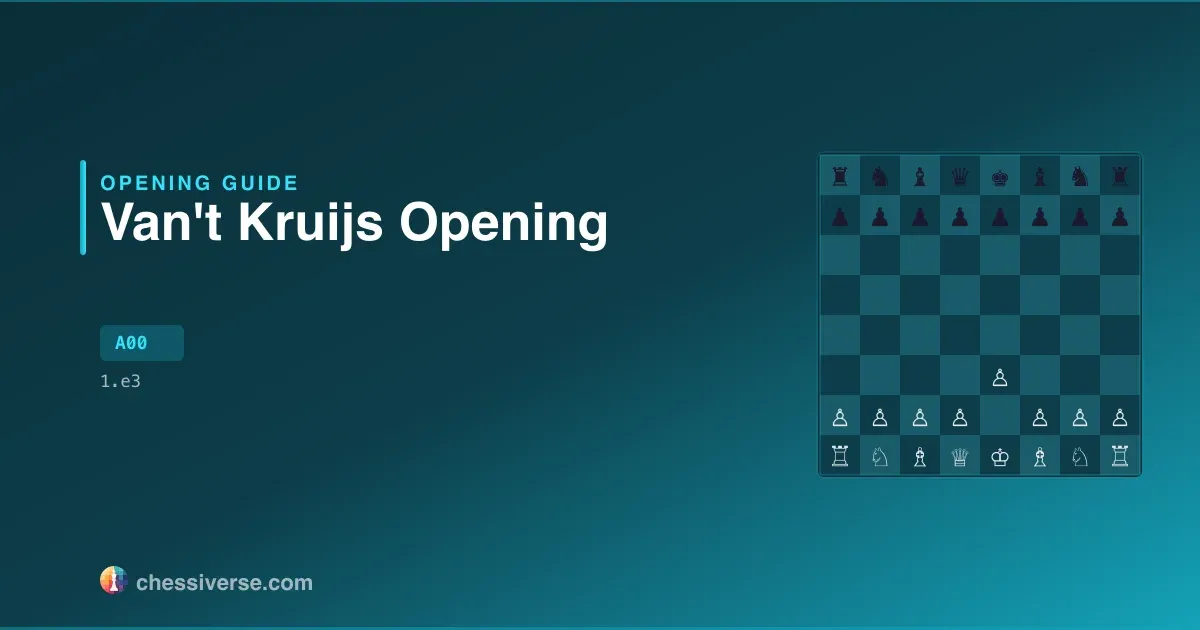
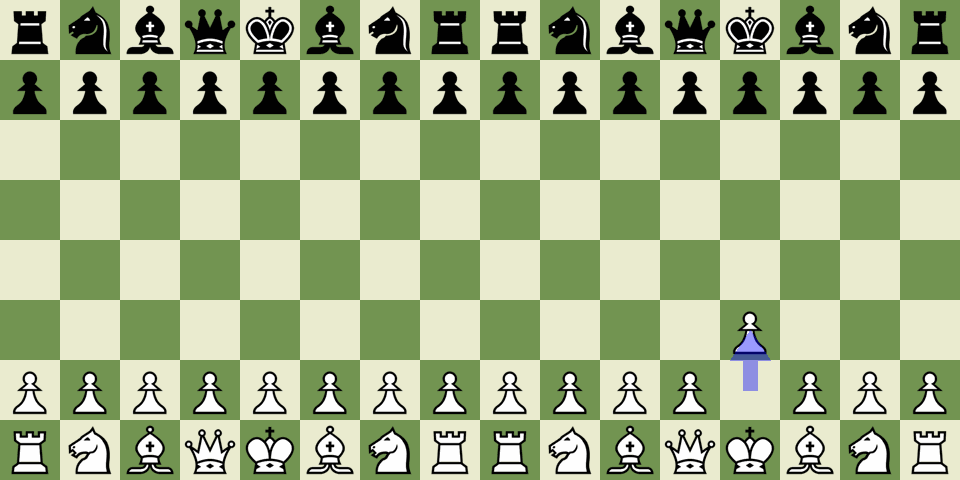
1.e3 opens the Van't Kruijs Opening, ECO A00. A modest first move that opens lines for the queen and king's bishop but cedes the center. Black gets a free hand to choose the structure.
Strategic Overview
1.e3 is an irregular but not ridiculous first move. It opens diagonals for the f1-bishop and the queen, but it does nothing to contest the center, and crucially it blocks the c1-bishop. Black can answer with almost anything sensible: 1...e5 and 1...d5 stake central claims, 1...Nf6 and 1...c5 keep options open, and 1...g6 sets up a flexible fianchetto that handles multiple White plans. From here, White's game is mostly transpositional. A follow-up c4 reaches the English, d4 leads to Queen's Pawn structures, b3 and Bb2 enter Larsen territory. One quirky possibility is 1...e5 2.e4, arriving at an Open Game with reversed colors and Black to move, which is mostly a curiosity. The real verdict: 1.e3 is passive but solid. Strong players will equalize, but the position stays playable for White as long as the queenside bishop eventually finds a diagonal.
Key Ideas
The recurring motifs below distinguish a confident handler of this opening from a beginner:
- Plan to free the queen's bishop early — The pawn on e3 hems in the c1-bishop. White either commits to b3 and Bb2, plays a later d4 and Bd2, or concedes a tempo with e4. Pick the plan before the bishop becomes a permanent problem.
- Use 1.e3 as a transposition tool — Many White systems include e3 anyway. With c4 you reach the English, with d4 a Queen's Pawn structure, with b3 a Larsen setup. Choose the destination once Black has shown their central preference.
- Let Black overcommit in the center — Because 1.e3 invites ...e5 and ...d5, Black often grabs more central space than they can defend. White's plan is to undermine that center later with c4 or f4, treating the early concession as bait.
Performance Across Rating Levels
The picture changes a lot as you climb the rating ladder. The 1200 bracket has 15,215,982 games (2.26% of all games at that level); White wins 46.6%, Black 49.3%, 4.1% are drawn. Move up to 1800 Elo and the share shifts to 1.06%, with White winning 46.7% versus Black's 48.9%. At the top end (2500+ Elo), popularity is 0.36% with 9.1% draws — a clear sign of how much theory rules the line at master level.
Time Control Patterns
Look at the same opening across time controls and bullet stands out. In bullet, it appears in 2.83% of games (75,114,786); White wins 48.6%. Blitz shows 1.67% adoption across 60,049,175 games, White scoring 46.9%. In rapid, the share rises to 1.72% — 19,052,276 games, White 45.3%. White's score swings 3.3pp across formats, so time control isn't just a stylistic choice here — it shifts the actual results.
Move Diversity and Theory Depth
Move choice is far from uniform in the Van't Kruijs Opening. At 1200 Elo (15,215,982 games), the top reply is e5, played 53.4% of the time. Three other moves each take at least 5% of games, and the top three moves account for 78.5% of games. Entropy: 2.29. By 2500 (49,084 games), d5 takes over as the top reply at 27.7%; four other moves reach 5% and the top three moves account for 64.8% of games. Entropy rises to 2.84. Even elite players don't fully agree on the best continuation here, which keeps the position dynamic.
Historical Trends
Tracking the Van't Kruijs Opening year over year shows a clear story. Adoption peaked in 2013 at 2.35% (67,636 games). By 2025 it sits at 1.62%, down 31% from that high, leaving the line in decline.
The move 1.e3 turns up in a number of 19th-century games but never became mainstream, since it stakes only a modest claim in the center. ChessBase data still ranks it sixth in popularity among the twenty possible first moves, and strong players have mostly used it as a way to steer the game into other openings.
Named after: Maarten van 't Kruijs (1813-1885), a Dutch player who won the sixth Dutch championship in 1878.
Notable players: Aron Nimzowitsch, Bent Larsen, Pavel Blatny
Because 1.e3 can morph into so many different systems, opening authors Benjamin and Schiller described it as a chameleon of an opening.
Main Lines and Variations
After 1.e3, the established follow-ups are:
Each branch leads to a different middlegame character — the resulting pawn structure decides what kind of game you get.
Common Mistakes
- Neglecting development — Extra pawn moves in the opening are tempting, especially when you "know the moves". Developing a piece each turn is the simple correction.
- Playing without a plan — Each Van't Kruijs Opening middlegame demands a specific approach. Decide whether the position calls for attack, manoeuvre, or simplification before reaching for a move.
Practice on Chessiverse
Ready to try the Van't Kruijs Opening against a bot? Pick an opponent at your level and play a game.