Zukertort Opening: Nf6

+76%
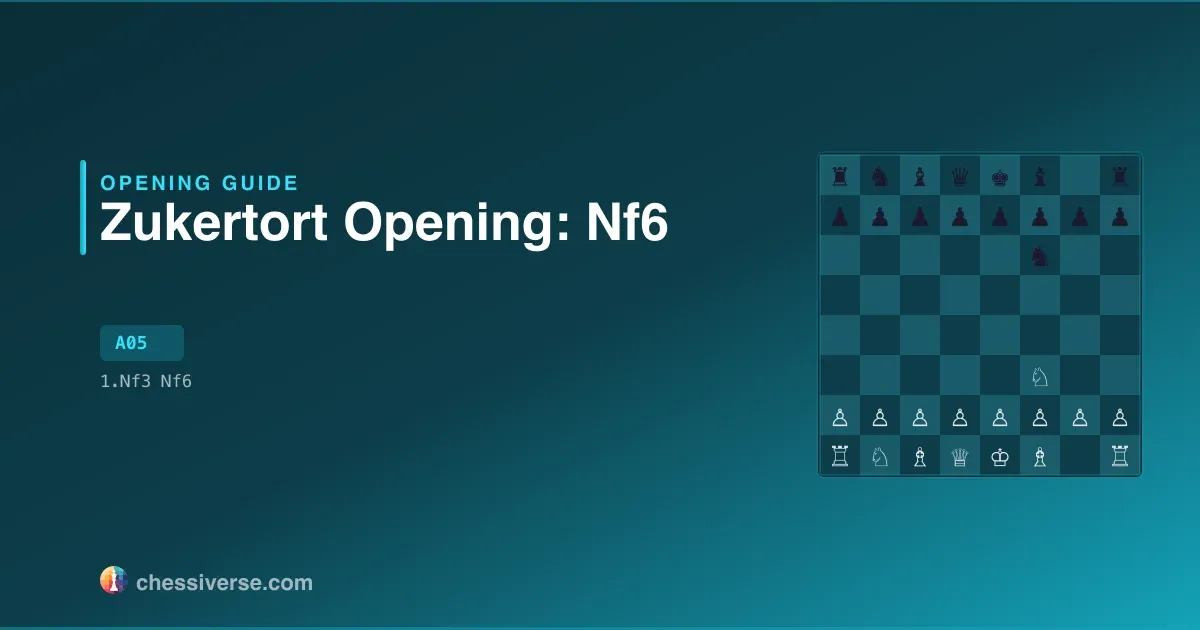
A051.Nf3 Nf6
Sep 1, 2027
TL;DR

A transpositional crossroads where Black develops a piece, covers e4, and waits for White to declare a structure first. Almost any major queen-pawn or English system can grow from here — Nimzo, Queen's Indian, KID, Symmetrical English all stay live around move 10.

Reviewed by

IM John Bartholomew
IM John BartholomewCo-Founder & Chess Educator

International Master and chess educator. Co-founded Chessable and joined Chessiverse as co-founder. Best known for his "Climbing the Rating Ladder" YouTube series and structured opening courses.

Zukertort Opening: Nf6: A Complete Guide
Zukertort Opening: Nf6 - Opening Moves
Summary

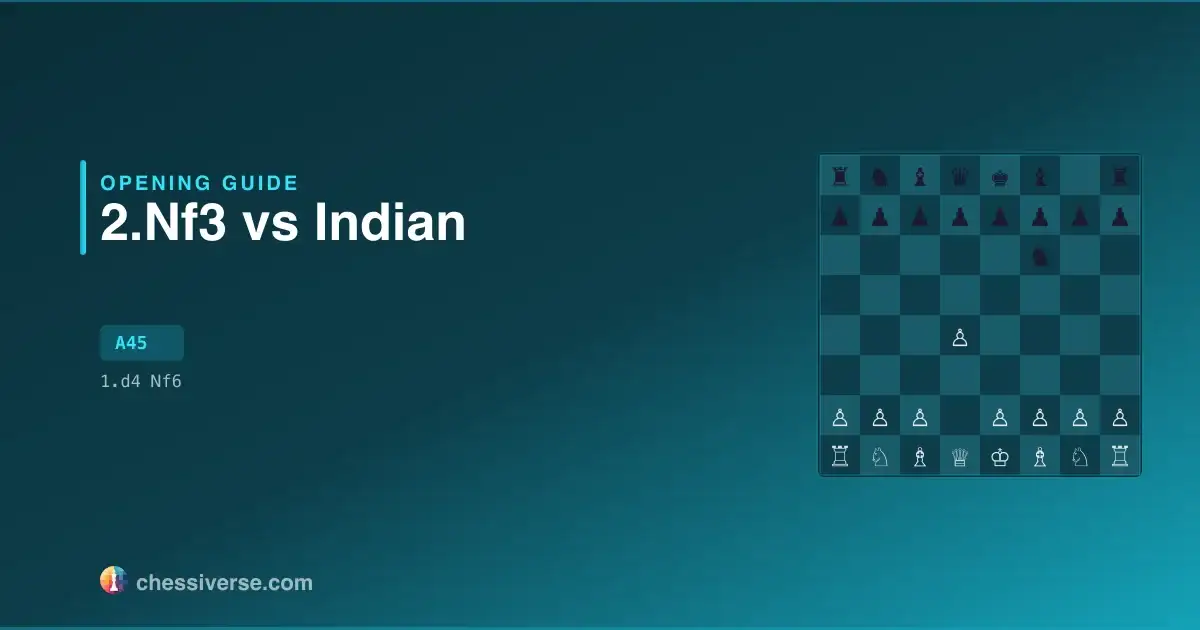
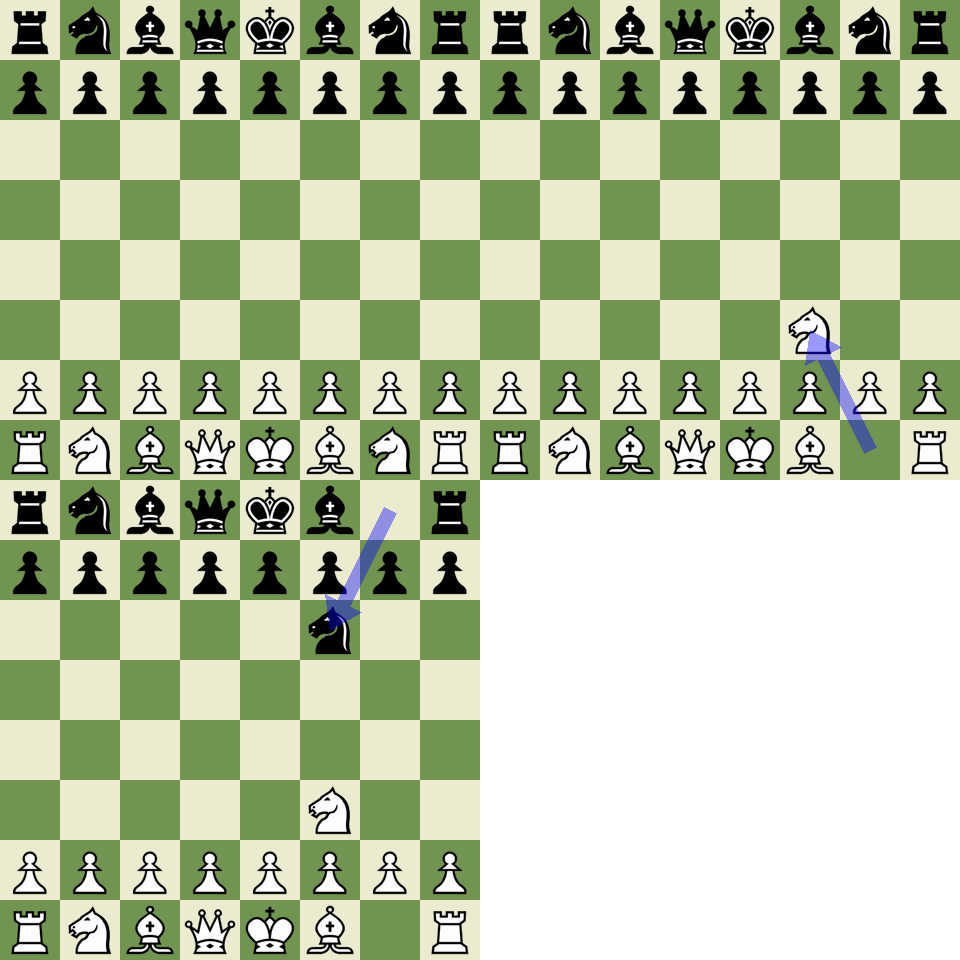
The Zukertort Opening: Nf6 begins with 1.Nf3 Nf6 (ECO A05). Black mirrors White's flexible flank move and refuses to commit to a structure first. The position is a transpositional crossroads — almost any major queen-pawn or English system can grow out of here.

Strategic Overview

1...Nf6 is the highest-class reply to 1.Nf3 precisely because it commits to nothing. Black develops a piece, covers e4, eyes d5, and waits to see which structure White will set up. The reason elite players gravitate to this move is that it preserves every reasonable defense: if White plays d4, Black can head for a Nimzo-Indian, Queen's Indian, King's Indian, or Grünfeld depending on taste. If White plays c4, a Symmetrical English or a normal Indian setup is on the menu. Even if White stays in pure Reti waters with g3, Bg2, and 0-0, Black can choose between ...d5 systems and ...g6 fianchetto plans. The middlegame character therefore depends entirely on which transposition both sides agree to. What 1...Nf6 does not promise is sharp early action — both kings get developed safely and the real fight tends to start around move 10, when pawn structure finally crystallizes. That suits players who like to outplay opponents in positions where understanding matters more than memorized lines.

Key Ideas

The recurring motifs below distinguish a confident handler of this opening from a beginner:

  • Maximum flexibility, minimum commitment — By developing a piece instead of pushing a pawn, Black keeps every major defensive system available. White has to reveal intentions first, and Black reacts accordingly.
  • Transposition is the whole point — Almost every game leaves the Reti and enters a 1.d4 or 1.c4 system. Knowing where you want the game to go matters more than memorizing pure 1.Nf3 lines.
  • Contest e4 and d5 from move one — The f6-knight already pressures e4 and supports a later ...d5. That makes it harder for White to build a big center with e4 in one move.

History and Notable Players

It arises from the Zukertort Opening. On the White side, Ulf Andersson (431 games), Aleksander Wojtkiewicz (363 games), Rafael A Vaganian (329 games) top the database. Notable Black exponents: Ivan Farago (188 games), Anatoly Karpov (149 games), Oleg M Romanishin (148 games).

Performance Across Rating Levels

Popularity and results vary sharply by rating level. Among 1200-rated players, it appears in 0.19% of games — 1,270,738 of them on record — with White winning 48.9% and Black 46.9%. By 1800, popularity is 0.55% and White's score is 49.1% to Black's 45.5%. At 2500, 3.94% of games go into this opening; draws sit at 11% — the line is well-mapped at this level. Positions also become less sharp as level rises (sharpness 0.96 → 0.89).

Time Control Patterns

Time control matters here: bullet players reach for this opening more than others. In bullet, it appears in 0.61% of games (16,325,142); White wins 50.6%. Blitz shows 0.52% adoption across 18,801,560 games, White scoring 49.2%. In rapid, the share rises to 0.32% — 3,531,069 games, White 47.9%. White's score swings 2.7pp across formats, so time control isn't just a stylistic choice here — it shifts the actual results.

Move Diversity and Theory Depth

What players actually play after the opening moves depends heavily on rating. At 1200 Elo, the top reply is d4, played 33.6% of the time. There are 6 other moves seeing meaningful share, and 70.2% of games stick to established theory. Entropy: 2.76. By 2500, g3 dominates at 40.2% of replies; only 4 viable alternatives remain and 87.7% of moves are theory. Entropy drops to 2.05. The narrowing is significant — strong players consolidate around a small set of best moves, while amateurs scatter across many plausible-looking options.

Tracking the Zukertort Opening: Nf6 year over year shows a clear story. Adoption peaked in 2020 at 0.56% (3,220,297 games). By 2025 it sits at 0.46% — a 76% shift overall, leaving the line on the rise.

Common Mistakes

  • Drifting away from main theory — At 400 Elo, theory adherence sits at 67.1% — versus 81.8% at 2000. The most popular deviation is Nc3 (played 23.9% of the time at 400, much less so up top). It looks fine but quietly hands the better-prepared side an edge.
  • Neglecting development — Extra pawn moves in the opening are tempting, especially when you "know the moves". Developing a piece each turn is the simple correction.
  • Playing without a plan — Each Zukertort Opening: Nf6 middlegame demands a specific approach. Decide whether the position calls for attack, manoeuvre, or simplification before reaching for a move.

Practice on Chessiverse

Ready to try the Zukertort Opening: Nf6 against a bot? Pick an opponent at your level and play a game.


Quick Facts

Main Line1.Nf3 Nf6
DifficultyBeginner
Parent OpeningZukertort Opening
22,332,629games on Lichess
49%
6.1%
44.9%
White wins Draws Black wins

Top Players

As White
As Black

Data from Lichess opening explorer (blitz & rapid)

Most Popular At2500
SharpnessBalanced

Popularity by Rating

Percentage of all games at each rating bracket that feature this opening.

Data from Lichess opening explorer (blitz & rapid games)

Theory Adherence by Rating

How often players choose the single most popular move at this position. Higher = more predictable play.

White to move after the opening line

Popularity Over Time

Share of all Lichess blitz + rapid games featuring this opening, by year.

Top Moves by Rating

White to move after the opening line

RatingMost Popular2nd3rd
400d425.6%Nc323.9%g317.5%
1000d430.9%g320.1%Nc319.4%
1200d433.6%g320.6%Nc316.1%
1400d435.3%g320.7%Nc312.7%
1600d434.2%g322.4%c415.5%
1800d432.1%g325.2%c420%
2000g330.8%d426.7%c424.3%
2200g335.7%c430.6%d419.2%
2500g340.2%c435%d412.5%

Popularity by Time Control

Bullet
0.61%16.3M
Blitz
0.52%18.8M
Rapid
0.32%3.5M
2% more decisive in bullet
Raw data tables (Lichess blitz + rapid)
Zukertort Opening: Nf6: popularity and win rates by player rating
Rating (Elo)Share %GamesWhite win %Black win %Draw %Sharpness
4000.24556,90848.046.06.00.940
10000.19801,27248.746.44.80.952
12000.191,270,73848.946.94.30.957
14000.221,999,68848.447.44.20.958
16000.313,106,61148.446.94.70.953
18000.554,643,79049.145.55.40.946
20001.175,310,25549.643.96.50.935
22002.434,106,04049.242.48.40.916
25003.94537,32748.840.211.00.890
Zukertort Opening: Nf6: move-choice theory adherence by rating
Rating (Elo)Top moveTop move %Viable movesTheory %Entropy
400d425.6667.12.897
1000d430.9770.42.805
1200d433.6670.22.760
1400d435.3568.82.702
1600d434.2672.02.649
1800d432.1577.32.542
2000g330.8481.82.405
2200g335.7485.62.224
2500g340.2487.72.053
Zukertort Opening: Nf6: popularity over time
YearShare %GamesWhite win %Black win %Draw %
20130.267,52546.649.63.8
20140.3632,82847.347.45.3
20150.49108,45248.146.85.1
20160.50308,62948.945.55.6
20170.50570,45849.345.25.5
20180.53994,96349.245.35.6
20190.541,538,13249.245.25.6
20200.563,220,29748.844.66.6
20210.473,602,13148.844.86.3
20220.463,369,06749.144.96.0
20230.433,435,45049.044.96.1
20240.453,353,47849.144.86.1
20250.463,404,37149.144.86.1
Zukertort Opening: Nf6: popularity by time control
FormatShare %GamesWhite win %Black win %Draw %Sharpness
bullet0.6116,325,14250.645.04.40.956
blitz0.5218,801,56049.244.76.10.939
rapid0.323,531,06947.945.86.20.938
Zukertort Opening: Nf6: top candidate moves by rating bracket
Rating (Elo)1st move1st %2nd move2nd %3rd move3rd %
400d425.6Nc323.9g317.5
1000d430.9g320.1Nc319.4
1200d433.6g320.6Nc316.1
1400d435.3g320.7Nc312.7
1600d434.2g322.4c415.5
1800d432.1g325.2c420.0
2000g330.8d426.7c424.3
2200g335.7c430.6d419.2
2500g340.2c435.0d412.5
Zukertort Opening: Nf6: top practitioners by side
SidePlayerGames
WhiteUlf Andersson431
WhiteAleksander Wojtkiewicz363
WhiteRafael A Vaganian329
BlackIvan Farago188
BlackAnatoly Karpov149
BlackOleg M Romanishin148

Frequently Asked Questions

What is the Zukertort Opening: Nf6?

The Zukertort Opening: Nf6 begins with 1.Nf3 Nf6 and is classified under ECO code A05. 1...Nf6, keeping the position symmetrical, is the most flexible reply to 1.Nf3.

Is the Zukertort Opening: Nf6 good for beginners?

The Zukertort Opening: Nf6 can be played at any level. Beginners should focus on understanding the key strategic ideas rather than memorizing long theoretical lines. Our AI bots at various rating levels provide a great way to practice the opening concepts.

What are the win rates for the Zukertort Opening: Nf6?

In a database of 22,332,629 master games, White wins 49% of the time, Black wins 44.9%, and 6.1% are drawn. Notable players on the White side include Ulf Andersson and Aleksander Wojtkiewicz. On the Black side, Ivan Farago and Anatoly Karpov are among the most frequent practitioners.

How can I practice the Zukertort Opening: Nf6?

On Chessiverse, you can practice the Zukertort Opening: Nf6 by playing against our 600+ AI bots. Each bot has a unique playing style and opening repertoire, so you can find the perfect sparring partner for any level.

Reviewed by

IM John Bartholomew
IM John BartholomewCo-Founder & Chess Educator

International Master and chess educator. Co-founded Chessable and joined Chessiverse as co-founder. Best known for his "Climbing the Rating Ladder" YouTube series and structured opening courses.

Practice This Opening on Chessiverse

Play against 1000+ AI bots with unique personalities and opening repertoires. From beginner-friendly to grandmaster-level opponents, find the perfect sparring partner for any opening.

Play Now

Not sure which opening fits you? Take the free chess personality test — your style determines which openings will work with you.

Back to Articles