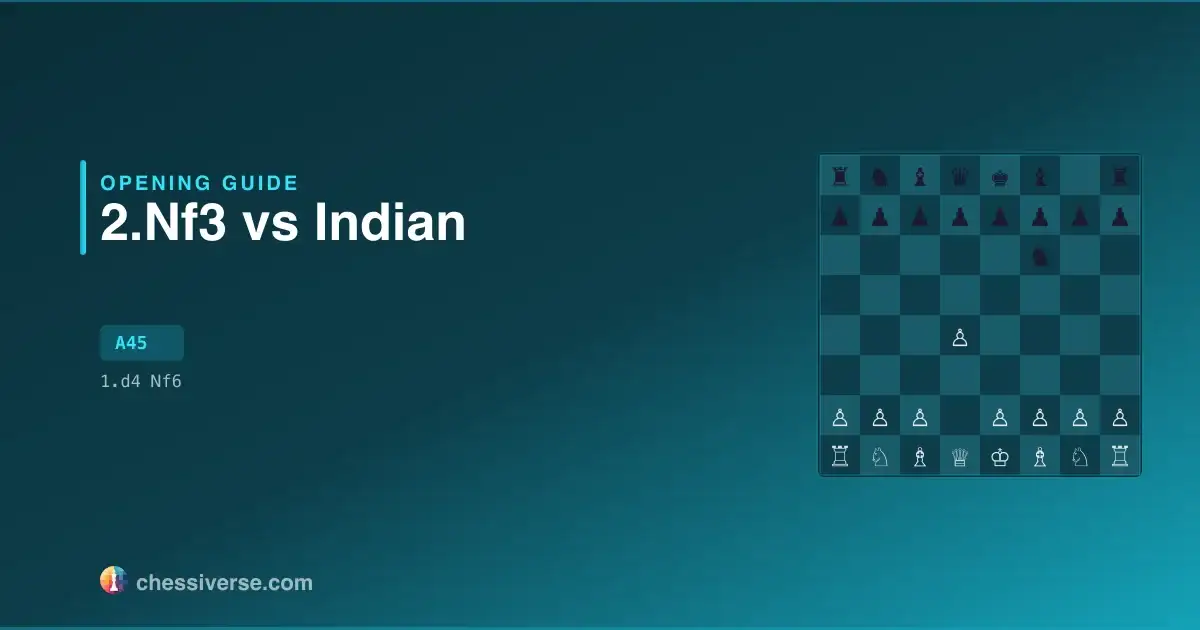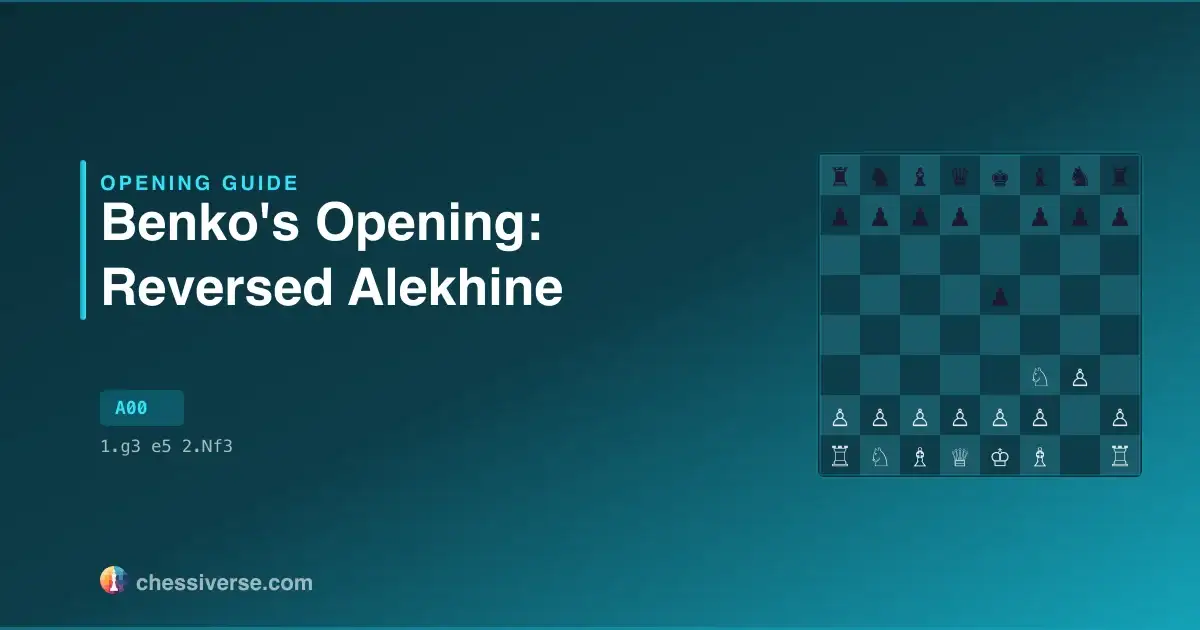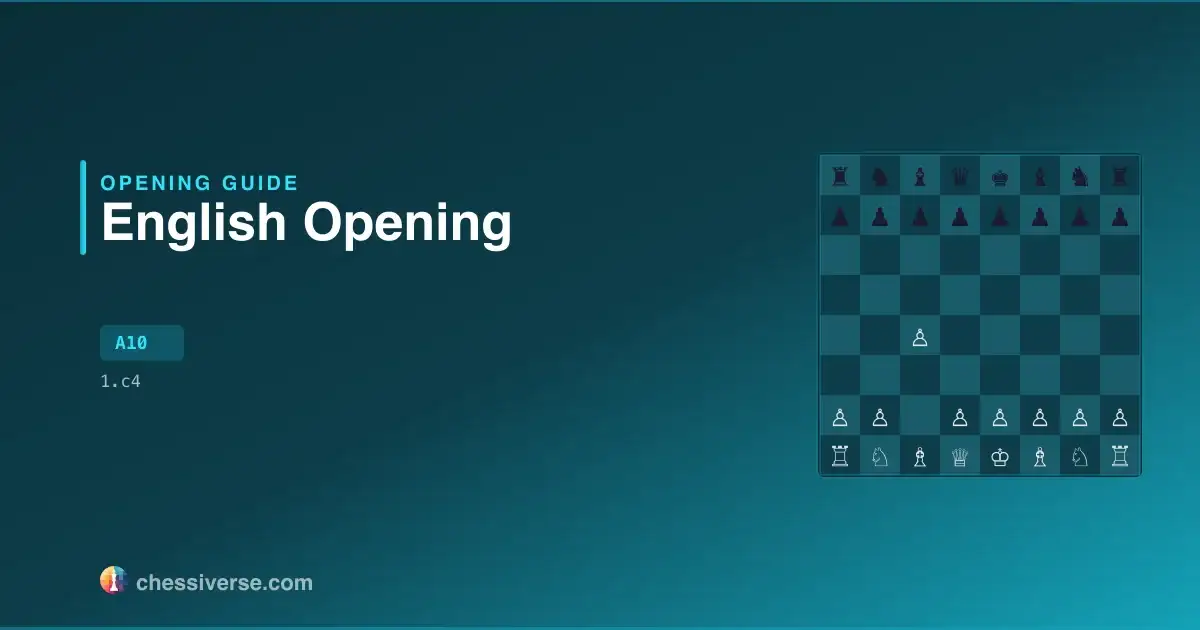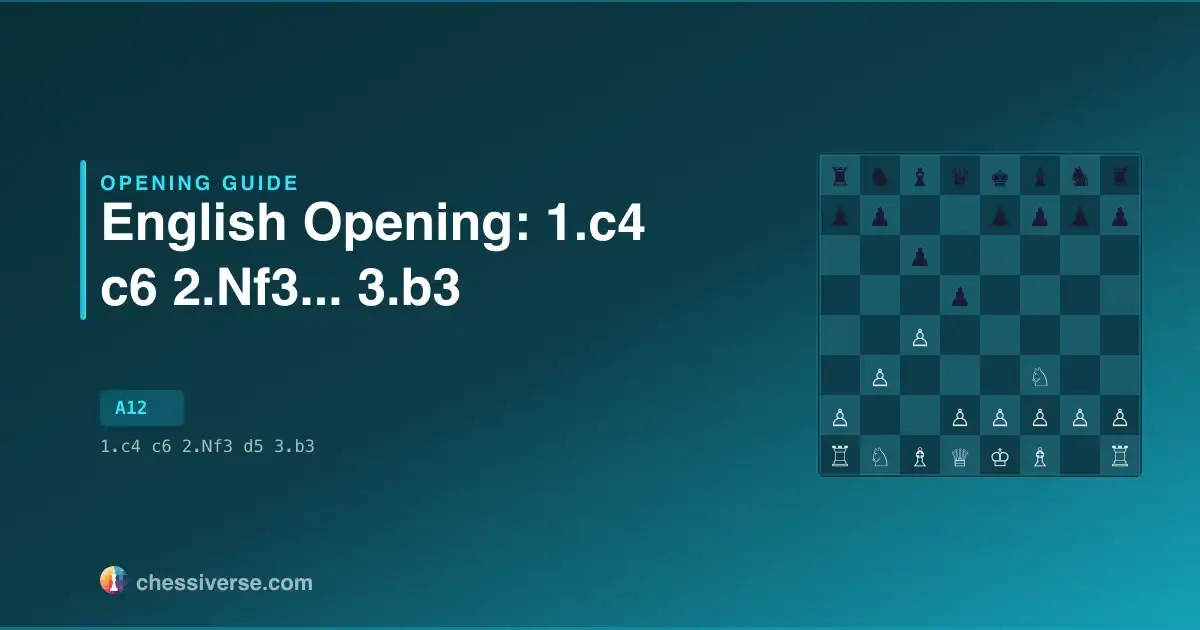




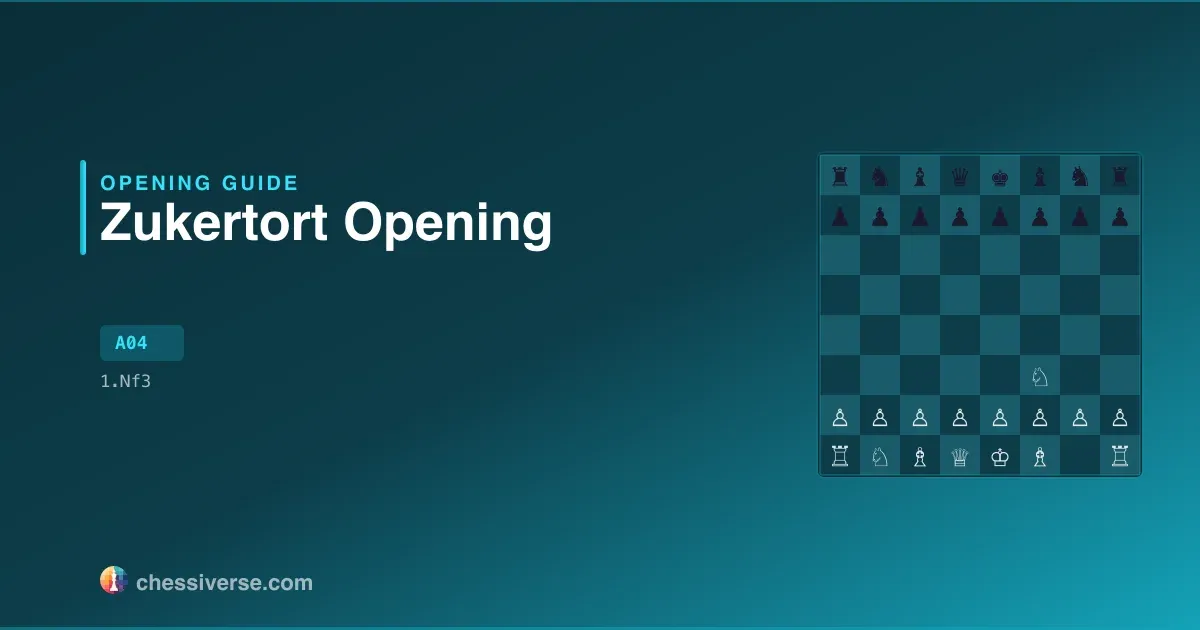
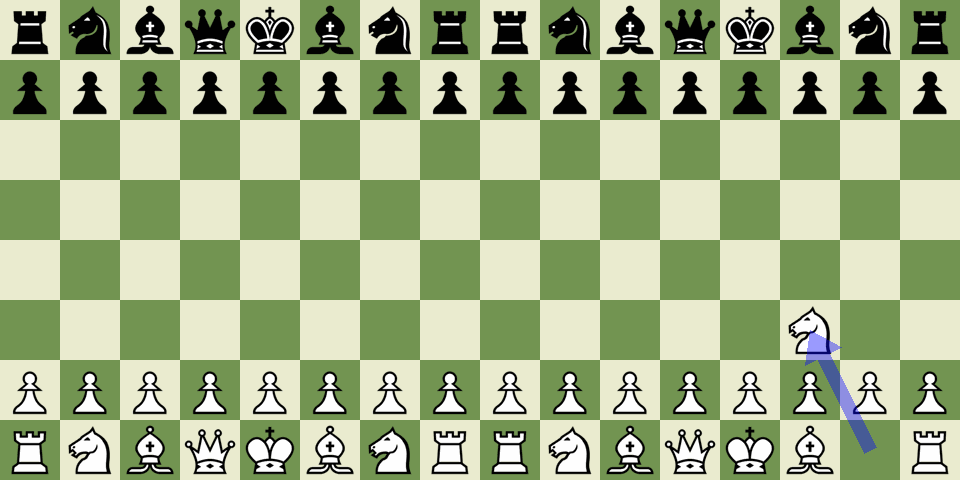
The Zukertort Opening arises after 1.Nf3 and falls under ECO code A04. As the third most popular first move in chess, 1.Nf3 reflects the philosophy that developing the knight is almost universally useful, while every pawn move represents a permanent commitment. A key practical benefit is that it prevents Black from playing 1...e5, a move Black would be happy to make for the same reasons White values 1.e4. The opening preserves maximum flexibility for White, who can later steer toward the Reti Opening, the King's Indian Attack, or frequently transpose into entirely different systems such as the Sicilian Defense or Queen's Gambit. This adaptability also serves a strategic purpose: if White dislikes a particular variation that could arise from other move orders, 1.Nf3 acts as a way to gather information about Black's intentions, allowing White to avoid unfavorable transpositions while accepting desirable ones. With 142.4 million Lichess games across all rating levels, it is one of the most popular openings.
- A flexible, non-committal developing move: White controls e5 and can wait to see Black's setup before choosing a central pawn structure.
- It is chess's great transpositional tool, often flowing into the Reti, King's Indian Attack, Catalan, English or Queen's Gambit lines.
- Nimzowitsch praised 1.Nf3 as the most solid first move, arguing that 1.e4 and 1.d4 commit White too early.
History and Notable Players
The opening is named after Johannes Zukertort. Among the most prolific practitioners on the White side are Ulf Andersson (896 games), Aleksander Wojtkiewicz (751 games), Lev Gutman (731 games). On the Black side, notable exponents include Ivan Farago (247 games), Viktor Korchnoi (234 games), Jan H Timman (232 games).
Johannes Zukertort was an early experimenter with 1.Nf3 in an age when most players opened 1.e4 exclusively, and the move took his name. He won London 1883 three points clear of Steinitz before losing the first official World Championship match to him in 1886. Today 1.Nf3 is White's third most popular first move, behind only 1.e4 and 1.d4.
Named after: Johannes Zukertort, the Polish-born master who contested the first official World Championship against Steinitz in 1886.
Notable players: Johannes Zukertort
Blindfold play was another of Zukertort's strengths: in 1876 he took on sixteen opponents at once without sight of the boards, winning eleven of those games.
Statistics
Based on 142.4 million Lichess games across all rating levels:
- White wins: 50.3%
- Black wins: 44.6%
- Draws: 5.1%
White holds a moderate edge statistically, though Black has good practical chances.
Main Lines and Variations
After 1.Nf3, the main continuations include:
Each of these lines leads to distinct types of positions and requires its own understanding of the resulting pawn structures and piece placements.
Practice on Chessiverse
The best way to learn the Zukertort Opening is through practice. On Chessiverse, you can play chess against computer opponents that specialize in this opening. Our AI bots range from beginner to grandmaster level, each with unique playing styles — from aggressive attackers to solid defenders. Choose a bot that matches your rating and work your way up as you master the opening's key ideas.
Performance Across Rating Levels
How well the Zukertort Opening works depends on what level you're playing at. Among 1200-rated players, it appears in 2.32% of games — 15,666,927 of them on record — with White winning 49.7% and Black 46.2%. At 1800 the opening surfaces in 3.25% of games; White wins 51.2%, Black 43.9%, draws 5%. Among 2500-rated players the line appears in 10.44% of games and draws spike to 10.8%, indicating tight preparation.
Time Control Patterns
Time control matters here: bullet players reach for this opening more than others. In bullet, it appears in 4.26% of games (113,147,473); White wins 51.5%. Blitz shows 3.19% adoption across 114,686,150 games, White scoring 50.4%. In rapid, the share rises to 2.50% — 27,697,052 games, White 49.9%.
Move Diversity and Theory Depth
Looking at move selection shows how forcing — or not — the position really is. At 1200 Elo (15,666,927 games), the top reply is d5, played 39.9% of the time. Six other moves each take at least 5% of games, and the top three moves account for 62.8% of games. Entropy: 2.85. By 2500 (1,423,033 games), Nf6 takes over as the top reply at 38.1%; only three other moves still reach 5% and the top three moves account for 80.5% of games. Entropy drops to 2.38.
Historical Trends
Tracking the Zukertort Opening year over year shows a clear story. Adoption peaked in 2019 at 3.19% (9,152,691 games). By 2025 it sits at 3.12%, 2% below the peak but still 39% above its 2013 level, so the line is up over the full period despite easing from the high.