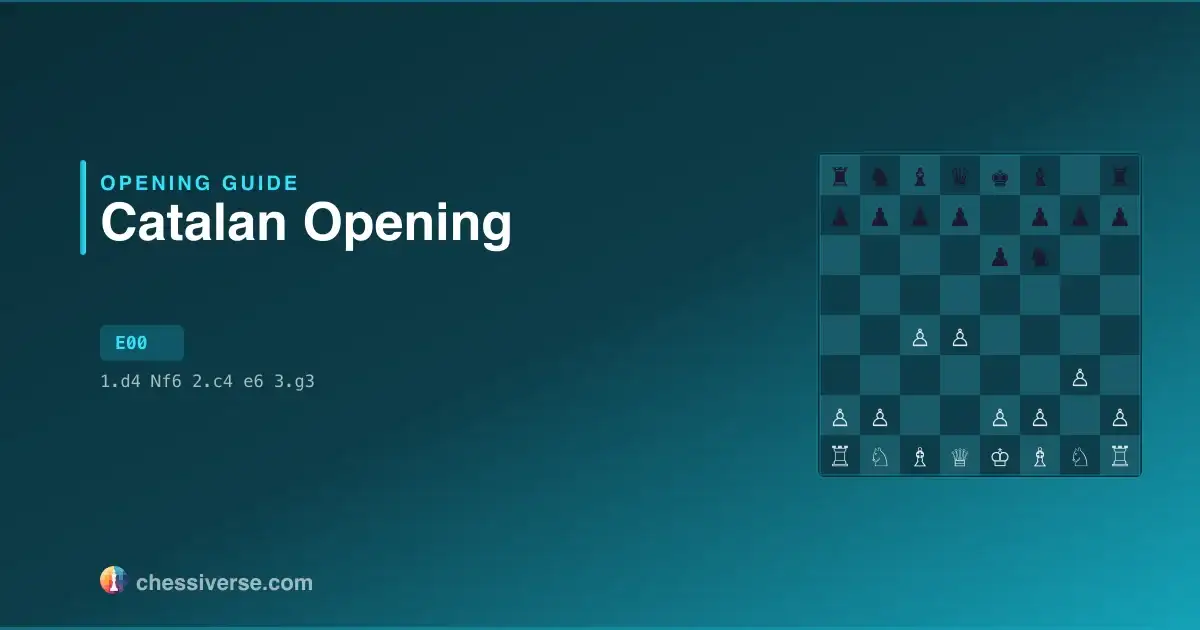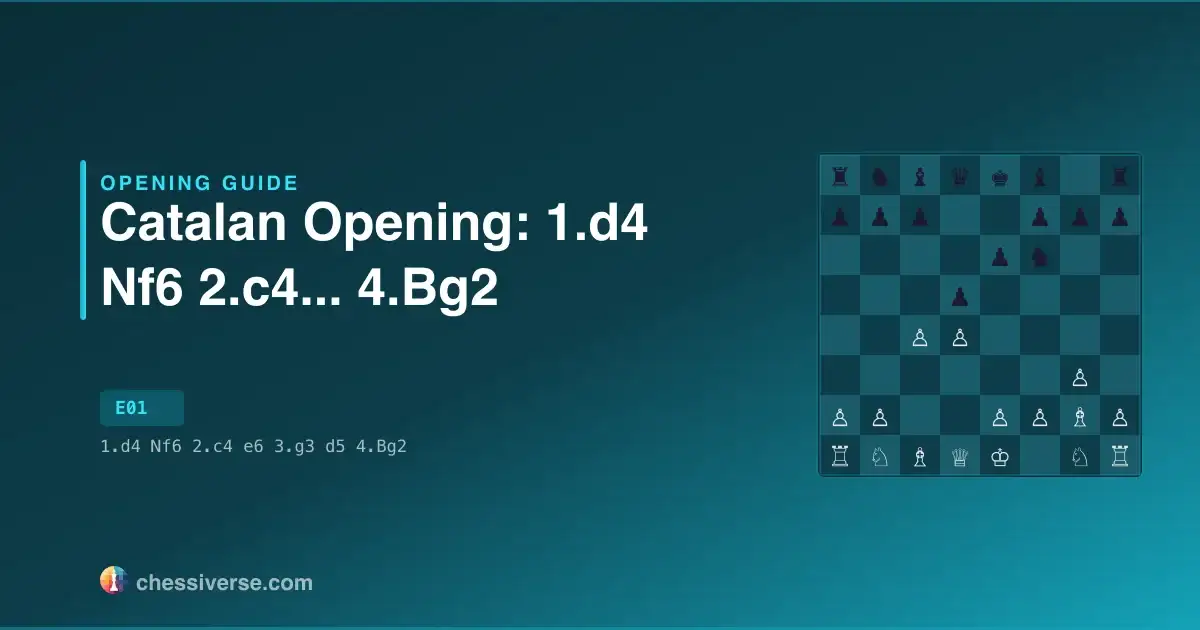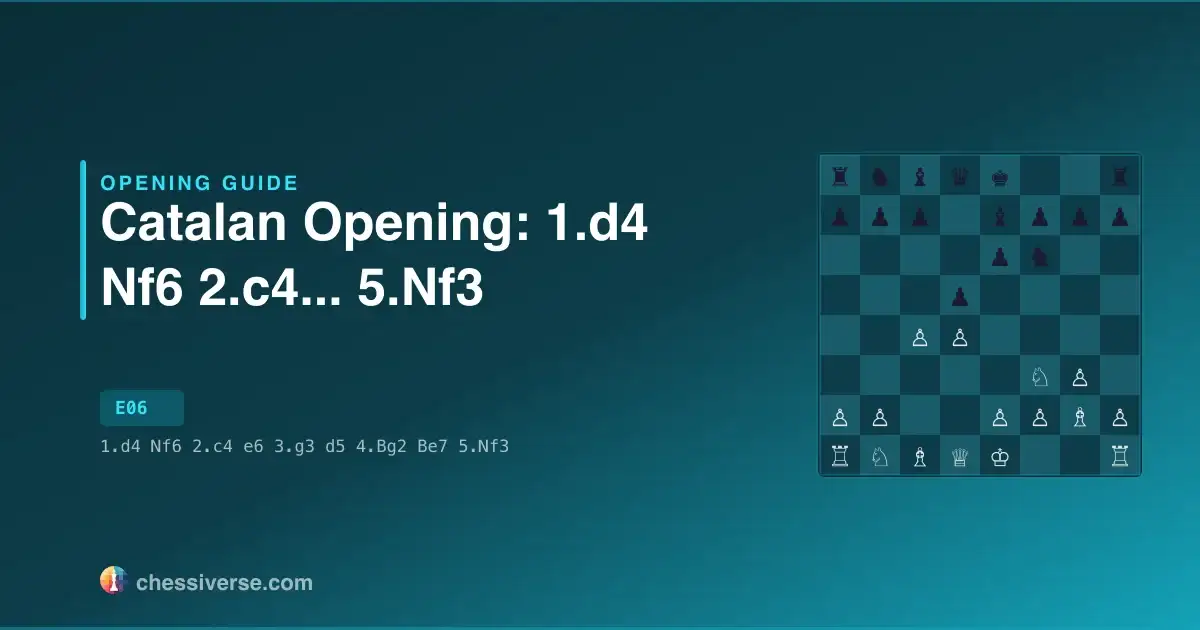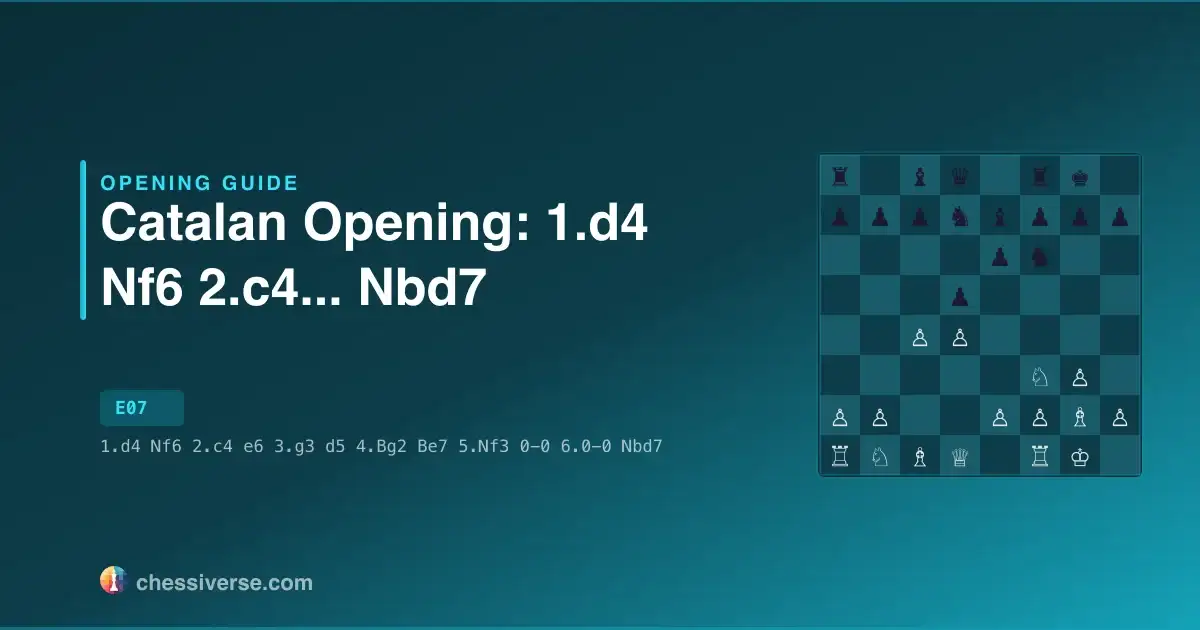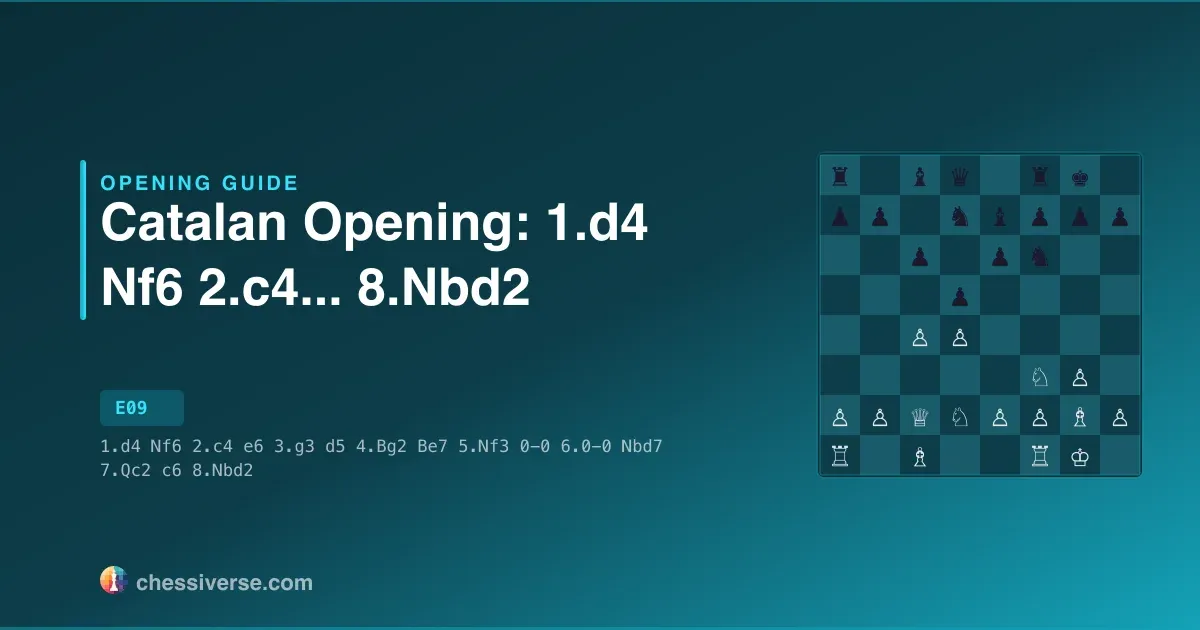
1.d4 Nf6 2.c4 e6 3.g3 d5 4.Bg2 Be7 5.Nf3 0-0 6.0-0 Nbd7 7.Qc2 c6 8.Nbd2 opens the Catalan Opening: Closed, Main Line, ECO E09. Across rating levels it shows up in 251,207 recorded games — enough data to map exactly where it succeeds and where it stalls.
History and Notable Players
It arises from the Catalan Opening: Closed (7.Qc2). Among the most prolific White practitioners are Zdenko Kozul (10 games), Alexander Raetsky (9 games), Daniel Summermatter (7 games). Black-side regulars include Jakov Geller (7 games), Chanda Sandipan (5 games), Jiri Fichtl (5 games).
Performance Across Rating Levels
The picture changes a lot as you climb the rating ladder. The 1200 bracket has 304 games (0.00% of all games at that level); White wins 53.3%, Black 44.1%, 2.6% are drawn. By 1800, popularity is 0.01% and White's score is 56.9% to Black's 37.1%. At the top end (2500+ Elo), popularity is 0.06% with 11.9% draws — a clear sign of how much theory rules the line at master level. White's edge erodes by 3.8pp from 1200 to 2500 Elo, suggesting Black's counterplay is easier to find with experience.
Move Diversity and Theory Depth
Move choice is far from uniform in the Catalan Opening: Closed, Main Line. At 1200 Elo (303 games), the top reply is b6, played 27.4% of the time. Seven other moves each take at least 5% of games, and the top three moves account for 52.6% of games. Entropy: 3.17. By 2500 (7,536 games), b6 dominates at 81.6% of replies; only one other move still reaches 5% and the top three moves account for 91.4% of games. Entropy drops to 1.20. That entropy collapse is the signature of a line where preparation pays off: at the top, players know the best move and play it.
Common Mistakes
- Drifting away from main theory — At 1200 Elo, the three most-played moves cover 52.6% of games, against 70.7% at 2000. The most popular deviation is a6 (played 12.3% of the time at 1200, less so up top). It looks fine but quietly hands the better-prepared side an edge.
- Neglecting development — It can feel productive to make extra pawn moves early, but falling behind in piece development is what loses most amateur games — especially in open positions where active pieces find squares fast.
- Playing without a plan — Each Catalan Opening: Closed, Main Line middlegame demands a specific approach. Decide whether the position calls for attack, manoeuvre, or simplification before reaching for a move.
Practice on Chessiverse
Ready to try the Catalan Opening: Closed, Main Line against a bot? Pick an opponent at your level and play a game.