Summary
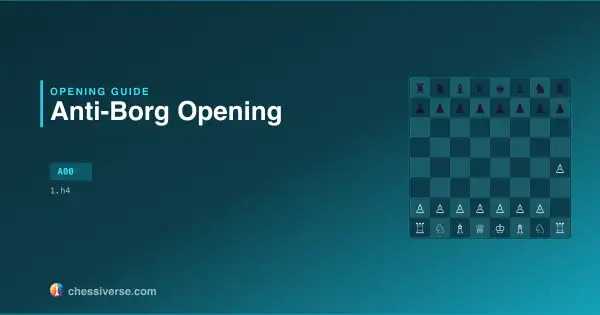
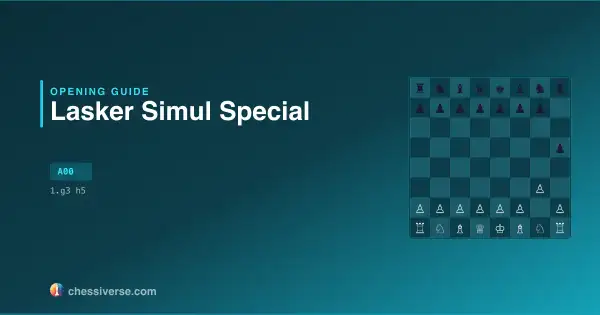
Starting from 1.a4 e5 2.h4, players enter the Crab Opening — ECO A00. Two wing pawns, no development, no center. White's pawns look like crab claws and the position looks about as effective.
Strategic Overview
1.a4 e5 2.h4 is a novelty move, not a system. White's first move already conceded a tempo, and the second move concedes another while weakening the kingside. There's no developmental gain, no central influence, and castling kingside has now become unattractive. The one tiny upside is that h4 prevents any future ...Qh4 ideas after a tempo-losing fianchetto, but that's a problem White created by playing 1.a4 in the first place. Black has free rein to develop normally with ...Nf6, ...d5 or ...d6, and ...Bc5, and the resulting position is structurally worse for White than nearly any sensible first two moves would have produced. Useful only for blitz trolling or to test whether an opponent can punish bad play. Against any reasonable response, White is fighting from a deficit by move three.
Key Ideas
When players succeed in this line, they usually do so by leaning on the following themes:
- Both wing pawns weaken the position — 1.a4 and 2.h4 leave White without central presence and with a damaged kingside. Castling short is now less appealing and castling long takes many more moves. The position is strategically worse than passing twice.
- Black develops and punishes naturally — There is no trap to fall into. Black plays normal developing moves like ...Nf6, ...d5, and ...Bc5, takes the center, and aims to open lines while White is still fiddling with rook pawns.
History and Notable Players
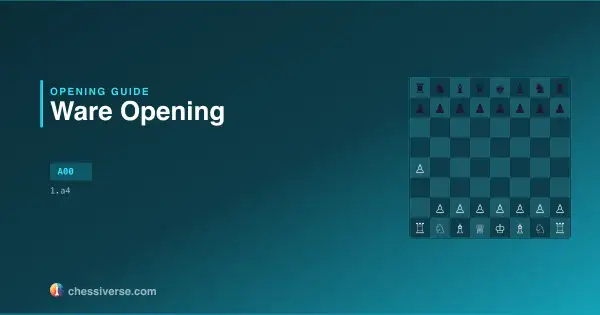
It arises from the Ware Opening.
Named after: Not a person: the name comes from the way the a- and h-pawns stick out like a crab's claws on either side of the board.
Common Mistakes
- Drifting away from main theory — At 400 Elo, the three most-played moves cover 64.5% of games, against 82.6% at 2000. The most popular deviation is Nc6 (played 13.8% of the time at 400, much less so up top). It looks fine but quietly hands the better-prepared side an edge.
- Neglecting development — It can feel productive to make extra pawn moves early, but falling behind in piece development is what loses most amateur games — especially in open positions where active pieces find squares fast.
- Playing without a plan — Each Crab Opening middlegame demands a specific approach. Decide whether the position calls for attack, manoeuvre, or simplification before reaching for a move.
Practice on Chessiverse
Ready to try the Crab Opening against a bot? Pick an opponent at your level and play a game.