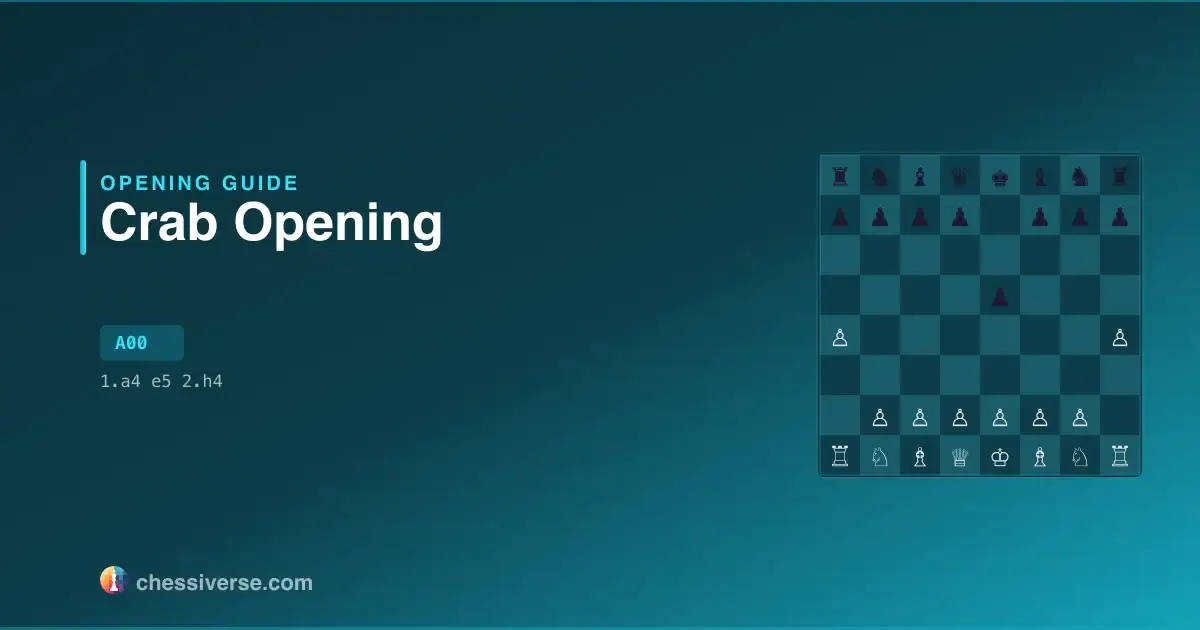


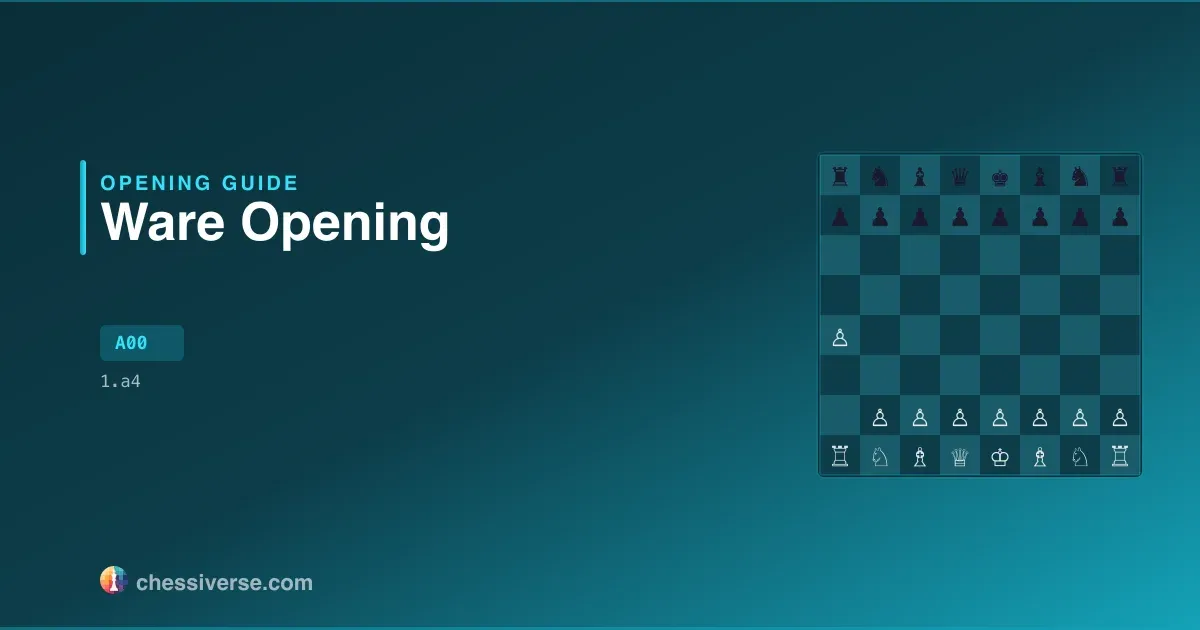
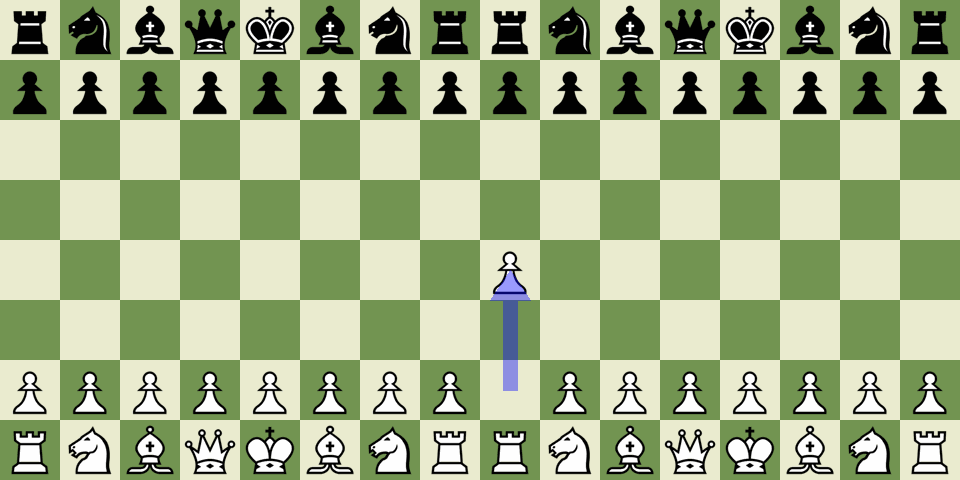
The Ware Opening begins with 1.a4 (ECO A00). Pushing the a-pawn on move one is, in chess terms, a polite way of skipping your turn. White doesn't develop a piece and doesn't touch the center.
Strategic Overview
1.a4 is an irregular sideline that essentially gifts Black a tempo. It does nothing for development, ignores the center, and the rook it allegedly activates won't reach a useful square for many moves. Beginners reach for it because they think rooks belong in the game early, then discover that 2.Ra3 invites the meadow hay trap, 2...Bxa3, losing a rook on move two if Black plays an e-pawn move first. Black's strongest reply is 1...e5, claiming the center and opening the f8-bishop's diagonal. After something normal like 2.e4, the position is roughly equal and White is just down on time, not material. The symmetrical 1...a5 wastes the structural concession Black was handed. Treat 1.a4 as a curiosity, not a system: it can lure unprepared opponents but offers nothing against accurate play.
Key Ideas
The recurring motifs below distinguish a confident handler of this opening from a beginner:
- Avoid the meadow hay trap on move two — After 1.a4 e5, the tempting rook lift 2.Ra3?? walks straight into 2...Bxa3, losing the rook. The dark-squared bishop covers a3 the moment the e-pawn moves, and the trap has caught countless beginners.
- Black should occupy the center immediately — 1...e5 is the natural reply, grabbing space and freeing the bishop and queen. Any standard center setup leaves Black with a comfortable game while White is functionally a tempo down.
- Rooks don't belong in the opening — The fantasy behind 1.a4 is an early rook lift via Ra3 and Rd3. In practice, rooks come alive once files open in the middlegame. Pushing wing pawns to free them just gives the opponent free development.
Performance Across Rating Levels
Popularity and results vary sharply by rating level. At 1200 Elo, the opening shows up in 0.10% of games (696,693 samples). White scores 41.1%, Black 52.6%, draws 6.3%. By 1800, popularity is 0.03% and White's score is 47.1% to Black's 48.6%. Among 2500-rated players the line appears in 0.05% of games and draws spike to 7.9%, indicating tight preparation. White's score improves by 7.1pp from the 1200 bracket to the 2500 bracket — the line rewards preparation.
Time Control Patterns
Time control matters here: bullet players reach for this opening more than others. In bullet, it appears in 0.10% of games (2,708,245); White wins 47.6%. Blitz shows 0.07% adoption across 2,435,917 games, White scoring 42.7%. In rapid, the share rises to 0.09% — 972,743 games, White 38.7%. White's score swings 8.9pp across formats, so time control isn't just a stylistic choice here — it shifts the actual results.
Move Diversity and Theory Depth
Looking at move selection shows how forcing — or not — the position really is. At 1200 Elo (696,693 games), the top reply is e5, played 46.9% of the time. Two other moves each take at least 5% of games, and the top three moves account for 74.6% of games. Entropy: 2.52. By 2500 (6,603 games), e5 is still the top reply, at 33.9%; four other moves reach 5% and the top three moves account for 70.5% of games. Entropy rises to 2.78. Even elite players don't fully agree on the best continuation here, which keeps the position dynamic.
Historical Trends
Tracking the Ware Opening year over year shows a clear story. Adoption peaked in 2013 at 0.10% (2,929 games). By 2025 it sits at 0.07%, down 31% from that high, leaving the line in decline.
The move 1.a4 carries the name of Preston Ware, a US player fond of offbeat openings. Magnus Carlsen played it as a little joke at the 2012 World Blitz Championship against Teimour Radjabov and won; he tried it again in the blitz at Norway Chess 2022 but lost to Wesley So.
Named after: Preston Ware, a US chess player with a taste for unusual opening moves.
Notable players: Preston Ware, Magnus Carlsen
Radjabov once told Carlsen he could open 1.a4 and still beat everyone; at the 2012 World Blitz Championship Carlsen played it against Radjabov himself as a little joke and won. The opening is also nicknamed the Meadow Hay Opening.
Main Lines and Variations
After 1.a4, the established follow-ups are:
Each branch leads to a different middlegame character — the resulting pawn structure decides what kind of game you get.
Common Mistakes
- Neglecting development — Extra pawn moves in the opening are tempting, especially when you "know the moves". Developing a piece each turn is the simple correction.
- Playing without a plan — Each Ware Opening middlegame demands a specific approach. Decide whether the position calls for attack, manoeuvre, or simplification before reaching for a move.
Practice on Chessiverse
Ready to try the Ware Opening against a bot? Pick an opponent at your level and play a game.