Dutch Defence: 1.d4 f5 2.c4...... c6

+115%
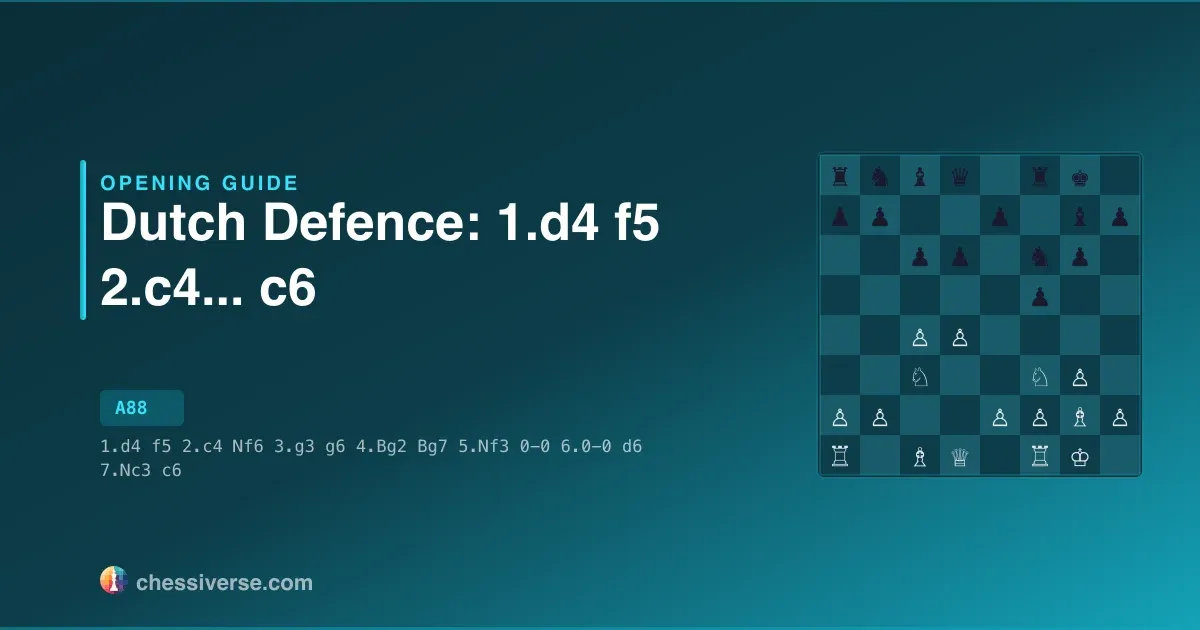
A881.d4 f5 2.c4 Nf6 3.g3 g6 4.Bg2 Bg7 5.Nf3 0-0 6.0-0 d6 7.Nc3 c6
Nov 10, 2027
TL;DR

The Leningrad Dutch mainline with the flexible 7...c6 — Black prepares either a ...d5 break or the strong ...Qa5 reroute, supporting a sharp middlegame from a structurally sound base. Patient strategic play rather than direct attack, and hard for White to crack open.

Reviewed by

IM John Bartholomew
IM John BartholomewCo-Founder & Chess Educator

International Master and chess educator. Co-founded Chessable and joined Chessiverse as co-founder. Best known for his "Climbing the Rating Ladder" YouTube series and structured opening courses.

Dutch Defence: 1.d4 f5 2.c4...... c6: A Complete Guide
Dutch Defence: 1.d4 f5 2.c4...... c6 - Opening Moves
Summary

Starting from 1.d4 f5 2.c4 Nf6 3.g3 g6 4.Bg2 Bg7 5.Nf3 0-0 6.0-0 d6 7.Nc3 c6, players enter the Dutch Defence: 1.d4 f5 2.c4... c6 — ECO A88. Across rating levels it shows up in 198,734 recorded games — enough data to map exactly where it succeeds and where it stalls.

History and Notable Players

It arises from the Dutch Defence: 1.d4 f5 2.c4... 5.Nf3. On the White side, Ivan Farago (12 games), Boris Gelfand (9 games), Wolfgang Uhlmann (8 games) top the database. Notable Black exponents: Pavel Potapov (28 games), Mihai-Lucian Grunberg (25 games), Evgenij Agrest (21 games).

Performance Across Rating Levels

How well the Dutch Defence: 1.d4 f5 2.c4... c6 works depends on what level you're playing at. The 1200 bracket has 634 games (0.00% of all games at that level); White wins 56.2%, Black 40.1%, 3.8% are drawn. At 1800 the opening surfaces in 0.01% of games; White wins 50.1%, Black 44.5%, draws 5.4%. At the top end (2500+ Elo), popularity is 0.05% with 9.7% draws — a clear sign of how much theory rules the line at master level. White's edge erodes by 9.5pp from 1200 to 2500 Elo, suggesting Black's counterplay is easier to find with experience.

Move Diversity and Theory Depth

What players actually play after the opening moves depends heavily on rating. At 1200 Elo, the top reply is Bg5, played 24.3% of the time. There are 7 other moves seeing meaningful share, and 58.6% of games stick to established theory. Entropy: 3.15. By 2500, d5 dominates at 38.7% of replies; only 6 viable alternatives remain and 69.9% of moves are theory. Entropy drops to 2.64. The narrowing is significant — strong players consolidate around a small set of best moves, while amateurs scatter across many plausible-looking options.

Common Mistakes

  • Neglecting development — Extra pawn moves in the opening are tempting, especially when you "know the moves". Developing a piece each turn is the simple correction.
  • Playing without a plan — Each Dutch Defence: 1.d4 f5 2.c4... c6 middlegame demands a specific approach. Decide whether the position calls for attack, manoeuvre, or simplification before reaching for a move.

Practice on Chessiverse

Ready to try the Dutch Defence: 1.d4 f5 2.c4... c6 against a bot? Pick an opponent at your level and play a game.

Quick Facts

Main Line1.d4 f5 2.c4 Nf6 3.g3 g6 4.Bg2 Bg7 5.Nf3 0-0 6.0-0 d6 7.Nc3 c6
DifficultyAdvanced
Style

Aggressor openings create immediate tension and look for direct attacks. These lines are designed to put pressure on the opponent from the very first moves, often leading to unbalanced positions.

198,734games on Lichess
49.1%
6.7%
44.2%
White wins Draws Black wins

Top Players

As White
As Black

Data from Lichess opening explorer (blitz & rapid)

Most Popular At2500
SharpnessCalm

Popularity by Rating

Percentage of all games at each rating bracket that feature this opening.

Data from Lichess opening explorer (blitz & rapid games)

Theory Adherence by Rating

How often players choose the single most popular move at this position. Higher = more predictable play.

White to move after the opening line

Popularity Over Time

Share of all Lichess blitz + rapid games featuring this opening, by year.

Top Moves by Rating

White to move after the opening line

RatingMost Popular2nd3rd
400Bg522.2%d518.5%b311.1%
1000Bg523.6%Re115.9%d510.8%
1200Bg524.3%Re119.8%d514.5%
1400Re126.7%Bg522%b38.6%
1600Re129.9%Bg520.5%Qc211.6%
1800Re128.1%Bg516.7%Qc213.8%
2000Re122.9%d519.6%Qc213.8%
2200d532.1%Re116.9%b316.5%
2500d538.7%b319.1%Re112%

Popularity by Time Control

Bullet
<0.01%107K
Blitz
<0.01%181K
Rapid
<0.01%17K
4% more decisive in bullet
Raw data tables (Lichess blitz + rapid)
Dutch Defence: 1.d4 f5 2.c4...... c6: popularity and win rates by player rating
Rating (Elo)Share %GamesWhite win %Black win %Draw %Sharpness
4000.002860.739.30.01.000
10000.0017252.343.64.10.959
12000.0063456.240.13.80.962
14000.002,71150.545.44.10.959
16000.0012,38250.644.74.60.954
18000.0141,71150.144.55.40.946
20000.0268,97649.144.36.70.933
22000.0465,68048.343.87.90.921
25000.056,44046.743.69.70.903
Dutch Defence: 1.d4 f5 2.c4...... c6: move-choice theory adherence by rating
Rating (Elo)Top moveTop move %Viable movesTheory %Entropy
400Bg522.2751.93.278
1000Bg523.6650.33.273
1200Bg524.3758.63.148
1400Re126.7757.33.093
1600Re129.9661.93.001
1800Re128.1558.63.018
2000Re122.9556.33.031
2200d532.1565.62.868
2500d538.7669.92.644
Dutch Defence: 1.d4 f5 2.c4...... c6: popularity over time
YearShare %GamesWhite win %Black win %Draw %
20130.005738.654.47.0
20140.0036049.745.64.7
20150.011,22450.743.46.0
20160.013,08248.144.97.0
20170.005,07349.744.55.8
20180.008,06849.744.85.5
20190.0012,36448.944.86.3
20200.0129,86048.644.37.1
20210.0030,50249.044.07.0
20220.0029,47449.244.26.6
20230.0029,50349.544.06.5
20240.0030,75149.443.76.9
20250.0032,24348.644.56.9
Dutch Defence: 1.d4 f5 2.c4...... c6: popularity by time control
FormatShare %GamesWhite win %Black win %Draw %Sharpness
bullet0.00106,57149.146.14.70.953
blitz0.01181,41149.144.36.60.934
rapid0.0017,32349.242.58.30.917
Dutch Defence: 1.d4 f5 2.c4...... c6: top candidate moves by rating bracket
Rating (Elo)1st move1st %2nd move2nd %3rd move3rd %
400Bg522.2d518.5b311.1
1000Bg523.6Re115.9d510.8
1200Bg524.3Re119.8d514.5
1400Re126.7Bg522.0b38.6
1600Re129.9Bg520.5Qc211.6
1800Re128.1Bg516.7Qc213.8
2000Re122.9d519.6Qc213.8
2200d532.1Re116.9b316.5
2500d538.7b319.1Re112.0
Dutch Defence: 1.d4 f5 2.c4...... c6: top practitioners by side
SidePlayerGames
WhiteIvan Farago12
WhiteBoris Gelfand9
WhiteWolfgang Uhlmann8
BlackPavel Potapov28
BlackMihai-Lucian Grunberg25
BlackEvgenij Agrest21

Frequently Asked Questions

What is the Dutch Defence: 1.d4 f5 2.c4... c6?

The Dutch Defence: 1.d4 f5 2.c4... c6 begins with 1.d4 f5 2.c4 Nf6 3.g3 g6 4.Bg2 Bg7 5.Nf3 0-0 6.0-0 d6 7.Nc3 c6 and is classified under ECO code A88.

Is the Dutch Defence: 1.d4 f5 2.c4... c6 good for beginners?

The Dutch Defence: 1.d4 f5 2.c4... c6 can be played at any level. Beginners should focus on understanding the key strategic ideas rather than memorizing long theoretical lines. Our AI bots at various rating levels provide a great way to practice the opening concepts.

What are the win rates for the Dutch Defence: 1.d4 f5 2.c4... c6?

In a database of 198,734 master games, White wins 49.1% of the time, Black wins 44.2%, and 6.7% are drawn. Notable players on the White side include Ivan Farago and Boris Gelfand. On the Black side, Pavel Potapov and Mihai-Lucian Grunberg are among the most frequent practitioners.

How can I practice the Dutch Defence: 1.d4 f5 2.c4... c6?

On Chessiverse, you can practice the Dutch Defence: 1.d4 f5 2.c4... c6 by playing against our 600+ AI bots. Each bot has a unique playing style and opening repertoire, so you can find the perfect sparring partner for any level.

Reviewed by

IM John Bartholomew
IM John BartholomewCo-Founder & Chess Educator

International Master and chess educator. Co-founded Chessable and joined Chessiverse as co-founder. Best known for his "Climbing the Rating Ladder" YouTube series and structured opening courses.

Practice This Opening on Chessiverse

Play against 1000+ AI bots with unique personalities and opening repertoires. From beginner-friendly to grandmaster-level opponents, find the perfect sparring partner for any opening.

Play Now

Not sure which opening fits you? Take the free chess personality test — your style determines which openings will work with you.

Back to Articles