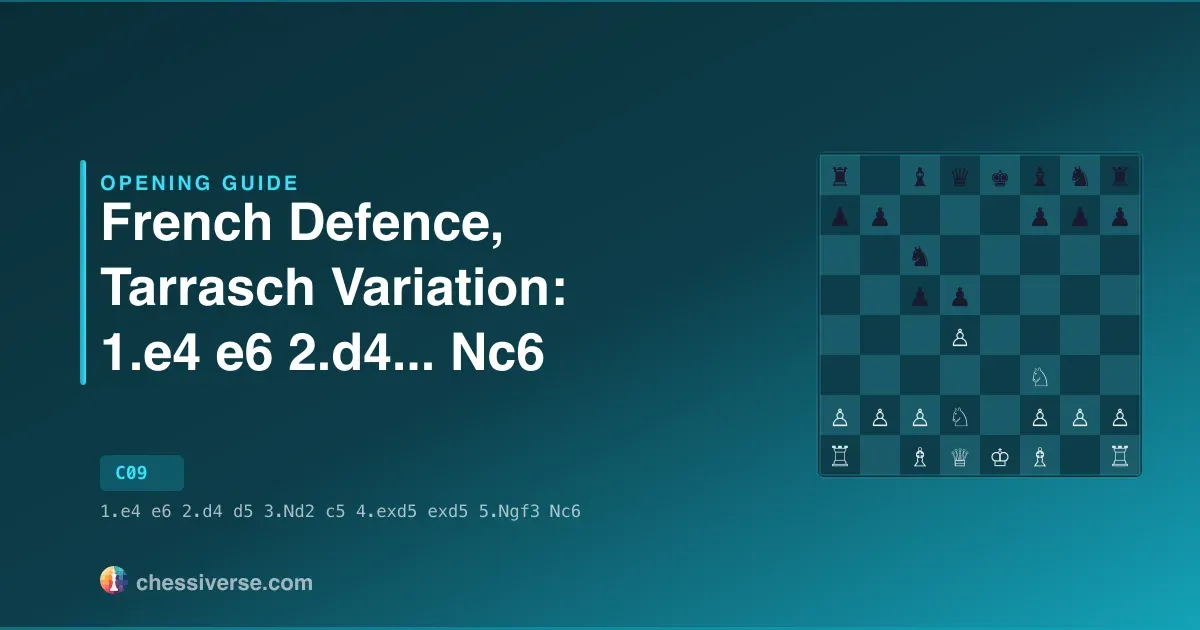
Starting from 1.e4 e6 2.d4 d5 3.Nd2 c5 4.exd5 exd5 5.Ngf3 Nc6, players enter the French Defense: Tarrasch Variation, Open System, Main Line — ECO C09. Lichess records 212,812 games in this line, which gives us a reliable view of how it actually performs in practice.
History and Notable Players
It arises from the French Defense: Tarrasch Variation, Open System. On the White side, Vlastimil Jansa (23 games), Efim Geller (15 games), Milan Matulovic (14 games) top the database. Notable Black exponents: Wolfgang Uhlmann (85 games), Rafael A Vaganian (64 games), Wlodzimierz Schmidt (34 games).
Performance Across Rating Levels
The picture changes a lot as you climb the rating ladder. At 1200 Elo, the opening shows up in 0.00% of games (2,638 samples). White scores 56%, Black 40.8%, draws 3.3%. At 1800 the opening surfaces in 0.01% of games; White wins 54%, Black 40.6%, draws 5.4%. At 2500, 0.05% of games go into this opening; draws sit at 12.7% — the line is well-mapped at this level. White's edge erodes by 9.9pp from 1200 to 2500 Elo, suggesting Black's counterplay is easier to find with experience.
Move Diversity and Theory Depth
What players actually play after the opening moves depends heavily on rating. At 1200 Elo (2,638 games), the top reply is Bb5, played 54.9% of the time. Three other moves each take at least 5% of games, and the top three moves account for 85.4% of games. Entropy: 2.08. By 2500 (6,936 games), Bb5 dominates at 87.4% of replies; only one other move still reaches 5% and the top three moves account for 98% of games. Entropy drops to 0.76. The narrowing is significant — strong players consolidate around a small set of best moves, while amateurs scatter across many plausible-looking options.
Common Mistakes
- Drifting away from main theory — At 1000 Elo, the three most-played moves cover 80.7% of games, against 92.4% at 2000. The most popular deviation is c3 (played 9.9% of the time at 1000, less so up top). It looks fine but quietly hands the better-prepared side an edge.
- Neglecting development — Extra pawn moves in the opening are tempting, especially when you "know the moves". Developing a piece each turn is the simple correction.
- Drifting into passivity — These openings are solid, but solid is not synonymous with passive. Look for the right moment to break with a central pawn advance — without it, your pieces stay cramped.
Practice on Chessiverse
Ready to try the French Defense: Tarrasch Variation, Open System, Main Line against a bot? Pick an opponent at your level and play a game.