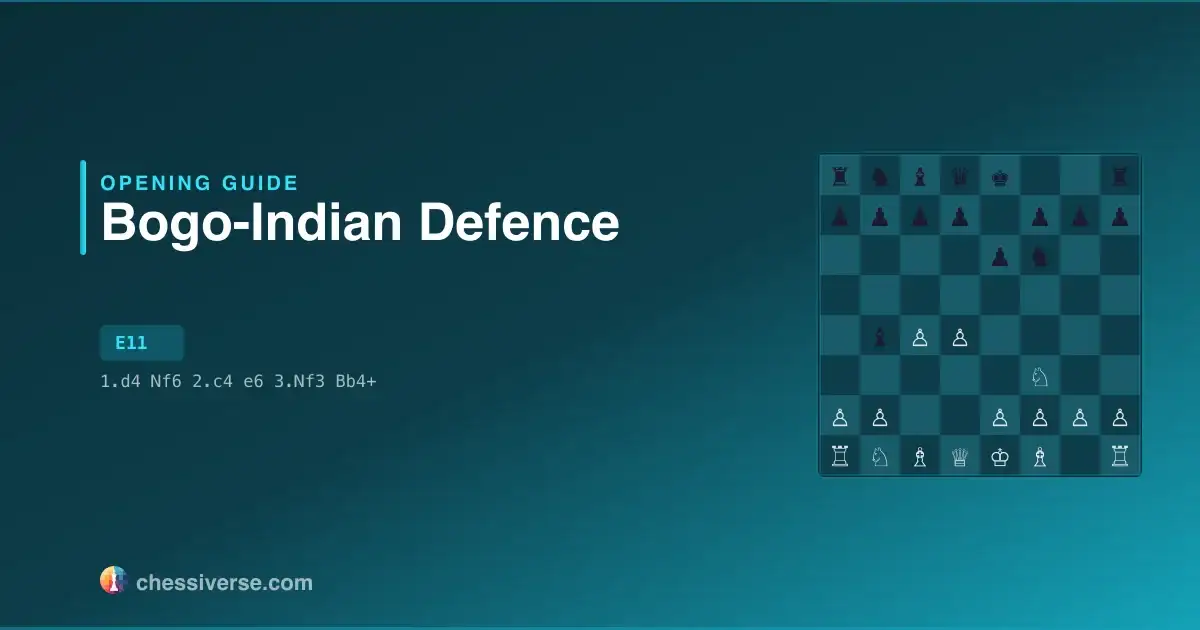




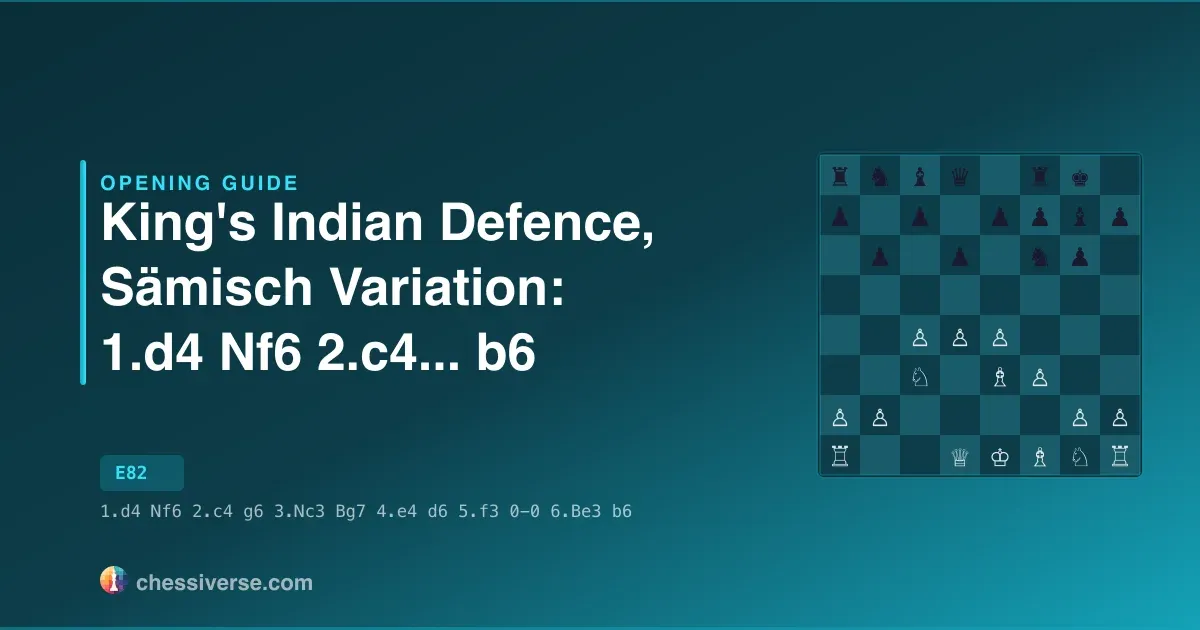
The King's Indian Defense: Sämisch Variation, Double Fianchetto begins with 1.d4 Nf6 2.c4 g6 3.Nc3 Bg7 4.e4 d6 5.f3 0-0 6.Be3 b6 (ECO E82). Across rating levels it shows up in 76,642 recorded games — enough data to map exactly where it succeeds and where it stalls.
History and Notable Players
It arises from the King's Indian Defense: Sämisch Variation, Normal Defense (5...0-0). On the White side, Florin Gheorghiu (14 games), Theodor Ghitescu (8 games), Rainer Knaak (7 games) top the database. Notable Black exponents: Milan Vukic (14 games), Leonid Stein (12 games), Wlodzimierz Schmidt (8 games).
Move Diversity and Theory Depth
What players actually play after the opening moves depends heavily on rating. At 1200 Elo (1,328 games), the top reply is Qd2, played 52.8% of the time. Two other moves each take at least 5% of games, and the top three moves account for 89.5% of games. Entropy: 2.00. By 2500 (902 games), Qd2 is still the top reply, at 42.8%; two other moves reach 5% and the top three moves account for 95.1% of games. Entropy drops to 1.85.
Common Mistakes
- Playing outside main lines — At 1000 Elo, only 82.8% of games stay with the three most-played moves; at 2000 that climbs to 97.6%. Most of the gap is players who pick a reasonable-looking move over the best one, and the position quietly drifts.
- Neglecting development — Extra pawn moves in the opening are tempting, especially when you "know the moves". Developing a piece each turn is the simple correction.
- Letting White own the centre — Hypermodern openings concede central space on purpose, but only if you strike back in time. Delay the counter-blow and you end up squeezed.
Practice on Chessiverse
Ready to try the King's Indian Defense: Sämisch Variation, Double Fianchetto against a bot? Pick an opponent at your level and play a game.