



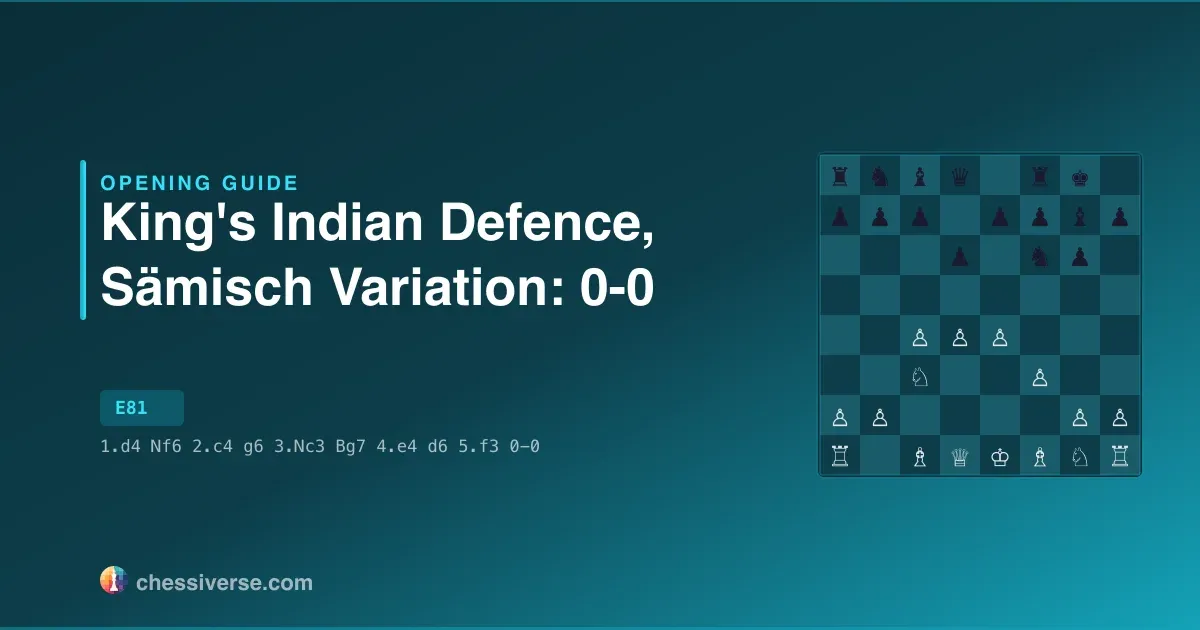
The King's Indian Defense: Sämisch Variation, Normal Defense (5...0-0) begins with 1.d4 Nf6 2.c4 g6 3.Nc3 Bg7 4.e4 d6 5.f3 0-0 (ECO E81). With 2,470,313 games on record, the patterns below come from the largest practical sample available.
History and Notable Players
It arises from the King's Indian Defense, Sämisch Variation. On the White side, Aleksey Dreev (85 games), Florin Gheorghiu (71 games), Chris G Ward (69 games) top the database. Notable Black exponents: Wolfgang Uhlmann (66 games), Svetozar Gligoric (62 games), John D M Nunn (56 games).
Performance Across Rating Levels
How well the King's Indian Defense: Sämisch Variation, Normal Defense (5...0-0) works depends on what level you're playing at. At 1200 Elo, the opening shows up in 0.00% of games (26,583 samples). White scores 50.5%, Black 46.3%, draws 3.2%. Move up to 1800 Elo and the share shifts to 0.08%, with White winning 51.5% versus Black's 44.1%. Among 2500-rated players the line appears in 0.30% of games and draws spike to 8.5%, indicating tight preparation. Positions also become less sharp as level rises (sharpness 0.97 → 0.92).
Time Control Patterns
The King's Indian Defense: Sämisch Variation, Normal Defense (5...0-0) skews toward blitz chess. In bullet, it appears in 0.05% of games (1,439,878); White wins 51.3%. Blitz shows 0.06% adoption across 2,188,374 games, White scoring 50.7%. In rapid, the share rises to 0.03% — 277,198 games, White 51.1%.
Move Diversity and Theory Depth
What players actually play after the opening moves depends heavily on rating. At 1200 Elo (26,513 games), the top reply is Be3, played 46.4% of the time. Three other moves each take at least 5% of games, and the top three moves account for 77.6% of games. Entropy: 2.40. By 2500 (40,524 games), Be3 dominates at 65.7% of replies; only two other moves still reach 5% and the top three moves account for 99.6% of games. Entropy drops to 1.30. The narrowing is significant — strong players consolidate around a small set of best moves, while amateurs scatter across many plausible-looking options.
Historical Trends
Year-over-year data tells you whether this opening is a contemporary fixture or a fading one. Adoption peaked in 2015 at 0.08% (18,791 games). By 2025 it sits at 0.05%, 47% below the peak and roughly back to its 2013 level, leaving the line flat over the full period.
Main Lines and Variations
The main branches off 1.d4 Nf6 2.c4 g6 3.Nc3 Bg7 4.e4 d6 5.f3 0-0 include:
- King's Indian Defense: Sämisch Variation, Double Fianchetto
- King's Indian Defense: Sämisch Variation, Panno Formation
- King's Indian Defense: Sämisch Variation, Orthodox Variation
Each branch leads to a different middlegame character — the resulting pawn structure decides what kind of game you get.
Common Mistakes
- Drifting away from main theory — At 400 Elo, the three most-played moves cover 56.5% of games, against 93.9% at 2000. The most popular deviation is Bd3 (played 19.5% of the time at 400, much less so up top). It looks fine but quietly hands the better-prepared side an edge.
- Neglecting development — Extra pawn moves in the opening are tempting, especially when you "know the moves". Developing a piece each turn is the simple correction.
- Letting White own the centre — Hypermodern openings concede central space on purpose, but only if you strike back in time. Delay the counter-blow and you end up squeezed.
Practice on Chessiverse
Ready to try the King's Indian Defense: Sämisch Variation, Normal Defense (5...0-0) against a bot? Pick an opponent at your level and play a game.