

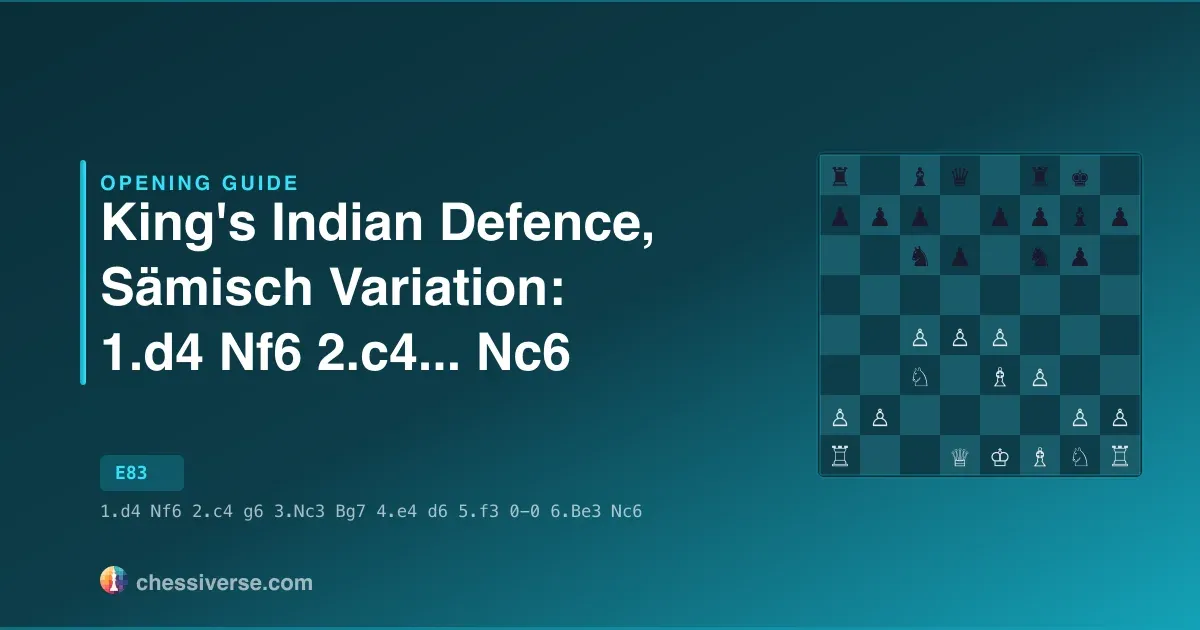
Starting from 1.d4 Nf6 2.c4 g6 3.Nc3 Bg7 4.e4 d6 5.f3 0-0 6.Be3 Nc6, players enter the King's Indian Defense: Sämisch Variation, Panno Formation — ECO E83. Across rating levels it shows up in 426,587 recorded games — enough data to map exactly where it succeeds and where it stalls.
History and Notable Players
It arises from the King's Indian Defense: Sämisch Variation, Normal Defense (5...0-0). Among the most prolific White practitioners are Florin Gheorghiu (19 games), Rainer Knaak (18 games), Jacob Murey (14 games). Black-side regulars include Heikki MJ Westerinen (42 games), Igor A Zaitsev (21 games), John D M Nunn (21 games).
Performance Across Rating Levels
How well the King's Indian Defense: Sämisch Variation, Panno Formation works depends on what level you're playing at. Among 1200-rated players, it appears in 0.00% of games — 2,242 of them on record — with White winning 53.3% and Black 44.1%. By 1800, popularity is 0.01% and White's score is 50.9% to Black's 44.9%. Among 2500-rated players the line appears in 0.04% of games and draws spike to 8.1%, indicating tight preparation. White's edge erodes by 6.1pp from 1200 to 2500 Elo, suggesting Black's counterplay is easier to find with experience.
Time Control Patterns
The King's Indian Defense: Sämisch Variation, Panno Formation skews toward blitz chess. In bullet, it appears in 0.01% of games (238,789); White wins 50.8%. Blitz shows 0.01% adoption across 386,809 games, White scoring 50.2%. In rapid, the share rises to 0.00% — 38,905 games, White 50.5%.
Move Diversity and Theory Depth
Looking at move selection shows how forcing — or not — the position really is. At 1200 Elo (2,237 games), the top reply is Qd2, played 44.6% of the time. Four other moves each take at least 5% of games, and the top three moves account for 78% of games. Entropy: 2.34. By 2500 (5,726 games), Nge2 takes over as the top reply at 67.2%; only one other move still reaches 5% and the top three moves account for 97.7% of games. Entropy drops to 1.20. The narrowing is significant — strong players consolidate around a small set of best moves, while amateurs scatter across many plausible-looking options.
Historical Trends
Long-term, the trajectory of this opening is informative. Adoption peaked in 2017 at 0.012% (13,275 games). By 2025 it sits at 0.008%, 30% below the peak and 16% under its 2013 level, leaving the line in decline.
Main Lines and Variations
From the position after 1.d4 Nf6 2.c4 g6 3.Nc3 Bg7 4.e4 d6 5.f3 0-0 6.Be3 Nc6, the recognised continuations are:
Each branch leads to a different middlegame character — the resulting pawn structure decides what kind of game you get.
Common Mistakes
- Drifting away from main theory — At 400 Elo, the three most-played moves cover 68.6% of games, against 93.7% at 2000. The most popular deviation is d5 (played 20% of the time at 400, much less so up top). It looks fine but quietly hands the better-prepared side an edge.
- Neglecting development — It can feel productive to make extra pawn moves early, but falling behind in piece development is what loses most amateur games — especially in open positions where active pieces find squares fast.
- Letting White own the centre — Hypermodern openings concede central space on purpose, but only if you strike back in time. Delay the counter-blow and you end up squeezed.
Practice on Chessiverse
Ready to try the King's Indian Defense: Sämisch Variation, Panno Formation against a bot? Pick an opponent at your level and play a game.