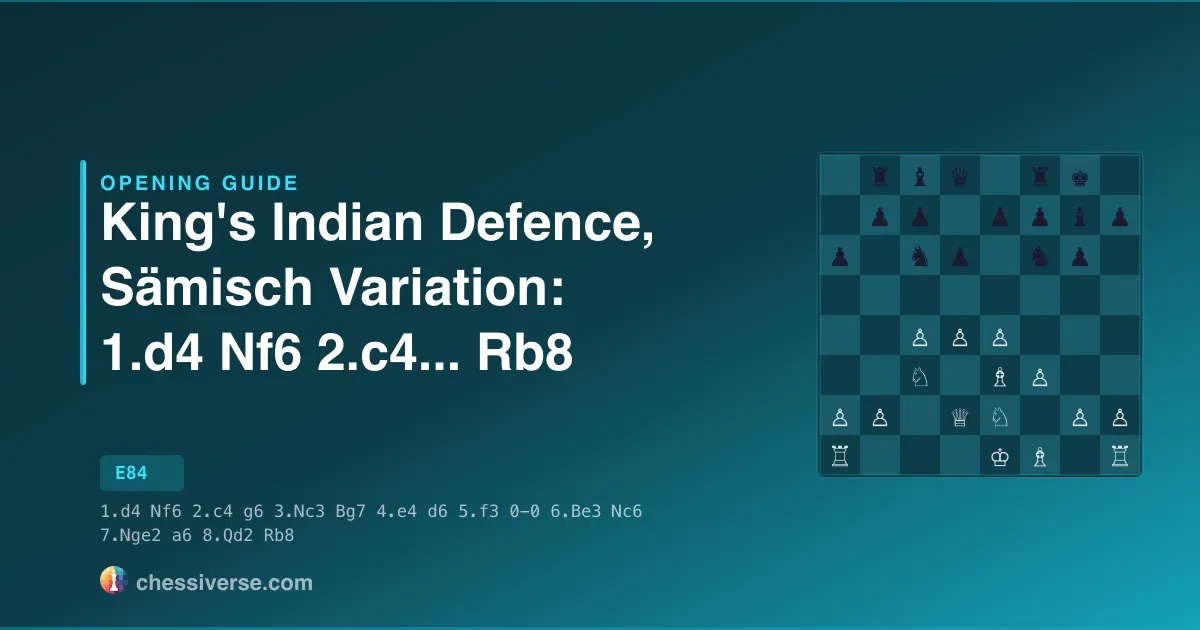
The King's Indian Defense: Sämisch Variation, Panno Main Line begins with 1.d4 Nf6 2.c4 g6 3.Nc3 Bg7 4.e4 d6 5.f3 0-0 6.Be3 Nc6 7.Nge2 a6 8.Qd2 Rb8 (ECO E84). Across rating levels it shows up in 41,668 recorded games — enough data to map exactly where it succeeds and where it stalls.
History and Notable Players
It arises from the King's Indian Defense: Sämisch Variation, Panno Formation. On the White side, Jacob Murey (14 games), Margeir Petursson (12 games), Yuri S Razuvaev (12 games) top the database. Notable Black exponents: John D M Nunn (22 games), Heikki MJ Westerinen (18 games), Alexei Fedorov (16 games).
Performance Across Rating Levels
How well the King's Indian Defense: Sämisch Variation, Panno Main Line works depends on what level you're playing at. The 1200 bracket has 3 games (0.00% of all games at that level); White wins 66.7%, Black 33.3%, 0% are drawn. By 1800, popularity is 0.00% and White's score is 45.8% to Black's 49.3%. Among 2500-rated players the line appears in 0.02% of games and draws spike to 9%, indicating tight preparation. White's edge erodes by 17.4pp from 1200 to 2500 Elo, suggesting Black's counterplay is easier to find with experience.
Move Diversity and Theory Depth
Move choice is far from uniform in the King's Indian Defense: Sämisch Variation, Panno Main Line. Below 1600 the samples are small (3 games at 1200, 51 at 1400), so the comparison starts at 1600, with 353 games. There, the top reply is g4, played 23.6% of the time. Seven other moves each take at least 5% of games, and the top three moves account for 52.7% of games. Entropy: 3.15. By 2500 (2,519 games), Rc1 takes over as the top reply at 32.9%; only five other moves still reach 5% and the top three moves account for 67.8% of games. Entropy drops to 2.79.
Common Mistakes
- Neglecting development — Extra pawn moves in the opening are tempting, especially when you "know the moves". Developing a piece each turn is the simple correction.
- Letting White own the centre — Hypermodern openings concede central space on purpose, but only if you strike back in time. Delay the counter-blow and you end up squeezed.
Practice on Chessiverse
Ready to try the King's Indian Defense: Sämisch Variation, Panno Main Line against a bot? Pick an opponent at your level and play a game.