



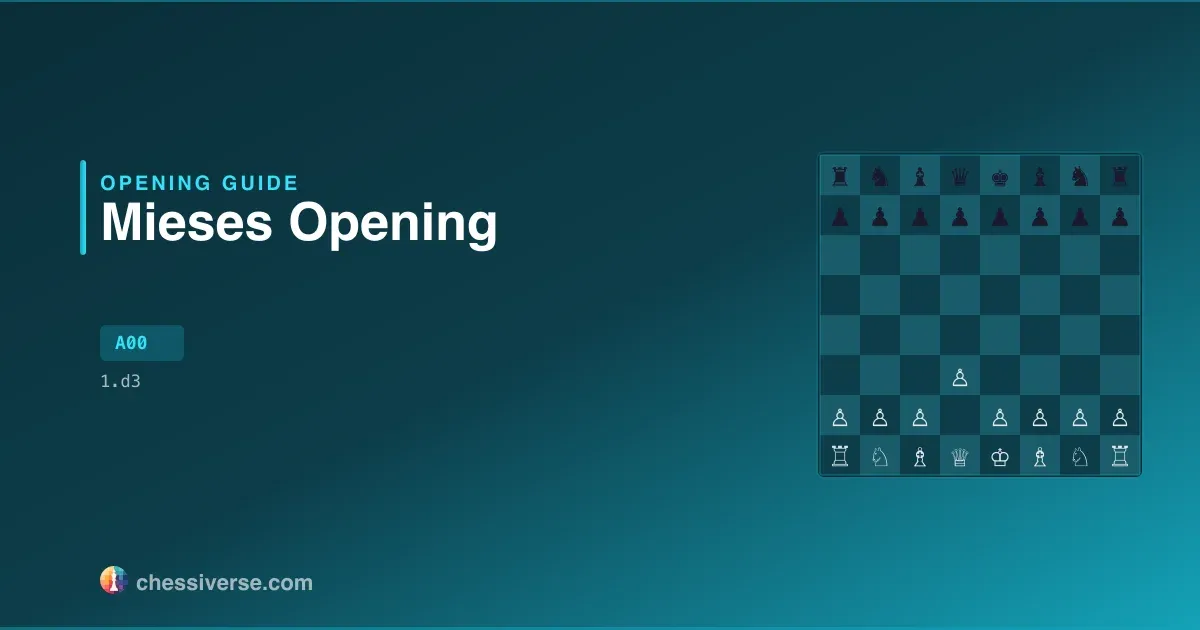
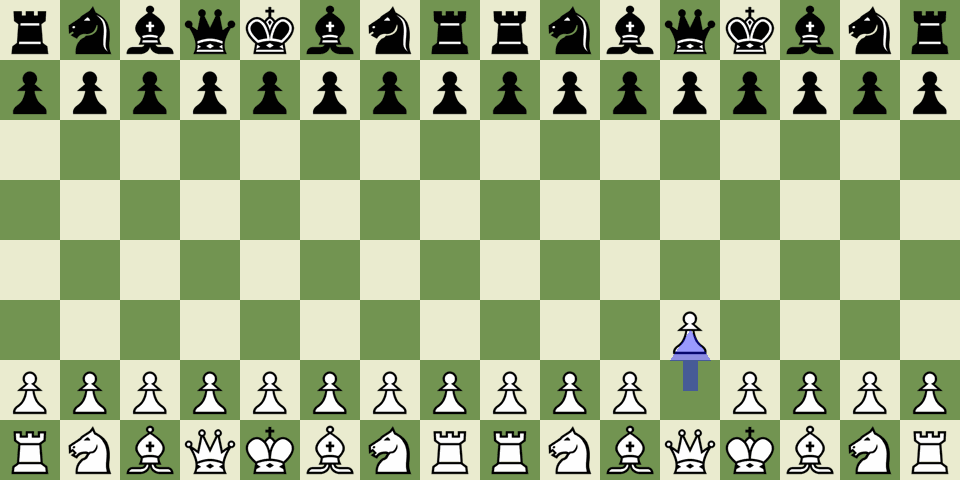
1.d3 opens the Mieses Opening, ECO A00. A modest first move that nudges the d-pawn one square rather than two. Playable, but it concedes the center for no clear gain.
Strategic Overview
1.d3 is a quiet, sub-optimal first move that almost always becomes something else. The pawn doesn't claim central squares, and worse, it locks in the light-squared bishop on c1. In practice, the position transposes into a King's Indian Attack if White follows up with g3 and Nf3, or into a reversed Modern, Pirc, or King's Indian if White plays it like a fianchetto system from the white side. The main complaint is opportunity cost: 1.d4 or 1.e4 gives the same long-term setups while staking real ground in the center. 1.d3 lets Black choose any structure freely, which usually means Black equalizes on move one. Use it only if you specifically want the KIA structure and prefer this move order to avoid Black's early central reactions. Otherwise, it's a step backward from the more direct first moves.
Key Ideas
The recurring motifs below distinguish a confident handler of this opening from a beginner:
- Treat it as a King's Indian Attack move order — The honest plan after 1.d3 is g3, Bg2, Nf3, Nbd2, e4, and so on, reaching a King's Indian Attack. The only reason to start with d3 is to keep that flexibility while seeing Black's reply first.
- Accept that the light-squared bishop is stuck for now — 1.d3 blocks the c1-bishop's natural diagonal and slows its development. Plan for a fianchetto with b3 and Bb2, or be patient: this bishop is going to take a while to get into the game.
Performance Across Rating Levels
The picture changes a lot as you climb the rating ladder. The 1200 bracket has 3,878,618 games (0.57% of all games at that level); White wins 45%, Black 50.3%, 4.7% are drawn. Move up to 1800 Elo and the share shifts to 0.45%, with White winning 47% versus Black's 48.4%. At 2500, 0.31% of games go into this opening; draws sit at 12.3% — the line is well-mapped at this level. Positions also become less sharp as level rises (sharpness 0.95 → 0.88).
Time Control Patterns
The Mieses Opening skews toward bullet chess. In bullet, it appears in 1.55% of games (41,142,621); White wins 49%. Blitz shows 0.56% adoption across 20,232,717 games, White scoring 46.3%. In rapid, the share rises to 0.40% — 4,390,230 games, White 43.1%. White's score swings 5.9pp across formats, so time control isn't just a stylistic choice here — it shifts the actual results.
Move Diversity and Theory Depth
What players actually play after the opening moves depends heavily on rating. At 1200 Elo (3,878,618 games), the top reply is e5, played 36.2% of the time. Two other moves each take at least 5% of games, and the top three moves account for 77.1% of games. Entropy: 2.48. By 2500 (41,932 games), d5 takes over as the top reply at 41.9%; four other moves reach 5% and the top three moves account for 70.8% of games. Entropy rises to 2.56. Move diversity stays high even at master level, suggesting the opening doesn't force one specific response.
Historical Trends
Tracking the Mieses Opening year over year shows a clear story. Adoption peaked in 2025 at 0.55% (4,071,740 games). 2025 marks the high — the opening is rising, currently at 0.55%.
The move was seen from Boden in the 1850s and became attached to Jacques Mieses after his 1910 match with Teichmann; in Spain it goes by the Valencia Opening. It resurfaced in man-versus-machine play: David Levy won with it against Cray Blitz in 1984, and Kasparov tried it against Deep Blue in 1997.
Named after: Named after German-British grandmaster Jacques Mieses, who used 1.d3 in his 1910 match against Teichmann.
Notable players: Jacques Mieses, Garry Kasparov, David Levy
Kasparov chose 1.d3 in game 3 of his 1997 rematch with Deep Blue, betting that an offbeat first move would pull the computer out of its prepared opening book - the game ended in a draw.
Main Lines and Variations
After 1.d3, the established follow-ups are:
Each branch leads to a different middlegame character — the resulting pawn structure decides what kind of game you get.
Common Mistakes
- Neglecting development — It can feel productive to make extra pawn moves early, but falling behind in piece development is what loses most amateur games — especially in open positions where active pieces find squares fast.
- Playing without a plan — Each Mieses Opening middlegame demands a specific approach. Decide whether the position calls for attack, manoeuvre, or simplification before reaching for a move.
Practice on Chessiverse
Ready to try the Mieses Opening against a bot? Pick an opponent at your level and play a game.