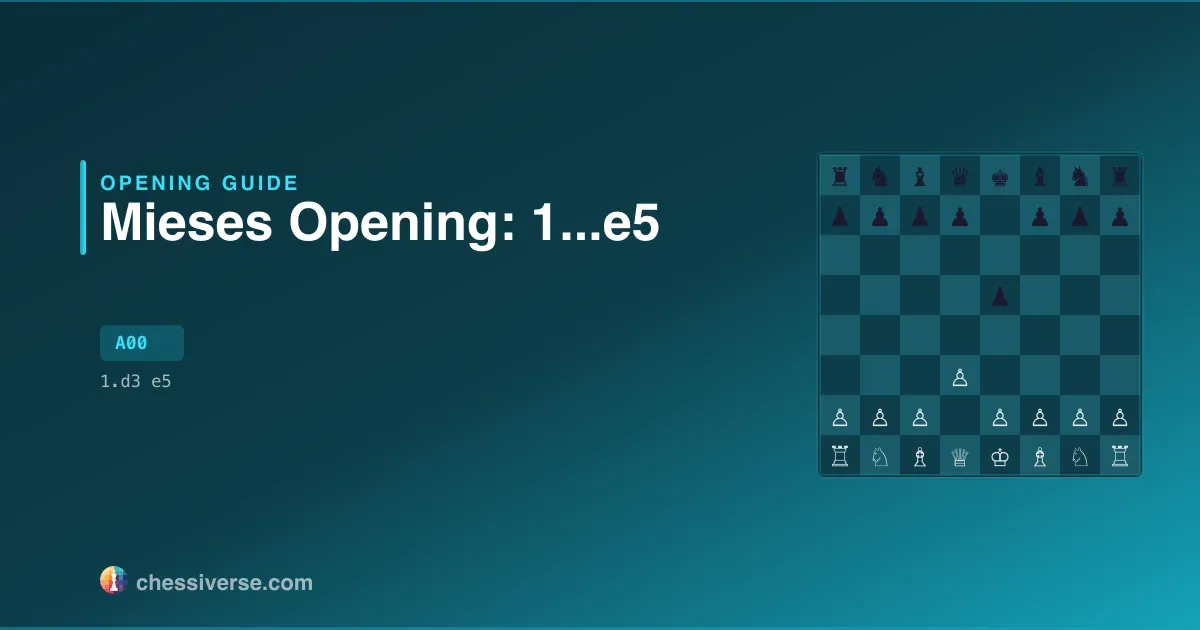
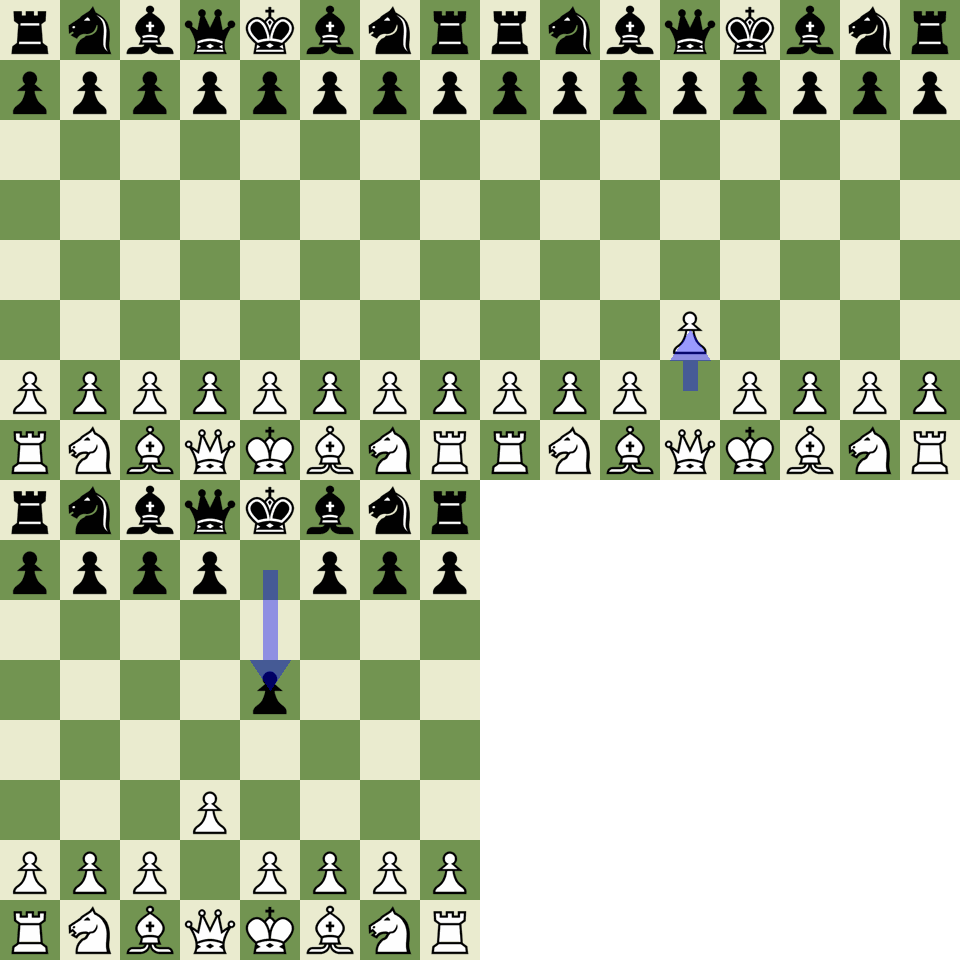
Starting from 1.d3 e5, players enter the Mieses Opening: Reversed Rat — ECO A00. Across rating levels it shows up in 6,998,654 recorded games — enough data to map exactly where it succeeds and where it stalls.
History and Notable Players
It arises from the Mieses Opening.
Performance Across Rating Levels
How well the Mieses Opening: Reversed Rat works depends on what level you're playing at. At 1200 Elo, the opening shows up in 0.20% of games (1,377,227 samples). White scores 44.8%, Black 50.8%, draws 4.4%. At 1800 the opening surfaces in 0.09% of games; White wins 47.4%, Black 48.3%, draws 4.3%. At 2500, 0.03% of games go into this opening; draws sit at 11.6% — the line is well-mapped at this level. White's edge erodes by 4.9pp from 1200 to 2500 Elo, suggesting Black's counterplay is easier to find with experience.
Time Control Patterns
Time control matters here: bullet players reach for this opening more than others. In bullet, it appears in 0.26% of games (6,847,263); White wins 49.4%. Blitz shows 0.15% adoption across 5,342,292 games, White scoring 46.1%. In rapid, the share rises to 0.15% — 1,656,362 games, White 42.9%. White's score swings 6.5pp across formats, so time control isn't just a stylistic choice here — it shifts the actual results.
Move Diversity and Theory Depth
Looking at move selection shows how forcing — or not — the position really is. At 1200 Elo (1,377,227 games), the top reply is e4, played 37.3% of the time. Three other moves each take at least 5% of games, and the top three moves account for 70.2% of games. Entropy: 2.82. By 2500 (4,526 games), e4 is still the top reply, at 32.7%; four other moves reach 5% and the top three moves account for 72.2% of games. Entropy drops to 2.66.
Historical Trends
Long-term, the trajectory of this opening is informative. Adoption peaked in 2013 at 0.16% (4,678 games). By 2025 it sits at 0.15%, down 9% from that high, leaving the line flat.
Main Lines and Variations
After 1.d3 e5, the established follow-ups are:
Each branch leads to a different middlegame character — the resulting pawn structure decides what kind of game you get.
Common Mistakes
- Neglecting development — Extra pawn moves in the opening are tempting, especially when you "know the moves". Developing a piece each turn is the simple correction.
- Playing without a plan — Each Mieses Opening: Reversed Rat middlegame demands a specific approach. Decide whether the position calls for attack, manoeuvre, or simplification before reaching for a move.
Practice on Chessiverse
Ready to try the Mieses Opening: Reversed Rat against a bot? Pick an opponent at your level and play a game.