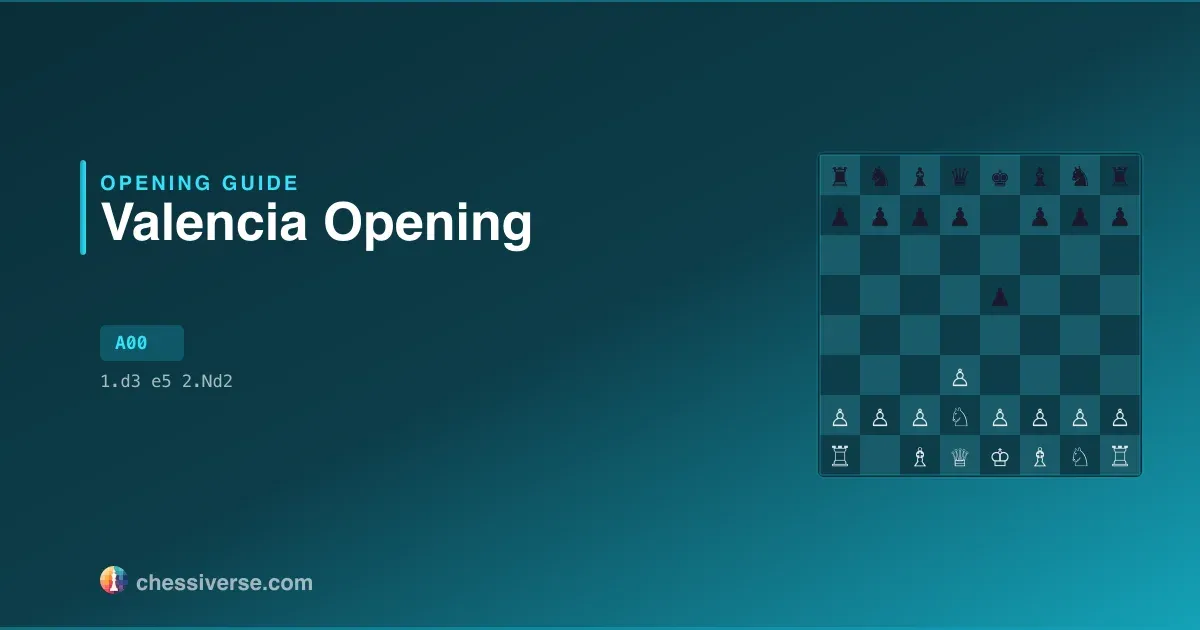
The Valencia Opening begins with 1.d3 e5 2.Nd2 (ECO A00). Across rating levels it shows up in 295,956 recorded games — enough data to map exactly where it succeeds and where it stalls.
- A modest central stake that immediately frees the c1-bishop while keeping every plan open
- White can steer play into a King's Indian Attack setup a move at a time
History and Notable Players
It arises from the Mieses Opening: Reversed Rat.
Boden used the quiet 1.d3 in the 1850s, and Mieses took it up for his 1910 match with Teichmann. It has stayed a sideline ever since - only about the tenth most popular of White's twenty first moves - but it resurfaced in man-versus-machine play, including David Levy's winning 1984 match against Cray Blitz.
Named after: The Spanish name for the Mieses Opening, 1.d3, which honours German-British grandmaster Jacques Mieses; the follow-up 2.Nd2 is known as the Valencia Variation.
Notable players: Jacques Mieses, Boden, Garry Kasparov
Garry Kasparov chose 1.d3 against Deep Blue in 1997, betting the computer would handle the opening poorly once forced off its opening book and onto its own judgement - the game was drawn.
Time Control Patterns
The Valencia Opening skews toward bullet chess. In bullet, it appears in 0.02% of games (526,593); White wins 51.8%. Blitz shows 0.01% adoption across 253,120 games, White scoring 50%. In rapid, the share rises to 0.00% — 42,836 games, White 47.8%. White's score swings 4.0pp across formats, so time control isn't just a stylistic choice here — it shifts the actual results.
Move Diversity and Theory Depth
What players actually play after the opening moves depends heavily on rating. At 1200 Elo (36,145 games), the top reply is d5, played 47.2% of the time. Four other moves each take at least 5% of games, and the top three moves account for 76.9% of games. Entropy: 2.38. By 2500 (400 games), d5 dominates at 50.5% of replies; only two other moves still reach 5% and the top three moves account for 90.5% of games. Entropy drops to 1.90.
Common Mistakes
- Drifting away from main theory — At 400 Elo, the three most-played moves cover 67.6% of games, against 80.1% at 2000. The most popular deviation is Nc6 (played 19.1% of the time at 400, less so up top). It looks fine but quietly hands the better-prepared side an edge.
- Neglecting development — Extra pawn moves in the opening are tempting, especially when you "know the moves". Developing a piece each turn is the simple correction.
- Playing without a plan — Each Valencia Opening middlegame demands a specific approach. Decide whether the position calls for attack, manoeuvre, or simplification before reaching for a move.
Practice on Chessiverse
Ready to try the Valencia Opening against a bot? Pick an opponent at your level and play a game.