

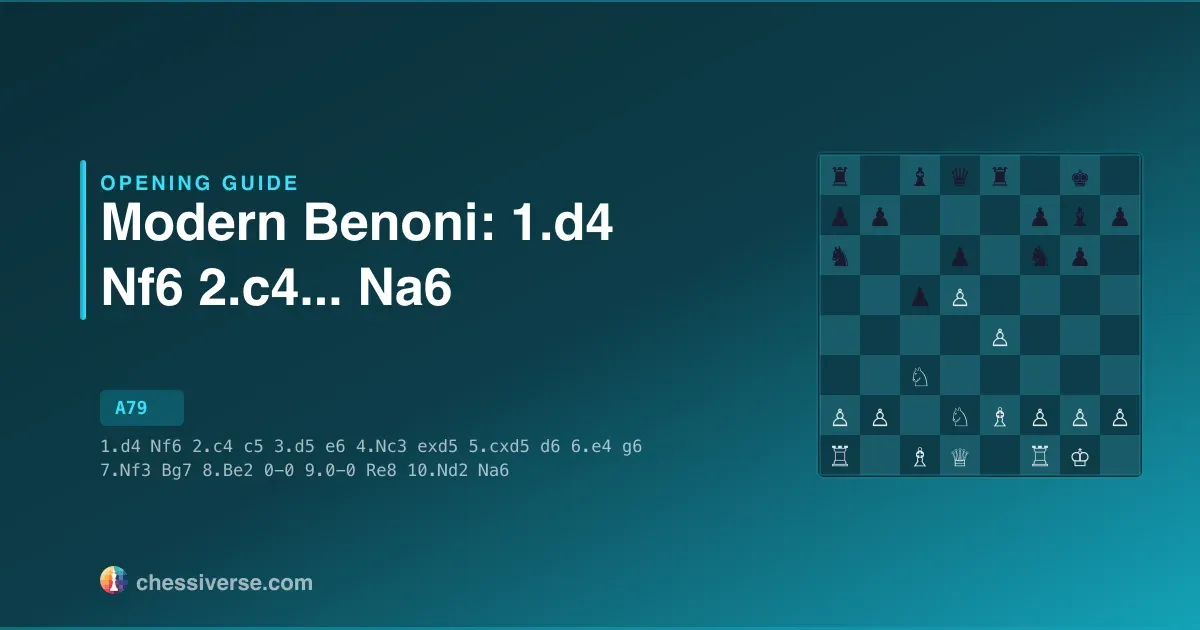
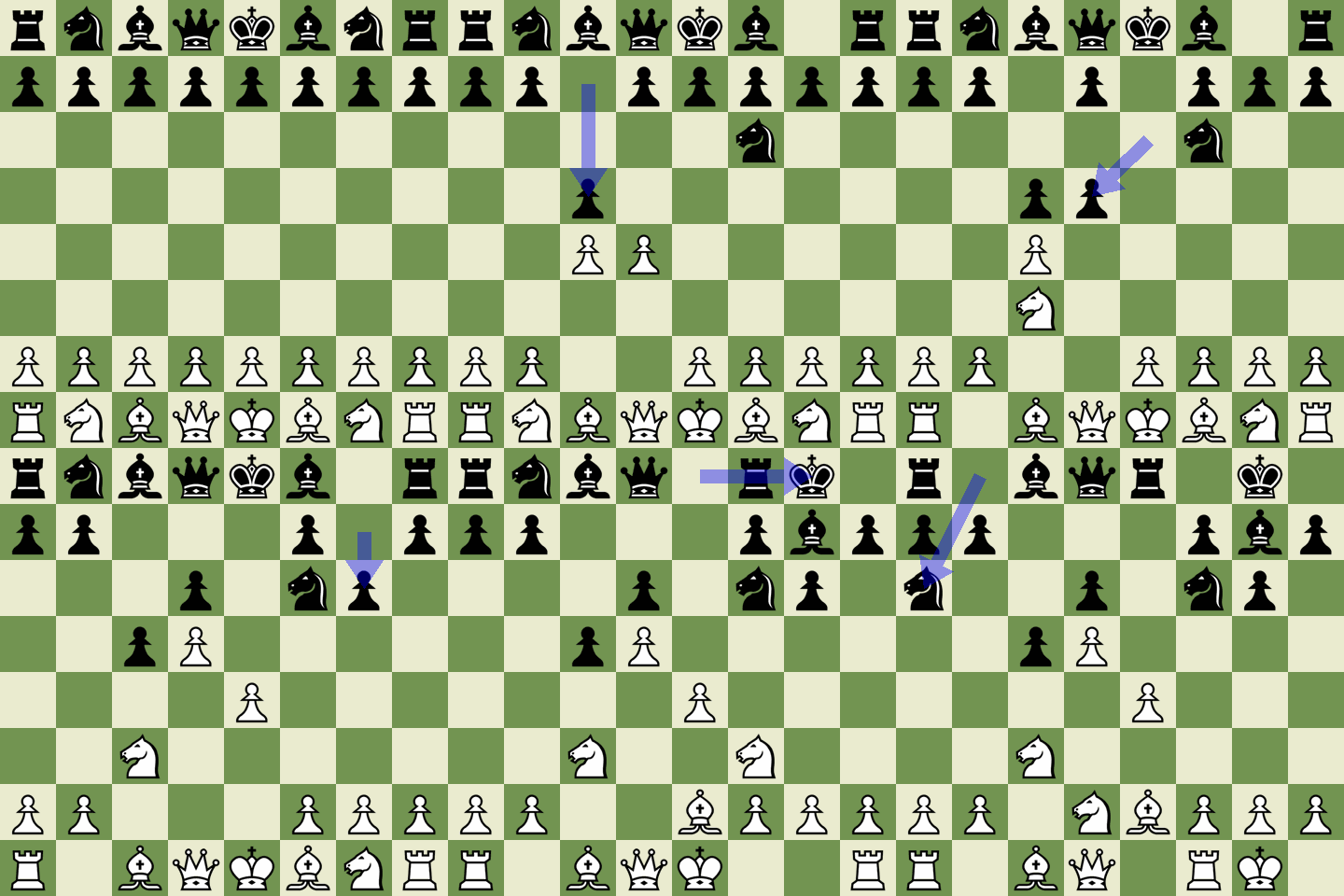
1.d4 Nf6 2.c4 c5 3.d5 e6 4.Nc3 exd5 5.cxd5 d6 6.e4 g6 7.Nf3 Bg7 8.Be2 0-0 9.0-0 Re8 10.Nd2 Na6 11.f3 opens the Benoni Defense: Classical Variation, Czerniak Defense (ECO A79). Lichess records 3,792 games in this line, which gives us a reliable view of how it actually performs in practice.
History and Notable Players
It arises from the Benoni Defense: Classical Variation, Czerniak Defense (ECO A78). On the White side, Jan Hein Donner (8 games), Svetozar Gligoric (8 games), Witold Balcerowski (6 games) top the database. Notable Black exponents: Milan Matulovic (9 games), Dragoljub Janosevic (9 games), Andrzej Filipowicz (8 games).
Move Diversity and Theory Depth
Black's reply to 11.f3 is close to settled. Below 1800 the samples are small (2 games at 1200, 10 at 1400, 48 at 1600), so the picture starts at 1800, with 252 games: 11...Nc7 is played 84.1% of the time, no other move reaches 5%, and entropy is 1.06. At 2200 (2,080 games) 11...Nc7 reaches 88.1% and entropy falls to 0.77. At 2500 (401 games) it stands at 86.5%, with 11...Nd7 (5.2%) the only other move above 5%, and entropy is 0.81.
Common Mistakes
- Playing outside main lines — At 1600 Elo (48 games), 81.3% of moves are one of the three most-played replies — at 2000 that climbs to 94%. Most of the gap is players who pick a reasonable-looking move over the best one, and the position quietly drifts.
- Neglecting development — Extra pawn moves in the opening are tempting, especially when you "know the moves". Developing a piece each turn is the simple correction.
- Playing without a plan — Each Benoni Defense: Classical Variation, Czerniak Defense (ECO A79) middlegame demands a specific approach. Decide whether the position calls for attack, manoeuvre, or simplification before reaching for a move.
Practice on Chessiverse
Ready to try the Benoni Defense: Classical Variation, Czerniak Defense (ECO A79) against a bot? Pick an opponent at your level and play a game.