

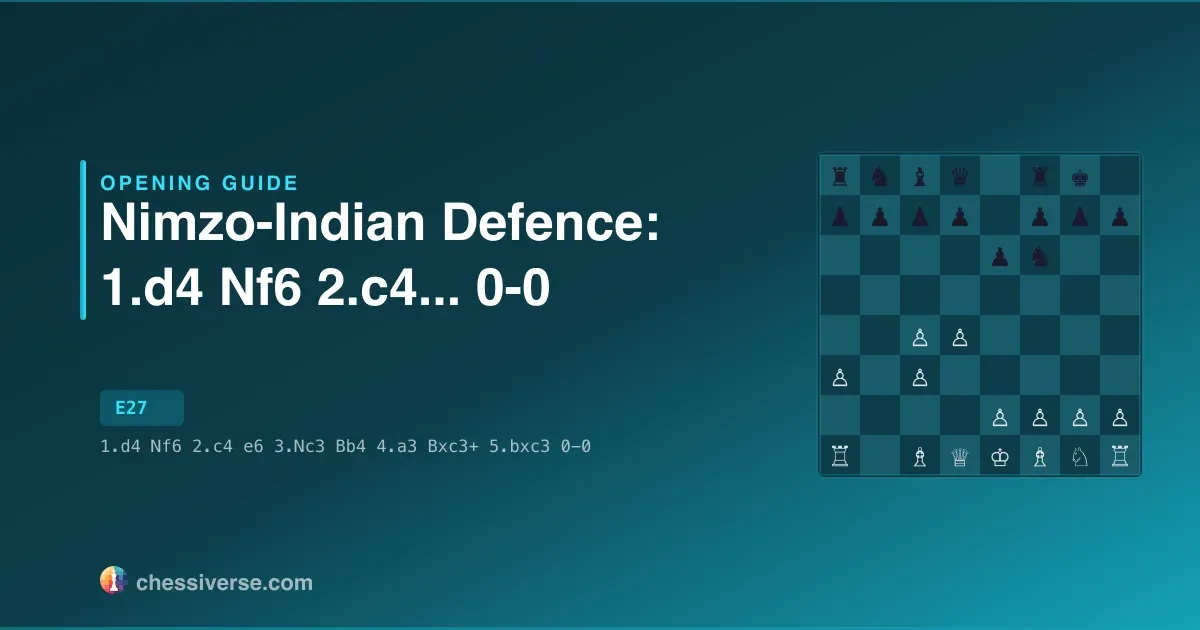
The Nimzo-Indian Defense: Sämisch Variation (ECO E27) begins with 1.d4 Nf6 2.c4 e6 3.Nc3 Bb4 4.a3 Bxc3+ 5.bxc3 0-0 (ECO E27). Lichess records 378,978 games in this line, which gives us a reliable view of how it actually performs in practice.
History and Notable Players
It arises from the Nimzo-Indian Defense: Sämisch Variation (ECO E24). Among the most prolific White practitioners are Christer Niklasson (5 games), Clara Mourot (5 games), Francisco Jose Perez Perez (4 games). Black-side regulars include Laszlo Eperjesi (5 games), Ludek Pachman (4 games), Lajos Portisch (3 games).
Performance Across Rating Levels
Popularity and results vary sharply by rating level. Among 1200-rated players, it appears in 0.00% of games — 26,126 of them on record — with White winning 48.9% and Black 47.6%. Move up to 1800 Elo and the share shifts to 0.01%, with White winning 47.2% versus Black's 47.9%. Among 2500-rated players the line appears in 0.03% of games and draws spike to 7.8%, indicating tight preparation.
Move Diversity and Theory Depth
Move choice is far from uniform in the Nimzo-Indian Defense: Sämisch Variation (ECO E27). At 1200 Elo (26,065 games), the top reply is Nf3, played 36.6% of the time. Three other moves each take at least 5% of games, and the top three moves account for 74.1% of games. Entropy: 2.68. By 2500 (3,712 games), f3 takes over as the top reply at 73.3%; only one other move still reaches 5% and the top three moves account for 94.9% of games. Entropy drops to 1.25. That entropy collapse is the signature of a line where preparation pays off: at the top, players know the best move and play it.
Historical Trends
Year-over-year data tells you whether this opening is a contemporary fixture or a fading one. Adoption peaked in 2015 at 0.012% (2,592 games). By 2025 it sits at 0.006%, 45% below the peak and 28% under its 2013 level, leaving the line in decline.
Main Lines and Variations
After 1.d4 Nf6 2.c4 e6 3.Nc3 Bb4 4.a3 Bxc3+ 5.bxc3 0-0, the established follow-ups are:
Each branch leads to a different middlegame character — the resulting pawn structure decides what kind of game you get.
Common Mistakes
- Neglecting development — It can feel productive to make extra pawn moves early, but falling behind in piece development is what loses most amateur games — especially in open positions where active pieces find squares fast.
- Letting White own the centre — Hypermodern openings concede central space on purpose, but only if you strike back in time. Delay the counter-blow and you end up squeezed.
Practice on Chessiverse
Ready to try the Nimzo-Indian Defense: Sämisch Variation (ECO E27) against a bot? Pick an opponent at your level and play a game.