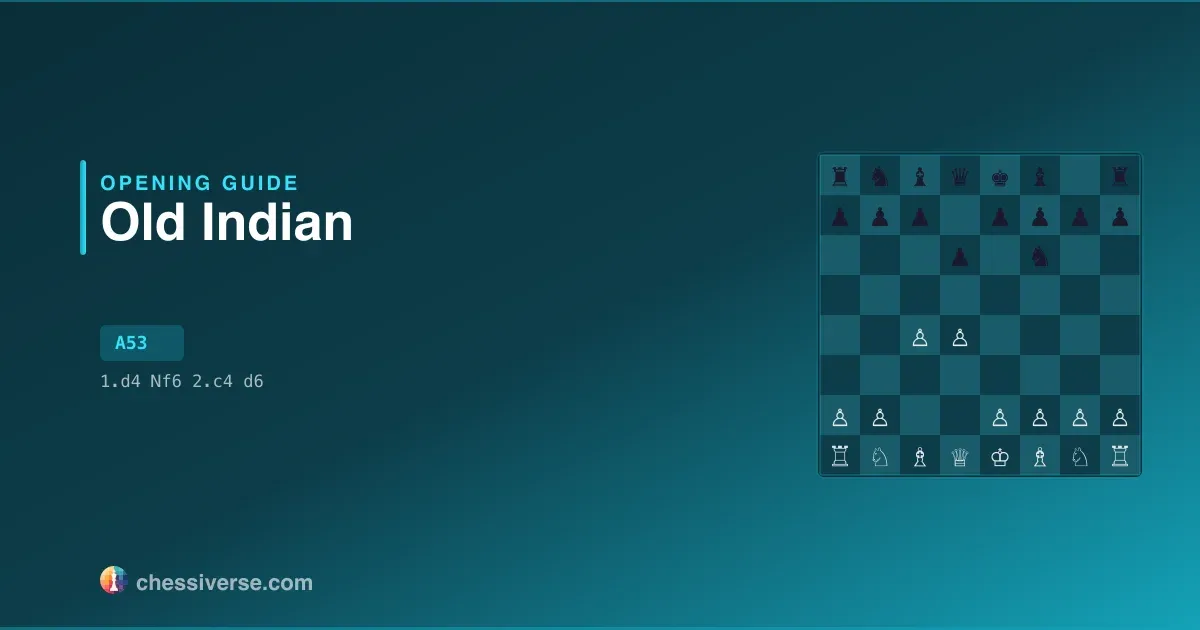
The Old Indian Defense arises after 1.d4 Nf6 2.c4 d6 and falls under ECO code A53. This setup frequently serves as a gateway to the King's Indian Defense, but it can also branch into its own independent variations that share a similar strategic outlook, notably the Tartakower-Indian. With 9.4 million Lichess games across all rating levels, it is a well-established opening choice.
- Black builds a ...d6 and ...e5 setup but develops the king's bishop modestly to e7 instead of fianchettoing it as in the King's Indian.
- Considered sound, though the e7-bishop is less active than a fianchetto; it never matched the King's Indian in popularity.
- Handy for sidestepping White's sharpest anti-King's Indian weapons, such as the Samisch and Averbakh setups.
History and Notable Players
It arises from the Indian Defense Systems. Among the most prolific practitioners on the White side are Ivan Farago (39 games), Rainer Knaak (30 games), Svetozar Gligoric (28 games). On the Black side, notable exponents include Lutz Espig (89 games), Alonso Zapata (80 games), Ekaterina Kovalevskaya (79 games).
Mikhail Chigorin pioneered the defence toward the end of his career, which is why it is sometimes called the Chigorin Indian. Dawid Janowski introduced the 3.Nc3 Bf5 line in the 1920s, though that variation only became popular in the 1980s.
Named after: Also called the Chigorin Indian, after Mikhail Chigorin, who pioneered the defence late in his career.
Notable players: Mikhail Tal, Bent Larsen, Florin Gheorghiu, Kamran Shirazi
Despite the 'old' label, part of its theory is surprisingly young: Janowski's 3...Bf5 idea from the 1920s only caught on some sixty years later, in the 1980s.
Statistics
Based on 9.4 million Lichess games across all rating levels:
- White wins: 48.6%
- Black wins: 46.6%
- Draws: 4.8%
The statistics show a roughly balanced opening where both sides have equal chances.
Main Lines and Variations
After 1.d4 Nf6 2.c4 d6, the main continuations include:
Each of these lines leads to distinct types of positions and requires its own understanding of the resulting pawn structures and piece placements.
Common Mistakes to Avoid
- Allowing White to build an overwhelming center: Hypermodern openings allow White space in the center, but you need to strike back at the right moment. Delaying the counterattack too long can leave you without active play.
Practice on Chessiverse
The best way to learn the Old Indian Defense is through practice. On Chessiverse, you can play chess against computer opponents that specialize in this opening. Our AI bots range from beginner to grandmaster level, each with unique playing styles — from aggressive attackers to solid defenders. Choose a bot that matches your rating and work your way up as you master the opening's key ideas.
Performance Across Rating Levels
The picture changes a lot as you climb the rating ladder. Among 1200-rated players, it appears in 0.11% of games — 772,607 of them on record — with White winning 49.4% and Black 46.7%. Move up to 1800 Elo and the share shifts to 0.29%, with White winning 48% versus Black's 47.1%. At 2500, 0.39% of games go into this opening; draws sit at 9.6% — the line is well-mapped at this level.
Time Control Patterns
Look at the same opening across time controls and bullet stands out. In bullet, it appears in 0.27% of games (7,126,766); White wins 48.4%. Blitz shows 0.22% adoption across 7,877,996 games, White scoring 48.5%. In rapid, the share rises to 0.14% — 1,531,587 games, White 49.2%.
Move Diversity and Theory Depth
What players actually play after the opening moves depends heavily on rating. At 1200 Elo (772,607 games), the top reply is Nc3, played 62.9% of the time. Two other moves each take at least 5% of games, and the top three moves account for 87% of games. Entropy: 1.87. By 2500 (53,739 games), Nc3 dominates at 61.3% of replies; only one other move still reaches 5% and the top three moves account for 98.9% of games. Entropy drops to 1.19. The narrowing is significant — strong players consolidate around a small set of best moves, while amateurs scatter across many plausible-looking options.
Historical Trends
Tracking the Old Indian Defense year over year shows a clear story. Adoption peaked in 2015 at 0.21% (47,211 games). By 2025 it sits at 0.20%, 4% below the peak but still 56% above its 2013 level, so the line is up over the full period despite easing from the high.