



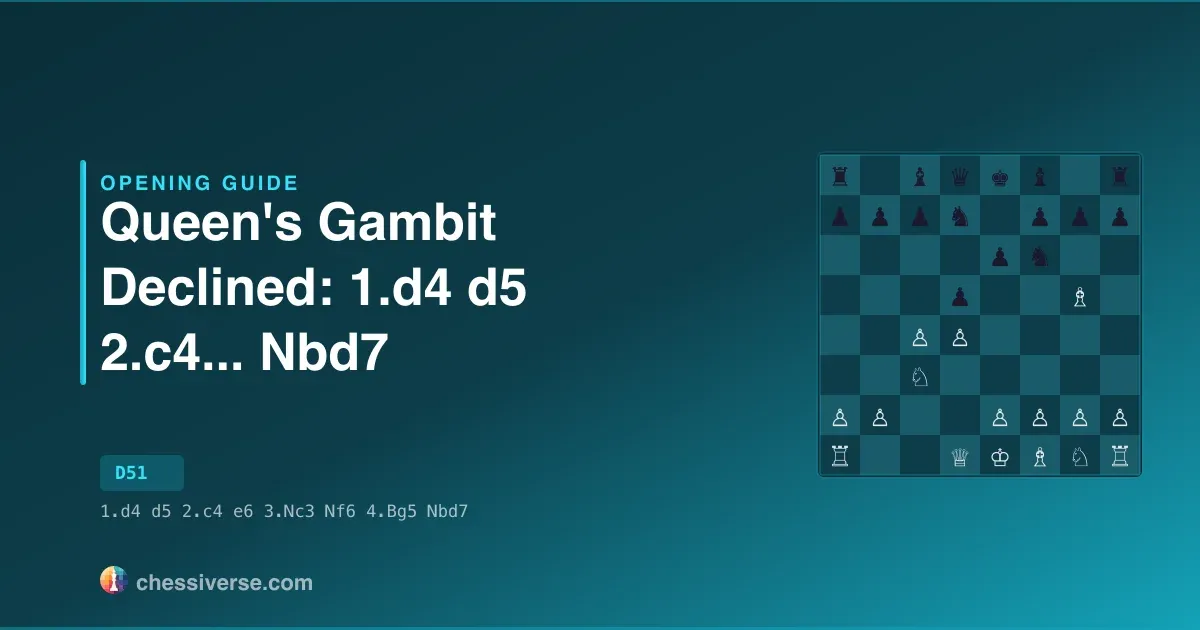
The Queen's Gambit Declined: Modern Variation, Knight Defense begins with 1.d4 d5 2.c4 e6 3.Nc3 Nf6 4.Bg5 Nbd7 (ECO D51). Black ignores the pin on f6 and just keeps developing — daring White to grab on d5. It's a trap as much as a developing move, and it's the gateway to the Cambridge Springs Defense.
Strategic Overview
4...Nbd7 is a deceptively quiet move that hides a sharp idea. The natural continuation is the Cambridge Springs setup: ...c6, ...Qa5, and pressure pointed at the knight on c3 and the bishop on g5. It's one of the few QGD lines that's both grandmaster-tested and friendly enough for amateurs because the strategy is concrete and explainable. The move also lays the famous d5 trap. If White innocently plays 5.cxd5 exd5 6.Nxd5?? thinking the f6 knight is pinned, Black uncorks 6...Nxd5! 7.Bxd8 Bb4+ and after the forced 8.Qd2 Black regains the queen with an extra piece. That trap has snared even strong players. Outside the trap, 5.cxd5 exd5 simply transposes into Exchange QGD waters, which are perfectly fine for both sides — the minority attack on the queenside is White's main idea, and Black has the classical setup with active piece play. White's other principal try is 5.Nf3, keeping options open against Black's eventual choice of system. The line's overall flavour is solid, somewhat slower than the sharp Bg5 main lines, and a useful way for Black to head for understood structures without memorising Botvinnik-Semi-Slav theory.
Key Ideas
The recurring motifs below distinguish a confident handler of this opening from a beginner:
- Sets up the Cambridge Springs with ...c6 and ...Qa5 — The natural follow-up is ...c6 and ...Qa5, hitting the bishop on g5 and the knight on c3 simultaneously. The plan is concrete and easy to remember, which is why it works at every level.
- Hides the famous Nxd5 trap — If White plays 5.cxd5 exd5 6.Nxd5??, Black wins material via 6...Nxd5 7.Bxd8 Bb4+ 8.Qd2 (forced) and recovers the queen with a piece advantage. Any 4.Bg5 player must know this sequence cold.
- Easy transposition into Exchange QGD — After 5.cxd5 exd5 the structure becomes a standard Exchange QGD where the minority attack is White's main theme and Black plays for piece activity. Both sides get a position they understand.
- Develops naturally without committing the bishop — Unlike 4...Be7 which immediately unpins, ...Nbd7 keeps the bishop flexible for Bb4+ ideas or staying on f8. That flexibility supports the Cambridge Springs structure once ...Qa5 lands.
History and Notable Players
It arises from the Queen's Gambit Declined: Modern Variation. Among the most prolific White practitioners are Alexander Alekhine (52 games), Frank James Marshall (44 games), Jose Raul Capablanca (26 games). Black-side regulars include Bela Lengyel (22 games), Dawid Markelowicz Janowski (20 games), Akiba Rubinstein (20 games).
Performance Across Rating Levels
The picture changes a lot as you climb the rating ladder. Among 1200-rated players, it appears in 0.01% of games — 41,814 of them on record — with White winning 50.1% and Black 46.2%. By 1800, popularity is 0.04% and White's score is 47.4% to Black's 47.1%. Among 2500-rated players the line appears in 0.02% of games and draws spike to 11.2%, indicating tight preparation. White's edge erodes by 4.6pp from 1200 to 2500 Elo, suggesting Black's counterplay is easier to find with experience.
Time Control Patterns
The Queen's Gambit Declined: Modern Variation, Knight Defense skews toward blitz chess. In bullet, it appears in 0.01% of games (224,974); White wins 49.8%. Blitz shows 0.02% adoption across 766,770 games, White scoring 48.5%. In rapid, the share rises to 0.02% — 213,607 games, White 46.9%. White's score swings 2.9pp across formats, so time control isn't just a stylistic choice here — it shifts the actual results.
Move Diversity and Theory Depth
Move choice is far from uniform in the Queen's Gambit Declined: Modern Variation, Knight Defense. At 1200 Elo (41,719 games), the top reply is Nf3, played 34.5% of the time. Three other moves each take at least 5% of games, and the top three moves account for 81.1% of games. Entropy: 2.36. By 2500 (3,291 games), e3 takes over as the top reply at 70.7%; only two other moves still reach 5% and the top three moves account for 98.8% of games. Entropy drops to 1.24. That entropy collapse is the signature of a line where preparation pays off: at the top, players know the best move and play it.
Historical Trends
Long-term, the trajectory of this opening is informative. Adoption peaked in 2013 at 0.04% (1,187 games). By 2025 it sits at 0.02%, down 59% from that high, leaving the line in decline.
Main Lines and Variations
From the position after 1.d4 d5 2.c4 e6 3.Nc3 Nf6 4.Bg5 Nbd7, the recognised continuations are:
Each branch leads to a different middlegame character — the resulting pawn structure decides what kind of game you get.
Common Mistakes
- Drifting away from main theory — At 400 Elo, the three most-played moves cover 75% of games, against 92% at 2000. The most popular deviation is Nf3 (played 29.2% of the time at 400, less so up top). It looks fine but quietly hands the better-prepared side an edge.
- Neglecting development — It can feel productive to make extra pawn moves early, but falling behind in piece development is what loses most amateur games — especially in open positions where active pieces find squares fast.
- Overextending the attack — Gambits look like permission to throw everything forward. They aren't — every attacking move should improve a piece. Random checks and threats burn the initiative once they fail to coordinate.
Practice on Chessiverse
Ready to try the Queen's Gambit Declined: Modern Variation, Knight Defense against a bot? Pick an opponent at your level and play a game.