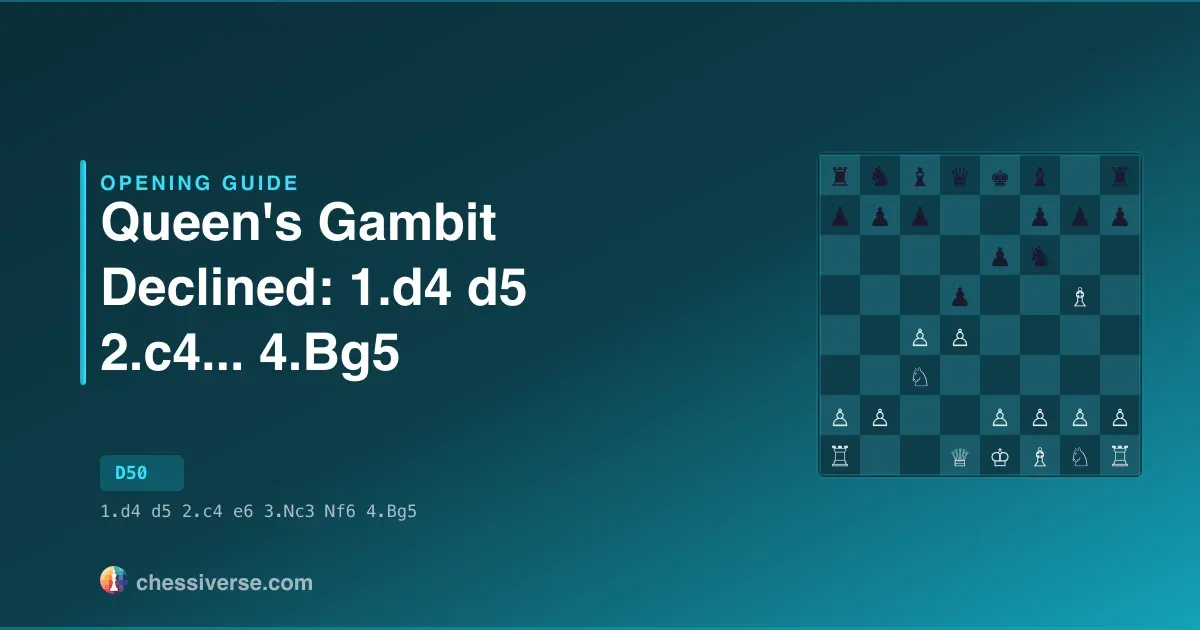
Starting from 1.d4 d5 2.c4 e6 3.Nc3 Nf6 4.Bg5, players enter the Queen's Gambit Declined: Modern Variation — ECO D50. The classical pin against the QGD. White doesn't rush to commit the centre — instead the bishop drops to g5 and asks Black to deal with the pressure on f6 before anything else gets done.
Strategic Overview
4.Bg5 is the old-school weapon, and the reason it has survived more than a century of theory is simple: it's annoying. The pin tethers Black's knight to the queen, which means every plan involving ...c5 or ...e5 has to be checked for tactics on d5 first. The bishop also stays flexible — White hasn't committed to Bd3 or Be2, hasn't shown the king's bishop path, and can transpose into Orthodox, Cambridge Springs, or Exchange structures depending on what Black does. Black's options now define the whole game. The Orthodox 4...Be7 unpins quietly and heads for solid castling. The Cambridge Springs (4...Nbd7 followed by ...c6 and ...Qa5) puts immediate pressure on the bishop and sets the famous trap on d5. The Tartakower with ...b6 and the Lasker with ...Ne4 are other mainstream paths to equality. Each one comes with its own pawn structure and its own choice for White between trading on f6 and keeping the pin. The shared theme across all of them is the fight for the e4 square and timing the central break. 4.Bg5 is a positional move, but every Black reply hides tactics, and the play often resolves only deep into the middlegame.
Key Ideas
When players succeed in this line, they usually do so by leaning on the following themes:
- The pin on f6 ties Black's hands — Pinning the knight against the queen restricts Black's options for breaking with ...c5 or ...e5 since the d5 square is suddenly fragile. Every Black plan has to account for tactics along the d-file and the b8-h2 diagonal.
- Maximum flexibility for White — By developing the bishop before committing to Bd3, Nf3, or e3 ordering, White keeps the option to transpose into Orthodox, Exchange or Cambridge Springs structures based on Black's choice.
- Black picks the system, not White — Whether the game becomes Orthodox, Tartakower, Lasker, or Cambridge Springs depends almost entirely on Black's next move. White's job is to find the best reply against each setup rather than impose one type of position.
- The exchange Bxf6 is always in the air — Trading bishop for knight gives White the bishop pair and damages Black's structure, but also concedes the dark squares. Knowing when to take and when to maintain the pin is a recurring decision.
History and Notable Players
It arises from the Queen's Gambit Declined: Normal Defense. Among the most prolific White practitioners are Alexander Alekhine (104 games), Frank James Marshall (101 games), Max Euwe (67 games). Black-side regulars include Carlos Enrique Guimard (42 games), Geza Maroczy (40 games), George Alan Thomas (39 games).
Performance Across Rating Levels
Popularity and results vary sharply by rating level. At 1200 Elo, the opening shows up in 0.11% of games (713,275 samples). White scores 52.2%, Black 43.9%, draws 3.8%. Move up to 1800 Elo and the share shifts to 0.40%, with White winning 50.3% versus Black's 44.1%. At 2500, 0.22% of games go into this opening; draws sit at 12.2% — the line is well-mapped at this level. White's edge erodes by 6.7pp from 1200 to 2500 Elo, suggesting Black's counterplay is easier to find with experience.
Time Control Patterns
Look at the same opening across time controls and blitz stands out. In bullet, it appears in 0.16% of games (4,203,929); White wins 50.6%. Blitz shows 0.26% adoption across 9,452,887 games, White scoring 50.8%. In rapid, the share rises to 0.20% — 2,232,355 games, White 50.9%.
Move Diversity and Theory Depth
What players actually play after the opening moves depends heavily on rating. At 1200 Elo (711,696 games), the top reply is Be7, played 44.2% of the time. Four other moves each take at least 5% of games, and the top three moves account for 75.9% of games. Entropy: 2.47. By 2500 (29,786 games), Be7 dominates at 58.9% of replies; four other moves reach 5% and the top three moves account for 80.9% of games. Entropy drops to 1.96. The narrowing is significant — strong players consolidate around a small set of best moves, while amateurs scatter across many plausible-looking options.
Historical Trends
Tracking the Queen's Gambit Declined: Modern Variation year over year shows a clear story. Adoption peaked in 2014 at 0.31% (27,596 games). By 2025 it sits at 0.22%, 28% below the peak and 23% under its 2013 level, leaving the line in decline.
Main Lines and Variations
After 1.d4 d5 2.c4 e6 3.Nc3 Nf6 4.Bg5, the established follow-ups are:
Each branch leads to a different middlegame character — the resulting pawn structure decides what kind of game you get.
Common Mistakes
- Drifting away from main theory — At 400 Elo, the three most-played moves cover 75.2% of games, against 85.3% at 2000. The most popular deviation is Bb4 (played 19.3% of the time at 400, much less so up top). It looks fine but quietly hands the better-prepared side an edge.
- Neglecting development — It can feel productive to make extra pawn moves early, but falling behind in piece development is what loses most amateur games — especially in open positions where active pieces find squares fast.
- Overextending the attack — Gambits look like permission to throw everything forward. They aren't — every attacking move should improve a piece. Random checks and threats burn the initiative once they fail to coordinate.
Practice on Chessiverse
Ready to try the Queen's Gambit Declined: Modern Variation against a bot? Pick an opponent at your level and play a game.