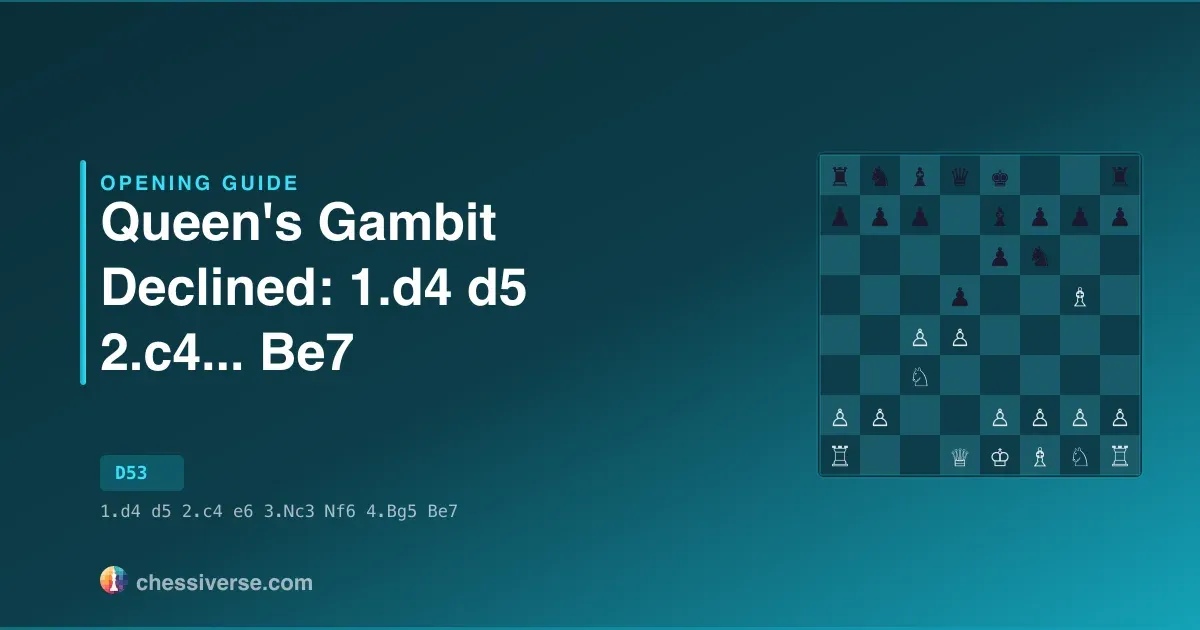
1.d4 d5 2.c4 e6 3.Nc3 Nf6 4.Bg5 Be7 opens the Queen's Gambit Declined (4...Be7), ECO D53. The classical Orthodox response. Black unpins, gets ready to castle, and signals an intent to play one of the most thoroughly mapped strategic battlegrounds in chess.
Strategic Overview
4...Be7 is as principled as it gets. Black breaks the pin by interposing the bishop, prepares short castling, and keeps the central pawn structure flexible. From here the game heads straight into the heart of QGD theory — Orthodox, Tartakower, or Lasker setups, depending on Black's next few moves. White's two main continuations, 5.e3 and 5.Nf3, almost always transpose into the same middlegames, so the move order rarely matters much. The eventual structures revolve around the same questions: when Black plays ...c6 and ...Nbd7, can White create pressure with the minority attack on the queenside; if Black goes ...c5, does the resulting IQP favour the attacker or the blockader; if Black trades on c4 and plays ...Nd5, can the queenside fianchetto with ...b6 hold against the c-file? The Orthodox is solid but not toothless — Black aims for the freeing manoeuvre ...Nd5 or the central break ...c5, and the entire game often hinges on whether Black can untangle the c8 bishop without making structural concessions.
Key Ideas
A few ideas come up again and again in this opening:
- Unpinning is the most natural and principled reply — Interposing the bishop breaks the pin on f6, prepares short castling, and clears the way for ...Nbd7. It's the move that defines the classical Orthodox approach to the QGD.
- 5.e3 and 5.Nf3 typically transpose — White's two main moves usually reach the same positions through different orders. Picking between them is more about taste and avoiding specific sidelines than about reaching distinct middlegames.
- Freeing the c8 bishop is the long-term project — Black's main strategic burden is the locked-in light-squared bishop. Plans typically involve ...b6 and ...Bb7, an eventual ...c5 to open the diagonal, or the freeing manoeuvre ...Nd5 with trades.
- The minority attack is White's standard plan — In structures with pawns on c6 and d5 for Black, White often plays b4-b5 to weaken Black's queenside pawns. Black counters with kingside play or central activity to outrun the slow squeeze.
History and Notable Players
It arises from the Queen's Gambit Declined: Modern Variation. On the White side, Frank James Marshall (56 games), Viktor Korchnoi (51 games), Alexander Alekhine (50 games) top the database. Notable Black exponents: Janis Klovans (37 games), Geza Maroczy (29 games), Paul Van der Sterren (29 games).
Performance Across Rating Levels
The picture changes a lot as you climb the rating ladder. At 1200 Elo, the opening shows up in 0.05% of games (317,766 samples). White scores 51.1%, Black 45%, draws 4%. At 1800 the opening surfaces in 0.26% of games; White wins 50%, Black 44.3%, draws 5.7%. Among 2500-rated players the line appears in 0.13% of games and draws spike to 12.8%, indicating tight preparation. White's edge erodes by 5.8pp from 1200 to 2500 Elo, suggesting Black's counterplay is easier to find with experience.
Time Control Patterns
The Queen's Gambit Declined (4...Be7) skews toward blitz chess. In bullet, it appears in 0.09% of games (2,397,281); White wins 50.4%. Blitz shows 0.16% adoption across 5,653,762 games, White scoring 50.3%. In rapid, the share rises to 0.11% — 1,211,797 games, White 50%.
Move Diversity and Theory Depth
Move choice is far from uniform in the Queen's Gambit Declined (4...Be7). At 1200 Elo (317,030 games), the top reply is Nf3, played 41.6% of the time. Three other moves each take at least 5% of games, and the top three moves account for 86.2% of games. Entropy: 2.15. By 2500 (17,576 games), e3 takes over as the top reply at 74.6%; only two other moves still reach 5% and the top three moves account for 98.6% of games. Entropy drops to 1.16. The narrowing is significant — strong players consolidate around a small set of best moves, while amateurs scatter across many plausible-looking options.
Historical Trends
Year-over-year data tells you whether this opening is a contemporary fixture or a fading one. Adoption peaked in 2015 at 0.18% (38,990 games). By 2025 it sits at 0.13%, 24% below the peak and 16% under its 2013 level, leaving the line in decline.
Main Lines and Variations
The main branches off 1.d4 d5 2.c4 e6 3.Nc3 Nf6 4.Bg5 Be7 include:
- Queen's Gambit Declined: Neo-Orthodox Variation
- Queen's Gambit Declined: Modern Variation, Normal Line
Each branch leads to a different middlegame character — the resulting pawn structure decides what kind of game you get.
Common Mistakes
- Drifting away from main theory — At 400 Elo, the three most-played moves cover 83.4% of games, against 90.5% at 2000. The most popular deviation is Bxf6 (played 16.4% of the time at 400, much less so up top). It looks fine but quietly hands the better-prepared side an edge.
- Neglecting development — Extra pawn moves in the opening are tempting, especially when you "know the moves". Developing a piece each turn is the simple correction.
- Overextending the attack — Gambits look like permission to throw everything forward. They aren't — every attacking move should improve a piece. Random checks and threats burn the initiative once they fail to coordinate.
Practice on Chessiverse
Ready to try the Queen's Gambit Declined (4...Be7) against a bot? Pick an opponent at your level and play a game.