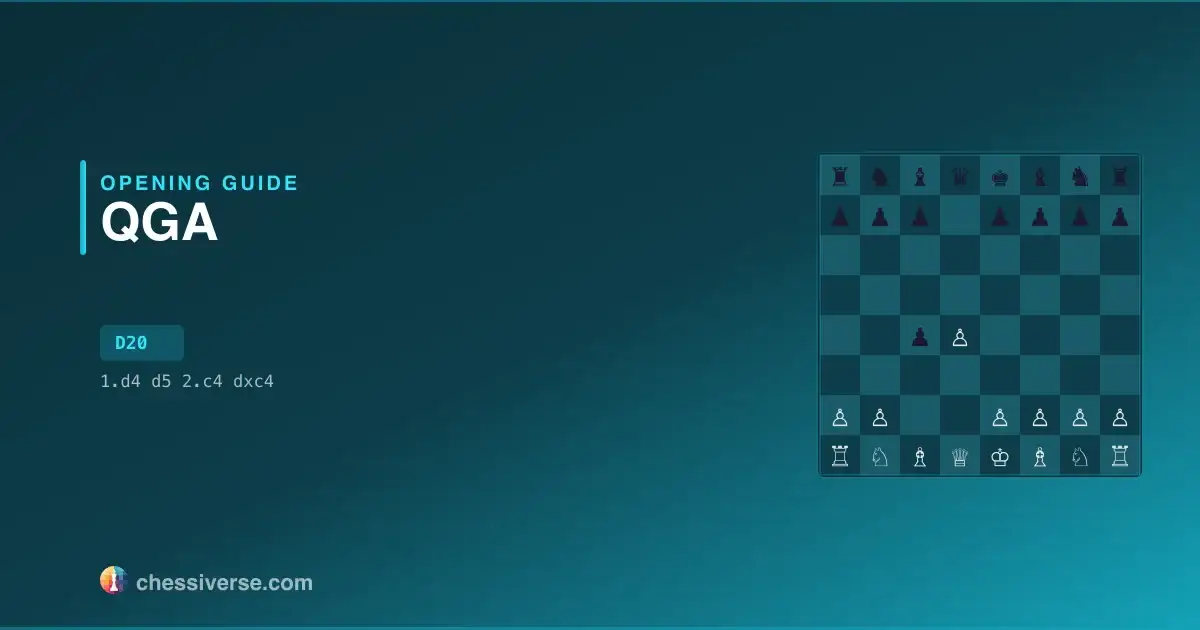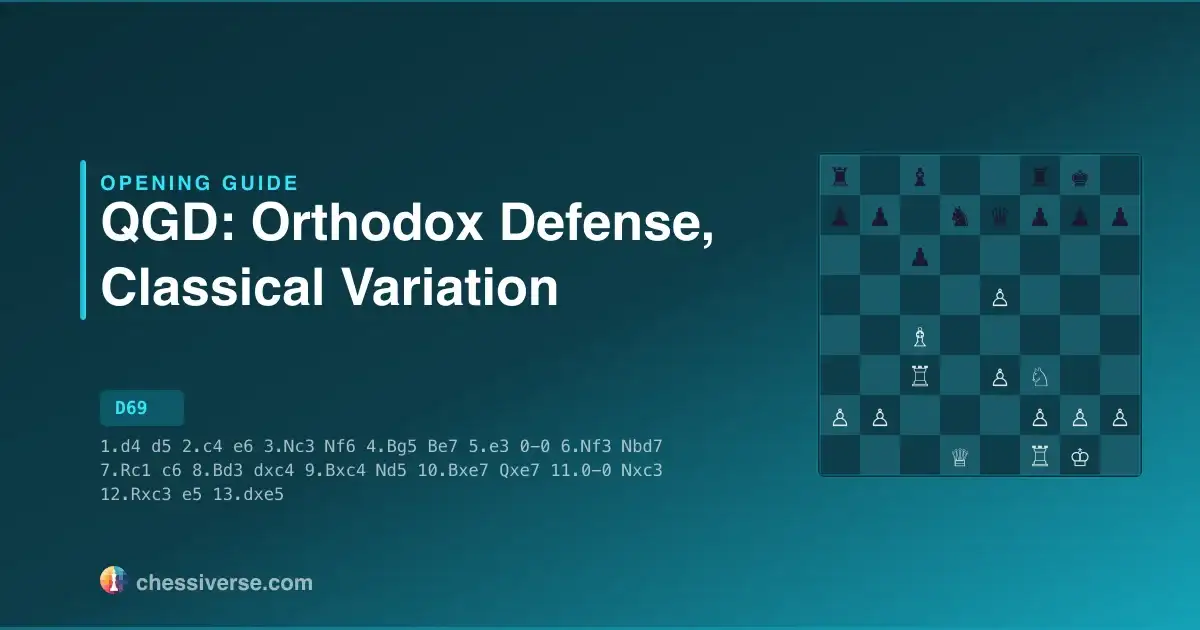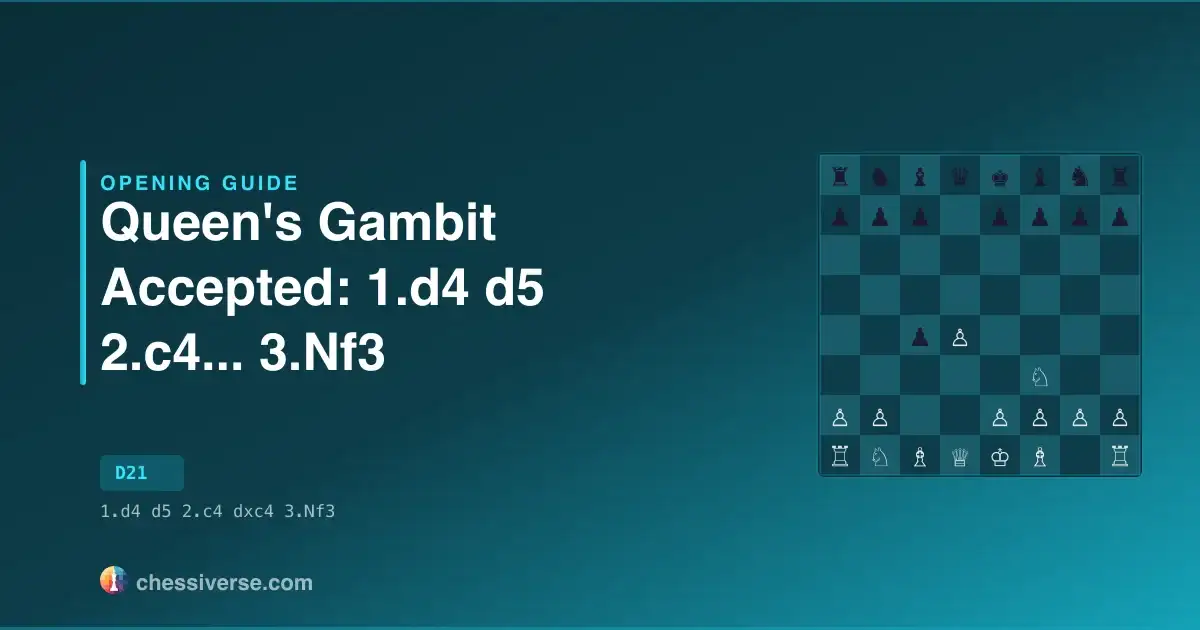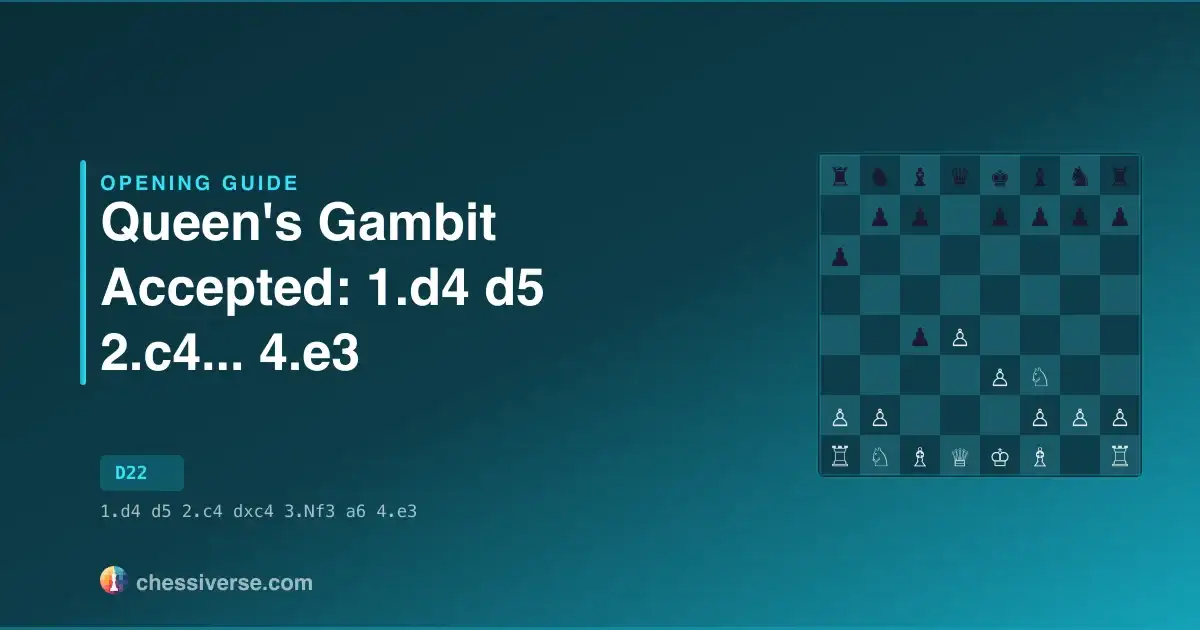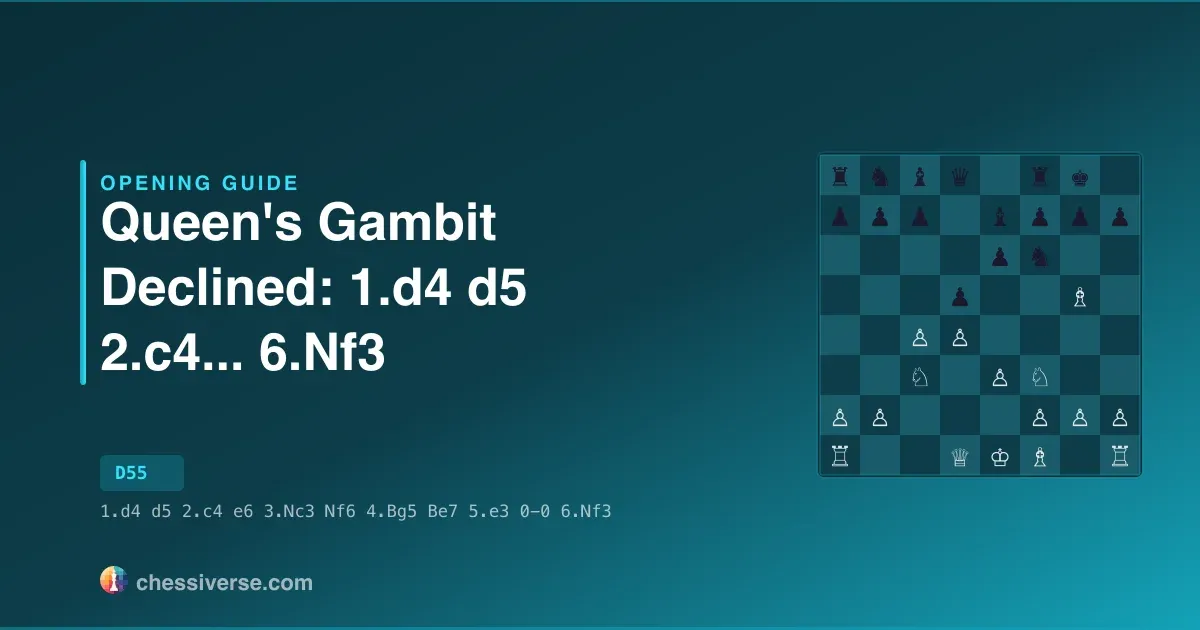
Starting from 1.d4 d5 2.c4 e6 3.Nc3 Nf6 4.Bg5 Be7 5.e3 0-0 6.Nf3, players enter the Queen's Gambit Declined: Modern Variation, Normal Line — ECO D55. With 3,343,611 games on record, the patterns below come from the largest practical sample available.
History and Notable Players
It arises from the Queen's Gambit Declined (4...Be7). On the White side, Svetozar Gligoric (45 games), Viktor Korchnoi (41 games), Gideon Stahlberg (28 games) top the database. Notable Black exponents: Andrei V Kharitonov (56 games), Lajos Portisch (53 games), Janis Klovans (48 games).
Performance Across Rating Levels
Popularity and results vary sharply by rating level. The 1200 bracket has 73,454 games (0.01% of all games at that level); White wins 51.6%, Black 44.6%, 3.8% are drawn. Move up to 1800 Elo and the share shifts to 0.12%, with White winning 49% versus Black's 45%. At 2500, 0.19% of games go into this opening; draws sit at 12.7% — the line is well-mapped at this level. White's edge erodes by 3.8pp from 1200 to 2500 Elo, suggesting Black's counterplay is easier to find with experience.
Time Control Patterns
Look at the same opening across time controls and blitz stands out. In bullet, it appears in 0.06% of games (1,617,436); White wins 49.6%. Blitz shows 0.08% adoption across 2,890,050 games, White scoring 49.3%. In rapid, the share rises to 0.04% — 446,900 games, White 49.4%.
Move Diversity and Theory Depth
What players actually play after the opening moves depends heavily on rating. At 1200 Elo (73,279 games), the top reply is h6, played 25.1% of the time. Six other moves each take at least 5% of games, and the top three moves account for 50.3% of games. Entropy: 3.15. By 2500 (25,620 games), h6 is still the top reply, at 42.4%; only four other moves still reach 5% and the top three moves account for 78.2% of games. Entropy drops to 2.36. The narrowing is significant — strong players consolidate around a small set of best moves, while amateurs scatter across many plausible-looking options.
Main Lines and Variations
From the position after 1.d4 d5 2.c4 e6 3.Nc3 Nf6 4.Bg5 Be7 5.e3 0-0 6.Nf3, the recognised continuations are:
Each branch leads to a different middlegame character — the resulting pawn structure decides what kind of game you get.
Common Mistakes
- Neglecting development — Extra pawn moves in the opening are tempting, especially when you "know the moves". Developing a piece each turn is the simple correction.
- Overextending the attack — Gambits look like permission to throw everything forward. They aren't — every attacking move should improve a piece. Random checks and threats burn the initiative once they fail to coordinate.
Practice on Chessiverse
Ready to try the Queen's Gambit Declined: Modern Variation, Normal Line against a bot? Pick an opponent at your level and play a game.