

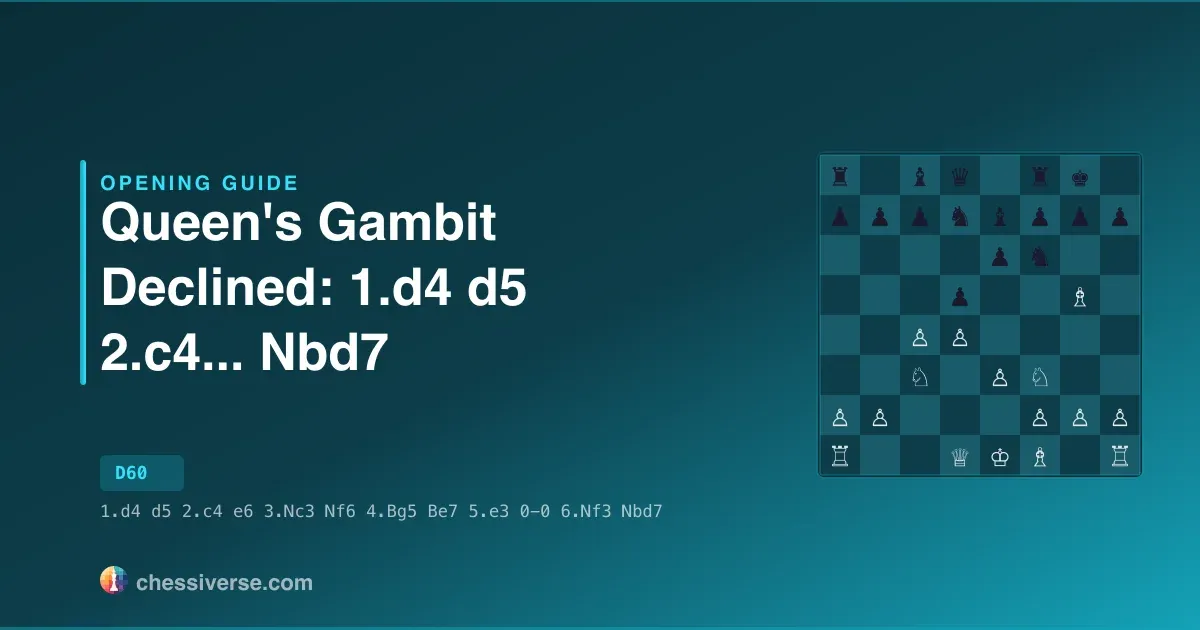
The Queen's Gambit Declined: Orthodox Defense begins with 1.d4 d5 2.c4 e6 3.Nc3 Nf6 4.Bg5 Be7 5.e3 0-0 6.Nf3 Nbd7 (ECO D60). With 905,140 games on record, the patterns below come from the largest practical sample available.
History and Notable Players
It arises from the Queen's Gambit Declined: Modern Variation, Normal Line. On the White side, Alexander Alekhine (74 games), Max Euwe (44 games), Frank James Marshall (42 games) top the database. Notable Black exponents: Geza Maroczy (46 games), Andrei V Kharitonov (39 games), Eduard Prandstetter (39 games).
Performance Across Rating Levels
The picture changes a lot as you climb the rating ladder. Among 1200-rated players, it appears in 0.00% of games — 14,252 of them on record — with White winning 48.8% and Black 47.3%. By 1800, popularity is 0.03% and White's score is 48.6% to Black's 45.4%. Among 2500-rated players the line appears in 0.07% of games and draws spike to 11.8%, indicating tight preparation. Positions also become less sharp as level rises (sharpness 0.96 → 0.88).
Time Control Patterns
The Queen's Gambit Declined: Orthodox Defense skews toward blitz chess. In bullet, it appears in 0.01% of games (357,353); White wins 49%. Blitz shows 0.02% adoption across 775,636 games, White scoring 48.7%. In rapid, the share rises to 0.01% — 127,846 games, White 48%.
Move Diversity and Theory Depth
Move choice is far from uniform in the Queen's Gambit Declined: Orthodox Defense. At 1200 Elo (14,204 games), the top reply is Bd3, played 43.8% of the time. Three other moves each take at least 5% of games, and the top three moves account for 77% of games. Entropy: 2.52. By 2500 (8,856 games), Rc1 takes over as the top reply at 36.3%; three other moves reach 5% and the top three moves account for 79.9% of games. Entropy drops to 2.27.
Historical Trends
Year-over-year data tells you whether this opening is a contemporary fixture or a fading one. Adoption peaked in 2015 at 0.03% (5,847 games). By 2025 it sits at 0.02%, 37% below the peak and 26% under its 2013 level, leaving the line in decline.
Main Lines and Variations
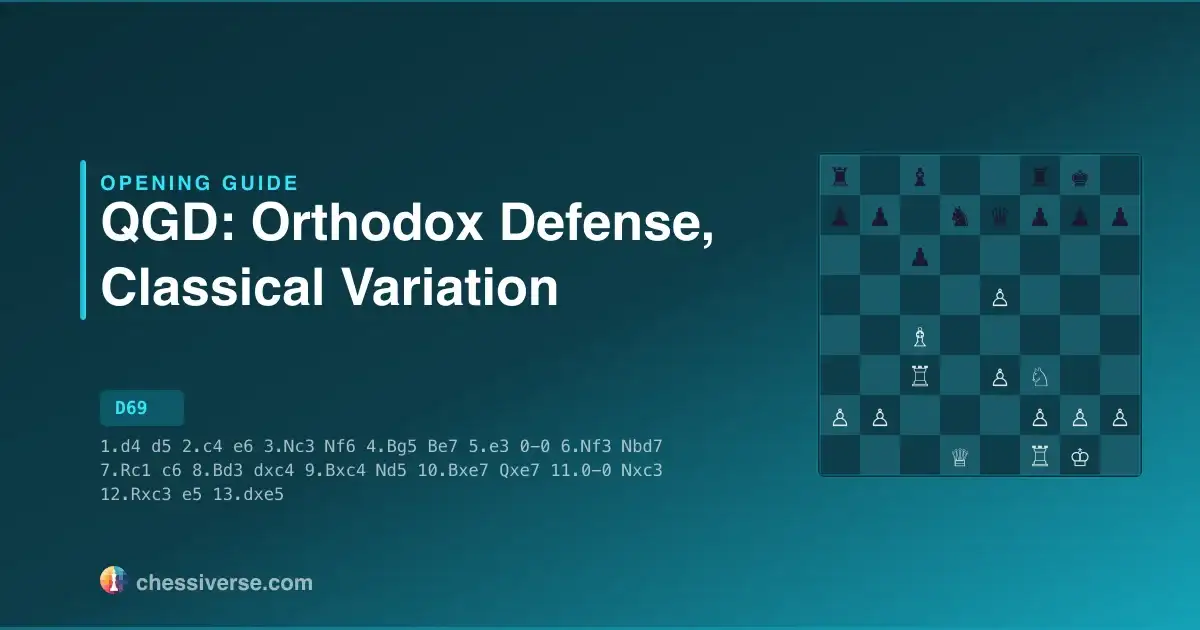
After 1.d4 d5 2.c4 e6 3.Nc3 Nf6 4.Bg5 Be7 5.e3 0-0 6.Nf3 Nbd7, the established follow-ups are:
- Queen's Gambit Declined: Orthodox Defense, Rubinstein Variation
- Queen's Gambit Declined: Orthodox Defense, Main Line
Each branch leads to a different middlegame character — the resulting pawn structure decides what kind of game you get.
Common Mistakes
- Neglecting development — Extra pawn moves in the opening are tempting, especially when you "know the moves". Developing a piece each turn is the simple correction.
- Overextending the attack — Gambits look like permission to throw everything forward. They aren't — every attacking move should improve a piece. Random checks and threats burn the initiative once they fail to coordinate.
Practice on Chessiverse
Ready to try the Queen's Gambit Declined: Orthodox Defense against a bot? Pick an opponent at your level and play a game.