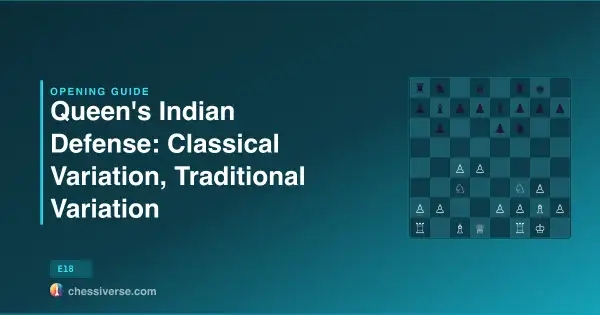
Queen's Indian Defense: Classical Variation, Traditional Variation, Main Line

Popularity increased 300% since 2013

E191.d4 Nf6 2.c4 e6 3.Nf3 b6 4.g3 Bb7 5.Bg2 Be7 6.0-0 0-0 7.Nc3 Ne4 8.Qc2 Nxc3 9.Qxc3

Feb 20, 20261 min read

TL;DR The old QID main line. Black has traded knights on c3 to relieve the tension and accepted a slight kingside concession in return for piece simplification. 11% of these games are drawn at master level, a hint at the line's endgame slant.

Queen's Indian Defense: Classical Variation, Traditional Variation, Main Line: A Complete Guide
Queen's Indian Defense: Classical Variation, Traditional Variation, Main Line - Opening Moves

Summary

Starting from 1.d4 Nf6 2.c4 e6 3.Nf3 b6 4.g3 Bb7 5.Bg2 Be7 6.0-0 0-0 7.Nc3 Ne4 8.Qc2 Nxc3 9.Qxc3, players enter the Queen's Indian Defense: Classical Variation, Traditional Variation, Main Line — ECO E19. With 56,063 games on record, the patterns below come from the largest practical sample available.

History and Notable Players

It arises from the Queen's Indian Defense: Classical Variation, Traditional Variation. On the White side, Borislav Ivkov (37 games), Ulf Andersson (20 games), Miguel Najdorf (14 games) top the database. Notable Black exponents: Anatoly Karpov (25 games), Aleksandar Matanovic (20 games), Miguel Najdorf (18 games).

Common Mistakes

  • Neglecting development — Extra pawn moves in the opening are tempting, especially when you "know the moves". Developing a piece each turn is the simple correction.
  • Letting White own the centre — Hypermodern openings concede central space on purpose, but only if you strike back in time. Delay the counter-blow and you end up squeezed.

Practice on Chessiverse

Ready to try the Queen's Indian Defense: Classical Variation, Traditional Variation, Main Line against a bot? Play chess against the computer at your level.


Play the Queen's Indian Defense: Classical Variation, Traditional Variation, Main Line

Play As
Start From

After 1.d4 Nf6 2.c4 e6 3.Nf3 b6 4.g3 Bb7 5.Bg2 Be7 6.0-0 0-0 7.Nc3 Ne4 8.Qc2 Nxc3 9.Qxc3 Pick the position up and play on from there.

Opponent

No account needed — your game saves if you sign up after.

Want the full game experience — enter the game arena!

Quick Facts

Games on Lichess
56,063
Most Popular At
2500
Sharpness
Calm
Scored as part of the Queen's Indian family
Main Line
1.d4 Nf6 2.c4 e6 3.Nf3 b6 4.g3 Bb7 5.Bg2 Be7 6.0-0 0-0 7.Nc3 Ne4 8.Qc2 Nxc3 9.Qxc3
FEN
rn1q1rk1/pbppbppp/1p2p3/8/2PP4/2Q2NP1/PP2PPBP/R1B2RK1 b - - 0 9
Style
Solid Defender

White wins 44.2%, draws 10.6%, Black wins 45.2%.

Top Players

As White

  1. Borislav Ivkov37 games
  2. Ulf Andersson20 games
  3. Miguel Najdorf14 games

As Black

  1. Anatoly Karpov25 games
  2. Aleksandar Matanovic20 games
  3. Miguel Najdorf18 games

Data from Lichess opening explorer (blitz & rapid)

Solid Defender
Solid Defender openings aim for a rock-solid pawn structure and safe piece placement. They resist aggression, minimize weaknesses, and seek to outplay the opponent in the long run.

Popularity by Rating

Popularity view

It's played most at 2500: about 1 in 4,600 games there, against fewer than 1 in 100,000 games at 1800. At 1800, White wins 41% and Black 51%; at 2500 it's 45% to 41%, with more draws (14%).

Percentage of all games at each rating bracket that feature this opening.

Data from Lichess opening explorer (blitz & rapid games)

Theory Adherence by Rating

Theory adherence view

At 1400, Black's most common reply is 9...c5 (29% of games), with four other moves each played in at least 1 in 20 games. At 2500, 9...d6 takes over (33%).

How often players choose the single most popular move at this position. Higher = more predictable play.

Black to move after the opening line

Popularity Over Time

It's about four times as popular as in 2013: about 1 in 83,000 games in 2025, up from fewer than 1 in 100,000 games. It peaked in 2015, at 1 in 63,000 games.

Share of all Lichess blitz + rapid games featuring this opening, by year.

Top Moves by Rating

Black to move after the opening line

Top moves by rating
RatingMost Popular2nd3rd
400———
10009...c550%9...f520%9...d610%
12009...c538.9%9...f516.7%9...d611.1%
14009...c529%9...f523%9...d618%
16009...d632.6%9...f520.8%9...c519.9%
18009...d630.2%9...f529.9%9...c518.5%
20009...f529.3%9...d626.6%9...Be418.6%
22009...f528.6%9...d626%9...Be417.8%
25009...d632.9%9...f521.1%9...c517.7%

Popularity by Time Control

It's played most in blitz: about 1 in 71,000 blitz games, against fewer than 1 in 100,000 rapid games. White wins more often in bullet (46%) than in rapid (42%).

  • Bullet<0.01%19K
  • Blitz<0.01%52K
  • Rapid<0.01%4K

5% more decisive in bullet

Raw Data Tables (Lichess Blitz + Rapid)
Queen's Indian Defense: Classical Variation, Traditional Variation, Main Line: popularity and win rates by player rating
Rating (Elo)Share %GamesWhite win %Black win %Draw %Sharpness
4000.0000.00.00.00.000
10000.001070.030.00.01.000
12000.001861.133.35.60.944
14000.0010050.040.010.00.900
16000.0045943.650.36.10.939
18000.003,40341.450.58.10.919
20000.0018,53444.446.29.50.905
22000.0230,56344.344.411.30.887
25000.022,97644.940.914.20.858
Queen's Indian Defense: Classical Variation, Traditional Variation, Main Line: move-choice theory adherence by rating
Rating (Elo)Top moveTop move %Viable movesTheory %Entropy
4009...—0.000.00.000
10009...c550.0580.01.961
12009...c538.9966.72.703
14009...c529.0570.02.762
16009...d632.6573.32.621
18009...d630.2478.72.387
20009...f529.3574.52.347
22009...f528.6572.42.358
25009...d632.9571.72.419
Queen's Indian Defense: Classical Variation, Traditional Variation, Main Line: popularity over time
YearShare %GamesWhite win %Black win %Draw %
20130.001040.060.00.0
20140.008441.750.08.3
20150.0034642.248.39.5
20160.0083141.847.311.0
20170.001,28544.145.810.0
20180.002,20841.649.19.3
20190.003,24943.046.810.2
20200.008,01144.244.011.8
20210.008,83544.444.211.4
20220.008,43844.344.810.9
20230.009,14743.945.910.2
20240.009,00744.645.410.0
20250.008,63044.545.310.1
Queen's Indian Defense: Classical Variation, Traditional Variation, Main Line: popularity by time control
FormatShare %GamesWhite win %Black win %Draw %Sharpness
bullet0.0018,95745.847.17.10.929
blitz0.0051,55944.445.110.50.895
rapid0.004,39441.546.112.30.877
Queen's Indian Defense: Classical Variation, Traditional Variation, Main Line: top candidate moves by rating bracket
Rating (Elo)1st move1st %2nd move2nd %3rd move3rd %
400——————
10009...c550.09...f520.09...d610.0
12009...c538.99...f516.79...d611.1
14009...c529.09...f523.09...d618.0
16009...d632.69...f520.89...c519.9
18009...d630.29...f529.99...c518.5
20009...f529.39...d626.69...Be418.6
22009...f528.69...d626.09...Be417.8
25009...d632.99...f521.19...c517.7
Queen's Indian Defense: Classical Variation, Traditional Variation, Main Line: top practitioners by side
SidePlayerGames
WhiteBorislav Ivkov37
WhiteUlf Andersson20
WhiteMiguel Najdorf14
BlackAnatoly Karpov25
BlackAleksandar Matanovic20
BlackMiguel Najdorf18

Frequently Asked Questions

Queen's Indian Defense: Classical Variation, Traditional Variation, Main Line

What is this opening?

This opening begins with 1.d4 Nf6 2.c4 e6 3.Nf3 b6 4.g3 Bb7 5.Bg2 Be7 6.0-0 0-0 7.Nc3 Ne4 8.Qc2 Nxc3 9.Qxc3 and is classified under ECO code E19.

Is this opening good for beginners?

This opening can be played at any level. Beginners should focus on understanding the key strategic ideas rather than memorizing long theoretical lines. Our AI bots at various rating levels provide a great way to practice the opening concepts.

What are the win rates for this opening?

In a database of 56,063 games, White wins 44.2% of the time, Black wins 45.2%, and 10.6% are drawn. Notable players on the White side include Borislav Ivkov and Ulf Andersson. On the Black side, Anatoly Karpov and Aleksandar Matanovic are among the most frequent practitioners.

How can I practice this opening?

On Chessiverse, you can practice this opening by playing against our 1,100+ AI bots. Each bot has a unique playing style and opening repertoire, so you can find the perfect sparring partner for any level.

Sources

Brought to you by

IM John BartholomewCo-Founder & Chess Educator

International Master and chess educator. Co-founded Chessable and joined Chessiverse as co-founder. Best known for his "Climbing the Rating Ladder" YouTube series and structured opening courses.

Practice This Opening on Chessiverse

Play against 1000+ AI bots with unique personalities and opening repertoires. From beginner-friendly to grandmaster-level opponents, find the perfect sparring partner for any opening.

Not sure which opening fits you? Take the free chess personality test — your style determines which openings will work with you.

Back to Articles