



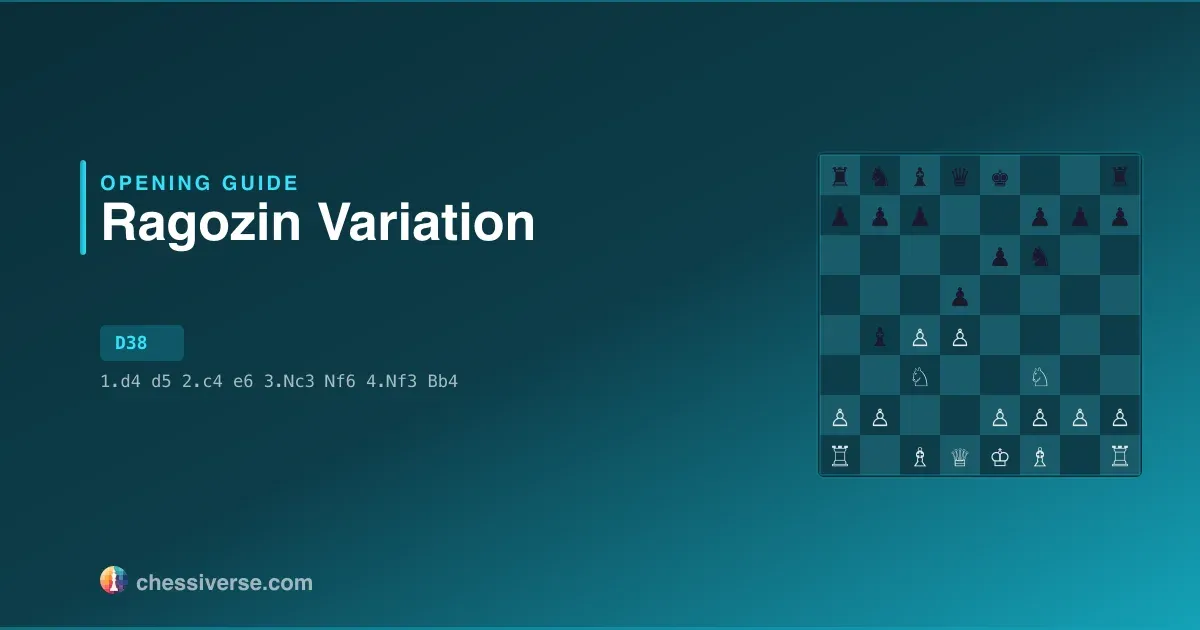
The Ragozin Variation begins with 1.d4 d5 2.c4 e6 3.Nc3 Nf6 4.Nf3 Bb4 (ECO D38). Black pins the c3-knight and turns the QGD into a Nimzo-Indian hybrid. The Ragozin gets the bishop active before the door closes — and creates immediate tactical pressure on the d5/c4 complex.
Strategic Overview
The Ragozin is a fascinating cross-pollination of the QGD and the Nimzo-Indian. By playing ...Bb4 early, Black pins White's c3-knight and immediately puts pressure on the c4-pawn and the central squares. The set-up shares ideas with the Nimzo (pin the knight, control e4, create structural concessions for the bishop pair) but keeps the QGD pawn structure with ...d5 already on the board. White's most testing replies involve 5.Bg5, applying counter-pressure on the f6-knight and entering classical Ragozin theory. From there 5...h6 leads to the Moscow variation, while 5...dxc4 enters the sharp Vienna variation where Black trades the bishop pair for active piece play and an immediate pawn-grab. Both lines have rich theory and have been played at the very top level — Magnus Carlsen and other world-class players use the Ragozin as a serious main weapon against 1.d4. The middlegames that arise tend to be unbalanced and full of concrete content: pin-pressure on f6 and the c3-knight, the structural question of doubled c-pawns after a possible ...Bxc3, and the central tension that defines QGD-family openings. This is sophisticated opening play — solid in spirit but with real fighting chances built in.
Key Ideas
A few ideas come up again and again in this opening:
- Nimzo ideas with the QGD structure — The Ragozin transplants the Nimzo-Indian's ...Bb4 pin into a QGD pawn structure. Black gets the active bishop development of the Nimzo while keeping ...d5 on the board, creating a hybrid system with the best features of both openings.
- 5.Bg5 is the principled mainline — White applies counter-pressure with the standard QGD pin. The arising positions become genuinely sharp, with two competing pins (Bg5 on f6, ...Bb4 on c3) creating tactical tension and a rich strategic landscape.
- 5...h6 enters the Moscow variation — After 5.Bg5, the move ...h6 forces White to choose: trade on f6 (granting Black the bishop pair with structural compensation) or retreat. The Moscow variation has substantial modern theory and is a serious weapon at top level.
- 5...dxc4 is the sharp Vienna — Instead of ...h6, Black grabs the pawn with ...dxc4 in the Vienna variation. The arising positions are concrete and tactical — Black has material temporarily, White has piece activity, and accurate play is required from both sides.
History and Notable Players
It arises from the Queen's Gambit Declined: Three Knights Variation. On the White side, Aleksey Dreev (41 games), Shakhriyar Mamedyarov (34 games), Pia Cramling (28 games) top the database. Notable Black exponents: Aleksej Aleksandrov (157 games), Goran Dizdar (88 games), Ventzislav Inkiov (74 games).
Ragozin's opening research centred on ways for Black to equalise against the Queen's Gambit and in Nimzo-Indian structures, and this Queen's Gambit Declined line is one result. It hands Black active play immediately and has come back into fashion in recent times.
Named after: Named after the Soviet grandmaster Viacheslav Ragozin (1908-1962), a player, writer and editor whose work on opening theory gave the line its name.
Ragozin was also the second world correspondence chess champion and Mikhail Botvinnik's secret training partner - historians credit their private matches as a real factor in Botvinnik's world title success.
Performance Across Rating Levels
The picture changes a lot as you climb the rating ladder. The 1200 bracket has 465,433 games (0.07% of all games at that level); White wins 53%, Black 43.4%, 3.6% are drawn. At 1800 the opening surfaces in 0.17% of games; White wins 54.4%, Black 40.7%, draws 4.9%. At the top end (2500+ Elo), popularity is 0.38% with 11.3% draws — a clear sign of how much theory rules the line at master level. White's edge erodes by 7.3pp from 1200 to 2500 Elo, suggesting Black's counterplay is easier to find with experience.
Time Control Patterns
The Ragozin Variation skews toward blitz chess. In bullet, it appears in 0.13% of games (3,412,627); White wins 54.4%. Blitz shows 0.13% adoption across 4,783,298 games, White scoring 53.6%. In rapid, the share rises to 0.09% — 993,800 games, White 53.6%.
Move Diversity and Theory Depth
Looking at move selection shows how forcing — or not — the position really is. At 1200 Elo (464,405 games), the top reply is Bg5, played 25.7% of the time. Five other moves each take at least 5% of games, and the top three moves account for 60.9% of games. Entropy: 2.94. By 2500 (51,111 games), Bg5 is still the top reply, at 30.5%; only three other moves still reach 5% and the top three moves account for 79.5% of games. Entropy drops to 2.47.
Historical Trends
Long-term, the trajectory of this opening is informative. Adoption peaked in 2019 at 0.14% (395,050 games). By 2025 it sits at 0.11%, 23% below the peak but still 25% above its 2013 level, so the line is up over the full period despite easing from the high.
Main Lines and Variations
The main branches off 1.d4 d5 2.c4 e6 3.Nc3 Nf6 4.Nf3 Bb4 include:
Each branch leads to a different middlegame character — the resulting pawn structure decides what kind of game you get.
Common Mistakes
- Neglecting development — Extra pawn moves in the opening are tempting, especially when you "know the moves". Developing a piece each turn is the simple correction.
- Playing without a plan — Each Ragozin Variation middlegame demands a specific approach. Decide whether the position calls for attack, manoeuvre, or simplification before reaching for a move.
Practice on Chessiverse
Ready to try the Ragozin Variation against a bot? Pick an opponent at your level and play a game.