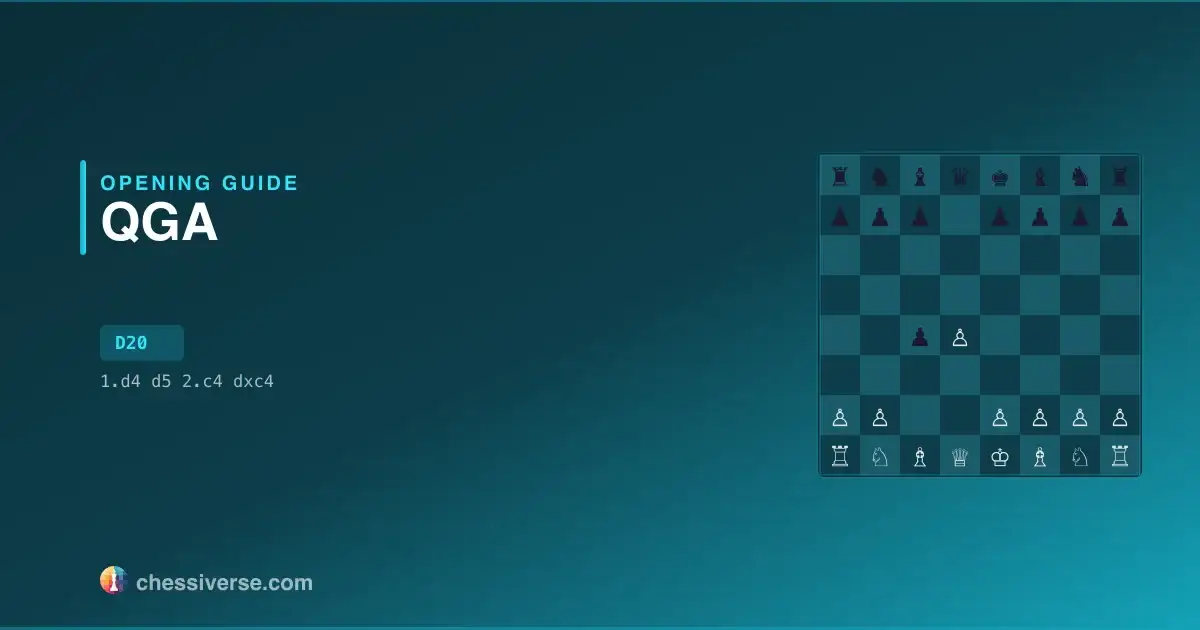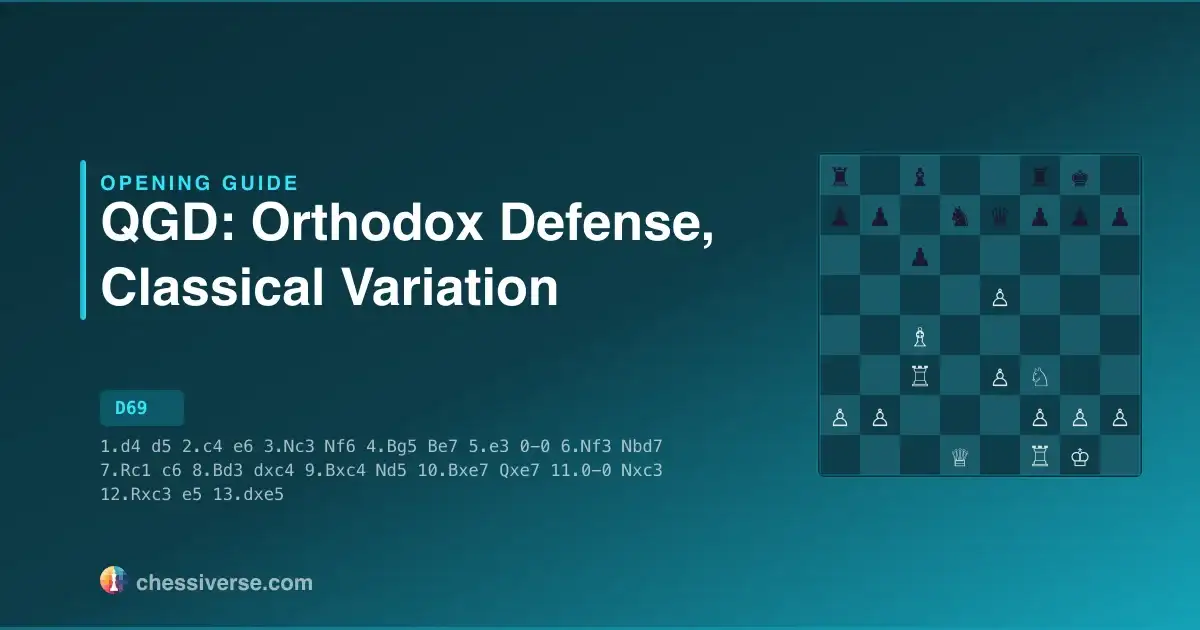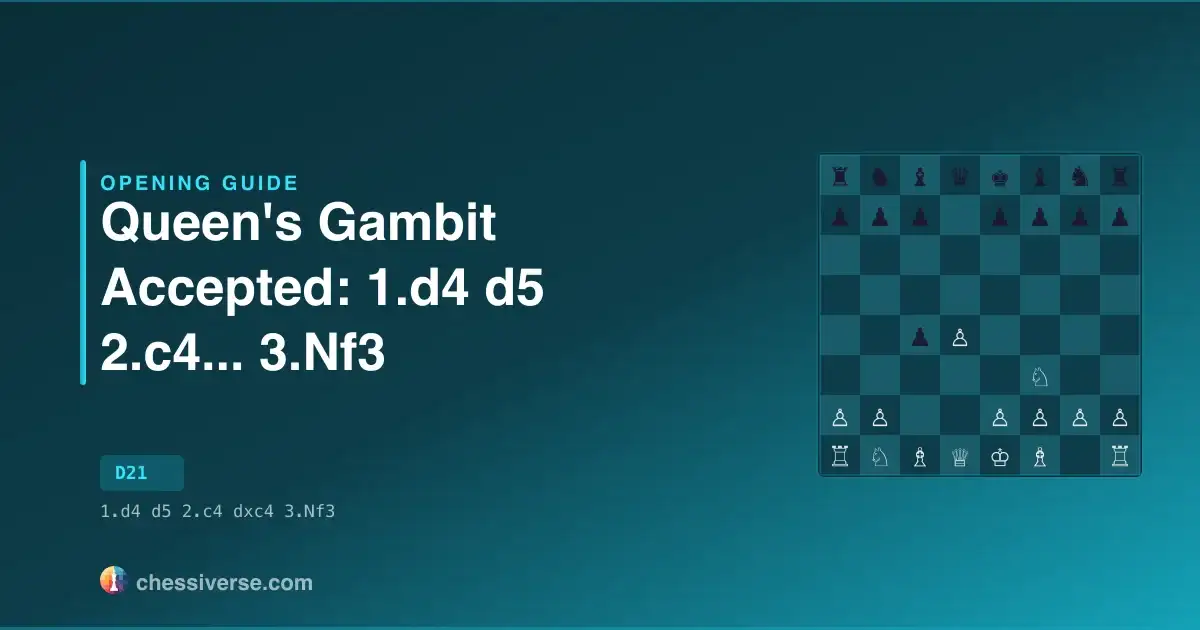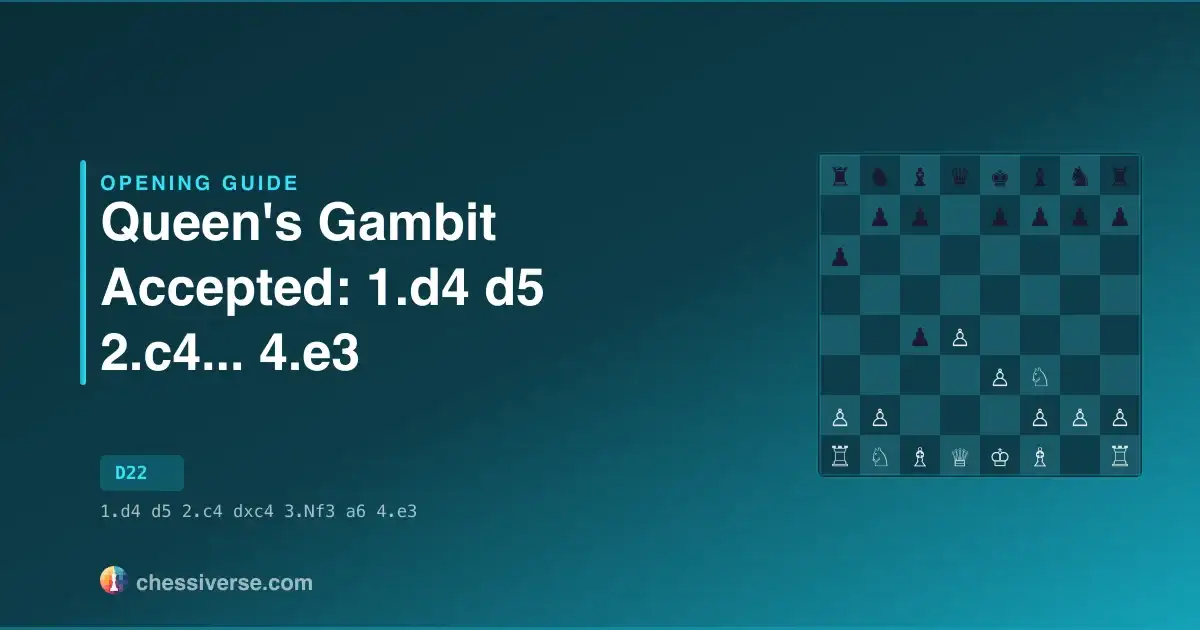


Queen's Gambit Declined: 1.d4 d5 2.c4...... 4.Nf3

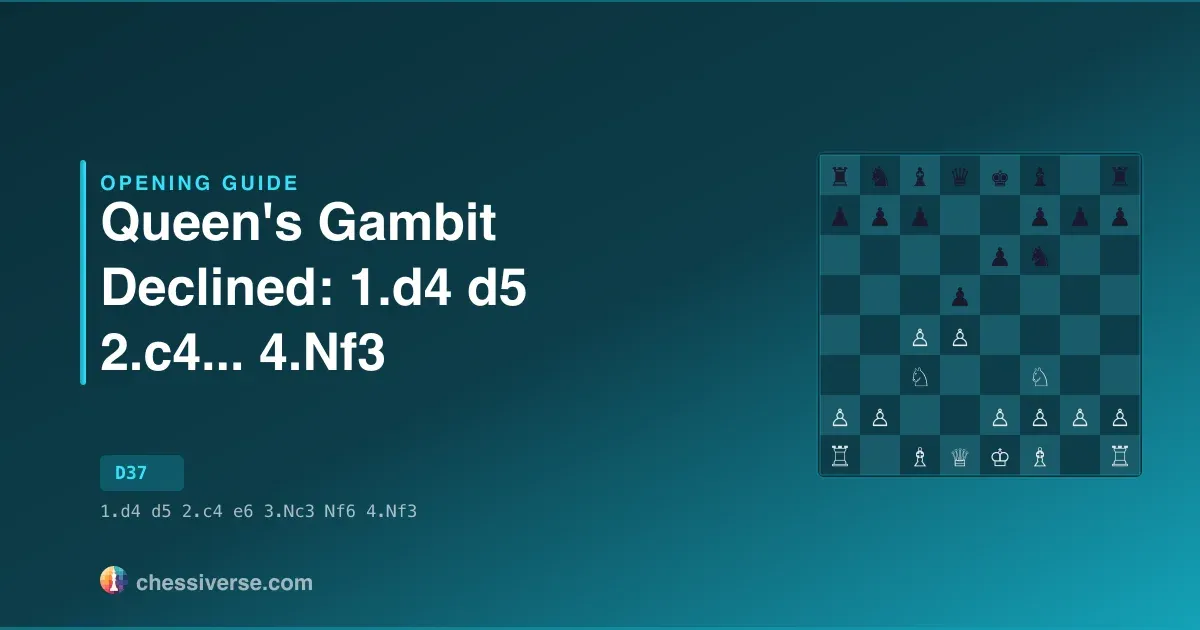
D371.d4 d5 2.c4 e6 3.Nc3 Nf6 4.Nf3
May 14, 2028
TL;DR

The most flexible QGD move order. White keeps Bg5, Bf4 and the Exchange all in reserve, and Black chooses among Lasker, Tartakower, Cambridge Springs and Ragozin systems. The classical-era tabiya behind countless world-championship games.

Reviewed by

IM John Bartholomew
IM John BartholomewCo-Founder & Chess Educator

International Master and chess educator. Co-founded Chessable and joined Chessiverse as co-founder. Best known for his "Climbing the Rating Ladder" YouTube series and structured opening courses.

Queen's Gambit Declined: 1.d4 d5 2.c4...... 4.Nf3: A Complete Guide
Queen's Gambit Declined: 1.d4 d5 2.c4...... 4.Nf3 - Opening Moves
Summary

1.d4 d5 2.c4 e6 3.Nc3 Nf6 4.Nf3 opens the Queen's Gambit Declined: 1.d4 d5 2.c4... 4.Nf3, ECO D37. Both sides have all four minor-piece developing moves left to play, and the central tension is at its peak. This is the QGD tabiya — the position from which a dozen serious classical lines branch off.

Strategic Overview

4.Nf3 is the flexible mainline. By developing the kingside knight before committing to any pawn or piece exchange, White keeps every option open: Bg5 for the Orthodox setups, cxd5 for the Exchange, e3 for the calmer Nimzo-style positions, or even Bf4 for the modern queenside-bishop systems. Black's choice on move four largely determines the strategic direction of the entire game. The standard QGD ideas remain in play — solid development, fight for the centre, careful piece coordination — but the specific structural decision can produce wildly different middlegames. Lines like the Lasker Defence (...Ne4), Tartakower (...b6), Cambridge Springs (...Nbd7 then ...Qa5), and the Ragozin (...Bb4) all branch from positions reachable shortly after 4.Nf3. This is one of the most important positions in classical chess opening theory and has been played in countless world championship games. The character of the eventual middlegame depends almost entirely on which specific system both sides commit to over the next few moves.

Key Ideas

When players succeed in this line, they usually do so by leaning on the following themes:

  • Maximum flexibility for both sides — 4.Nf3 doesn't commit to any specific pawn structure or piece exchange. White retains the choice of Bg5, cxd5, e3, or Bf4 setups, and Black has equally many strategic options. The next two moves will determine the entire middlegame character.
  • The classical Orthodox QGD lurks here — Many of the heaviest classical theoretical battles — the Orthodox, Lasker, Tartakower, Cambridge Springs — start from positions very close to this one. Knowing the typical plans matters more than memorising specific move-orders.
  • Black's fourth move chooses the system — Whether Black plays ...Be7 (Orthodox), ...Bb4 (Ragozin), or ...Nbd7 (Cambridge Springs setup) effectively chooses the entire strategic direction. Each system has its own distinct ideas and middlegame patterns.

History and Notable Players

It arises from the Queen's Gambit Declined: 1.d4 d5 2.c4... Nf6. On the White side, Aleksey Dreev (187 games), Ivan Farago (160 games), Loek Van Wely (156 games) top the database. Notable Black exponents: Alexander G Beliavsky (154 games), Aleksej Aleksandrov (150 games), Evgeny Sveshnikov (141 games).

Performance Across Rating Levels

The picture changes a lot as you climb the rating ladder. Among 1200-rated players, it appears in 0.15% of games — 986,949 of them on record — with White winning 52% and Black 44.3%. Move up to 1800 Elo and the share shifts to 0.59%, with White winning 51.4% versus Black's 43.3%. Among 2500-rated players the line appears in 1.71% of games and draws spike to 11.7%, indicating tight preparation. White's edge erodes by 5.7pp from 1200 to 2500 Elo, suggesting Black's counterplay is easier to find with experience.

Time Control Patterns

The Queen's Gambit Declined: 1.d4 d5 2.c4... 4.Nf3 skews toward bullet chess. In bullet, it appears in 0.48% of games (12,742,255); White wins 52.3%. Blitz shows 0.44% adoption across 15,788,708 games, White scoring 51.3%. In rapid, the share rises to 0.25% — 2,795,540 games, White 51.3%.

Move Diversity and Theory Depth

Move choice is far from uniform in the Queen's Gambit Declined: 1.d4 d5 2.c4... 4.Nf3. At 1200 Elo, the top reply is Bb4, played 41.4% of the time. There are 6 other moves seeing meaningful share, and 67.2% of games stick to established theory. Entropy: 2.76. By 2500, Be7 dominates at 29.1% of replies; only 7 viable alternatives remain and 62.7% of moves are theory. Entropy drops to 2.76. Even elite players don't fully agree on the best continuation here, which keeps the position dynamic.

Main Lines and Variations

From the position after 1.d4 d5 2.c4 e6 3.Nc3 Nf6 4.Nf3, the recognised continuations are:

Each branch leads to a different middlegame character — the resulting pawn structure decides what kind of game you get.

Common Mistakes

  • Neglecting development — Extra pawn moves in the opening are tempting, especially when you "know the moves". Developing a piece each turn is the simple correction.
  • Overextending the attack — Gambits look like permission to throw everything forward. They aren't — every attacking move should improve a piece. Random checks and threats burn the initiative once they fail to coordinate.

Practice on Chessiverse

Ready to try the Queen's Gambit Declined: 1.d4 d5 2.c4... 4.Nf3 against a bot? Pick an opponent at your level and play a game.

Quick Facts

Main Line1.d4 d5 2.c4 e6 3.Nc3 Nf6 4.Nf3
DifficultyAdvanced
Style

Theoretician openings have deep, well-studied lines where knowledge of specific variations gives a significant advantage. Preparation and memorization of key lines are essential.

18,620,475games on Lichess
51.3%
5.4%
43.3%
White wins Draws Black wins

Top Players

As White

Data from Lichess opening explorer (blitz & rapid)

Most Popular At2500
SharpnessSharp

Popularity by Rating

Percentage of all games at each rating bracket that feature this opening.

Data from Lichess opening explorer (blitz & rapid games)

Theory Adherence by Rating

How often players choose the single most popular move at this position. Higher = more predictable play.

Black to move after the opening line

Popularity Over Time

Share of all Lichess blitz + rapid games featuring this opening, by year.

Top Moves by Rating

Black to move after the opening line

RatingMost Popular2nd3rd
400Bb434.2%Nc622.3%dxc412.3%
1000Bb439.5%Nc617.3%c510.3%
1200Bb441.4%c513.3%Nc612.5%
1400Bb438.9%c515.6%Be712.7%
1600Bb432%Be719.7%c515.6%
1800Be727.5%Bb424.7%c614.6%
2000Be734.7%c618.8%Bb418.5%
2200Be737.9%c618.1%Bb415.8%
2500Be729.1%Bb419.7%c614%

Popularity by Time Control

Bullet
0.48%12.7M
Blitz
0.44%15.8M
Rapid
0.25%2.8M
3% more decisive in bullet
Raw data tables (Lichess blitz + rapid)
Queen's Gambit Declined: 1.d4 d5 2.c4...... 4.Nf3: popularity and win rates by player rating
Rating (Elo)Share %GamesWhite win %Black win %Draw %Sharpness
4000.0376,12952.144.53.40.966
10000.08336,33052.044.43.60.964
12000.15986,94952.044.33.70.963
14000.242,170,50052.143.94.00.960
16000.383,812,88351.843.64.50.955
18000.594,997,33251.443.35.30.947
20000.883,986,70651.042.76.30.937
22001.202,020,49649.842.38.00.920
25001.71233,15046.342.111.70.883
Queen's Gambit Declined: 1.d4 d5 2.c4...... 4.Nf3: move-choice theory adherence by rating
Rating (Elo)Top moveTop move %Viable movesTheory %Entropy
400Bb434.2568.82.812
1000Bb439.5567.12.764
1200Bb441.4667.22.764
1400Bb438.9667.32.807
1600Bb432.0467.32.876
1800Be727.5466.72.842
2000Be734.7471.92.710
2200Be737.9671.82.613
2500Be729.1762.72.760
Queen's Gambit Declined: 1.d4 d5 2.c4...... 4.Nf3: popularity over time
YearShare %GamesWhite win %Black win %Draw %
20130.3610,38453.042.54.5
20140.3632,76552.342.75.0
20150.4497,21952.342.94.8
20160.42256,45052.942.05.1
20170.42478,84552.442.65.0
20180.44827,51351.943.05.0
20190.441,258,93251.643.35.1
20200.442,528,91151.542.85.7
20210.403,061,13951.343.15.5
20220.402,987,42251.143.55.4
20230.393,063,48051.043.55.5
20240.372,750,64751.043.45.5
20250.352,619,62051.043.55.5
Queen's Gambit Declined: 1.d4 d5 2.c4...... 4.Nf3: popularity by time control
FormatShare %GamesWhite win %Black win %Draw %Sharpness
bullet0.4812,742,25552.344.33.40.966
blitz0.4415,788,70851.343.35.40.946
rapid0.252,795,54051.342.95.90.941
Queen's Gambit Declined: 1.d4 d5 2.c4...... 4.Nf3: top candidate moves by rating bracket
Rating (Elo)1st move1st %2nd move2nd %3rd move3rd %
400Bb434.2Nc622.3dxc412.3
1000Bb439.5Nc617.3c510.3
1200Bb441.4c513.3Nc612.5
1400Bb438.9c515.6Be712.7
1600Bb432.0Be719.7c515.6
1800Be727.5Bb424.7c614.6
2000Be734.7c618.8Bb418.5
2200Be737.9c618.1Bb415.8
2500Be729.1Bb419.7c614.0
Queen's Gambit Declined: 1.d4 d5 2.c4...... 4.Nf3: top practitioners by side
SidePlayerGames
WhiteAleksey Dreev187
WhiteIvan Farago160
WhiteLoek Van Wely156
BlackAlexander G Beliavsky154
BlackAleksej Aleksandrov150
BlackEvgeny Sveshnikov141

Frequently Asked Questions

What is the Queen's Gambit Declined: 1.d4 d5 2.c4... 4.Nf3?

The Queen's Gambit Declined: 1.d4 d5 2.c4... 4.Nf3 begins with 1.d4 d5 2.c4 e6 3.Nc3 Nf6 4.Nf3 and is classified under ECO code D37.

Is the Queen's Gambit Declined: 1.d4 d5 2.c4... 4.Nf3 good for beginners?

The Queen's Gambit Declined: 1.d4 d5 2.c4... 4.Nf3 can be played at any level. Beginners should focus on understanding the key strategic ideas rather than memorizing long theoretical lines. Our AI bots at various rating levels provide a great way to practice the opening concepts.

What are the main variations of the Queen's Gambit Declined: 1.d4 d5 2.c4... 4.Nf3?

The main continuations include: Ragozin Variation; Semi-Tarrasch Defence; Semi-Slav Defence. Each variation leads to distinct types of positions with their own strategic themes.

What are the win rates for the Queen's Gambit Declined: 1.d4 d5 2.c4... 4.Nf3?

In a database of 18,620,475 master games, White wins 51.3% of the time, Black wins 43.3%, and 5.4% are drawn. Notable players on the White side include Aleksey Dreev and Ivan Farago. On the Black side, Alexander G Beliavsky and Aleksej Aleksandrov are among the most frequent practitioners.

Reviewed by

IM John Bartholomew
IM John BartholomewCo-Founder & Chess Educator

International Master and chess educator. Co-founded Chessable and joined Chessiverse as co-founder. Best known for his "Climbing the Rating Ladder" YouTube series and structured opening courses.

Practice This Opening on Chessiverse

Play against 1000+ AI bots with unique personalities and opening repertoires. From beginner-friendly to grandmaster-level opponents, find the perfect sparring partner for any opening.

Play Now

Not sure which opening fits you? Take the free chess personality test — your style determines which openings will work with you.

Back to Articles