

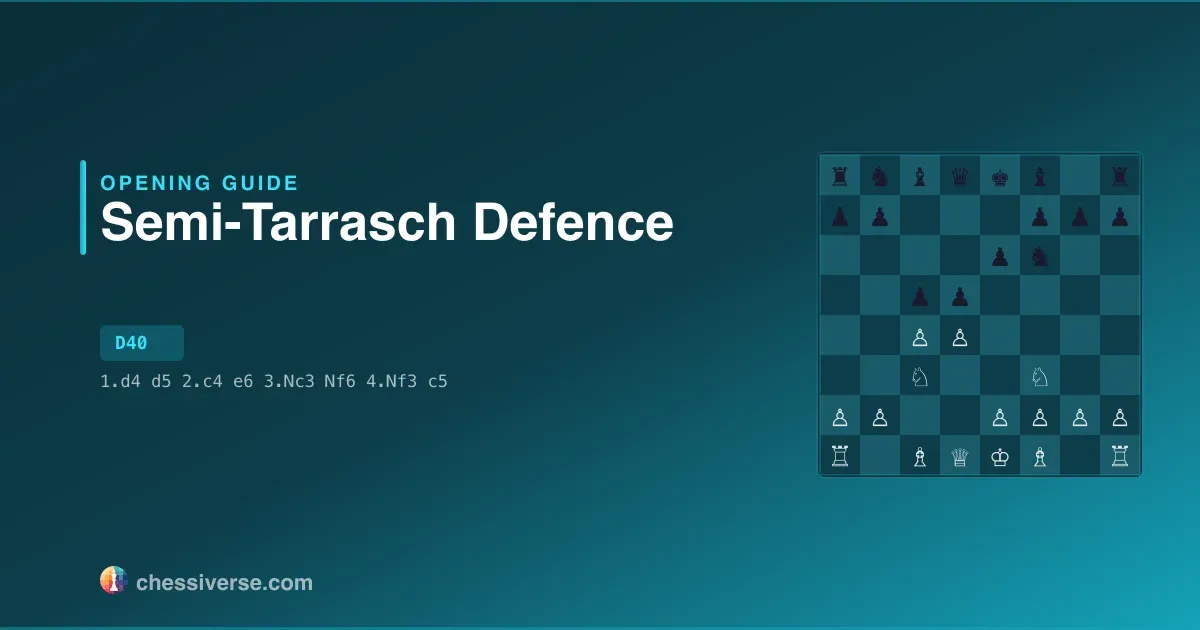
Starting from 1.d4 d5 2.c4 e6 3.Nc3 Nf6 4.Nf3 c5, players enter the Semi-Tarrasch Defense — ECO D40. Black gets the classical Tarrasch pawn break ...c5 without inheriting the isolated d-pawn that scares so many people away from the real thing. The cost is a little less central elbow room.
Strategic Overview
Black's 4...c5 challenges the centre right away, but the plan is sharper than it looks: after 5.cxd5, Black recaptures with the knight, not the pawn. That detail is the whole point. Recapturing with the pawn drops Black into a position where Bg5 is genuinely uncomfortable, so the knight steps in, the centre opens differently, and Black avoids the isolated queen pawn that gives the Tarrasch its reputation. The trade-off is space. White's pieces breathe more easily, and the position tends to have a small but durable spatial pull. From there, White's two big choices set the tone of the middlegame. 6.e3 is the calm version, building slowly with development and saving e4 for later, often steering into IQP-style structures only on Black's terms. 6.e4 is the principled try, claiming the centre at once and inviting a sharper fight where Black's piece play has to compensate for the space deficit. Both have been tested at the highest level for nearly a century. The Semi-Tarrasch suits players who want active, well-developed positions without the long-term structural burden of the genuine Tarrasch.
Key Ideas
The recurring motifs below distinguish a confident handler of this opening from a beginner:
- Knight recapture avoids the isolated d-pawn — The whole identity of the Semi-Tarrasch is recapturing on d5 with the knight rather than the pawn. That sidesteps the classic IQP structure Black accepts in the regular Tarrasch and keeps the pawn skeleton sounder.
- Black trades structure for a small space deficit — Once the knights and pawns settle, White typically enjoys a touch more central and queenside space. Black accepts this as the price of healthier pawns and easy piece development behind the lines.
- 6.e3 vs 6.e4 splits the system in two — 6.e3 is the positional path, with slow build-up and pressure on the queenside. 6.e4 stakes out the full centre at once and produces sharper, more tactical middlegames where Black must counterpunch with piece activity.
- Piece activity must compensate for less space — Because Black voluntarily cedes some central terrain, the bishops and knights need active squares. Quick development, timely exchanges, and well-timed central breaks keep Black from being slowly squeezed.
History and Notable Players
It arises from the Queen's Gambit Declined: Three Knights Variation. On the White side, Miguel Najdorf (22 games), Wolfgang Uhlmann (21 games), Tigran V Petrosian (17 games) top the database. Notable Black exponents: Ludek Pachman (38 games), Ivan Farago (37 games), Viktor Korchnoi (32 games).
A Queen's Gambit Declined variation with a long pedigree at the top level: Bobby Fischer used it against Tigran Petrosian in their 1971 Candidates match, and Ding Liren beat Hikaru Nakamura with it at the 2022 Candidates on his way to winning the 2023 world championship.
Named after: Siegbert Tarrasch, the German master who championed the related Tarrasch Defense; in the 'semi' version Black plays ...c5 only after ...Nf6.
Notable players: Bobby Fischer, Wesley So, Ding Liren
Ding Liren's win over Hikaru Nakamura with the Semi-Tarrasch at the 2022 Candidates helped him qualify for the world championship match he went on to win in 2023.
Performance Across Rating Levels
How well the Semi-Tarrasch Defense works depends on what level you're playing at. The 1200 bracket has 176,945 games (0.03% of all games at that level); White wins 48.2%, Black 47.9%, 3.9% are drawn. By 1800, popularity is 0.09% and White's score is 50.1% to Black's 43.9%. At 2500, 0.21% of games go into this opening; draws sit at 14.4% — the line is well-mapped at this level. White's edge erodes by 4.7pp from 1200 to 2500 Elo, suggesting Black's counterplay is easier to find with experience.
Time Control Patterns
The Semi-Tarrasch Defense skews toward bullet chess. In bullet, it appears in 0.07% of games (1,810,313); White wins 49.3%. Blitz shows 0.06% adoption across 2,289,046 games, White scoring 49.2%. In rapid, the share rises to 0.04% — 478,120 games, White 48.7%.
Move Diversity and Theory Depth
Looking at move selection shows how forcing — or not — the position really is. At 1200 Elo (176,563 games), the top reply is Bg5, played 31.8% of the time. Four other moves each take at least 5% of games, and the top three moves account for 79.1% of games. Entropy: 2.46. By 2500 (28,313 games), cxd5 takes over as the top reply at 79.1%; only one other move still reaches 5% and the top three moves account for 97.9% of games. Entropy drops to 1.02. The narrowing is significant — strong players consolidate around a small set of best moves, while amateurs scatter across many plausible-looking options.
Historical Trends
Tracking the Semi-Tarrasch Defense year over year shows a clear story. Adoption peaked in 2019 at 0.07% (191,125 games). By 2025 it sits at 0.05%, 22% below the peak and roughly back to its 2013 level, leaving the line flat over the full period.
Main Lines and Variations
From the position after 1.d4 d5 2.c4 e6 3.Nc3 Nf6 4.Nf3 c5, the recognised continuations are:
Each branch leads to a different middlegame character — the resulting pawn structure decides what kind of game you get.
Common Mistakes
- Drifting away from main theory — At 400 Elo, the three most-played moves cover 69.6% of games, against 87.4% at 2000. The most popular deviation is dxc5 (played 10.8% of the time at 400, less so up top). It looks fine but quietly hands the better-prepared side an edge.
- Neglecting development — Extra pawn moves in the opening are tempting, especially when you "know the moves". Developing a piece each turn is the simple correction.
- Playing without a plan — Each Semi-Tarrasch Defense middlegame demands a specific approach. Decide whether the position calls for attack, manoeuvre, or simplification before reaching for a move.
Practice on Chessiverse
Ready to try the Semi-Tarrasch Defense against a bot? Pick an opponent at your level and play a game.