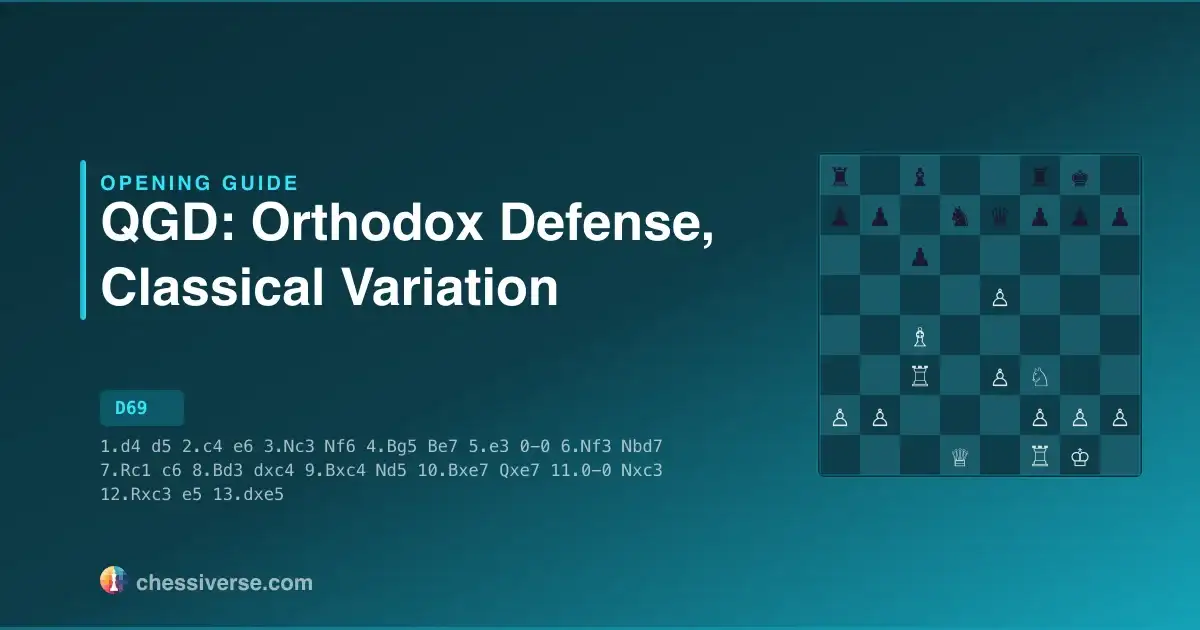




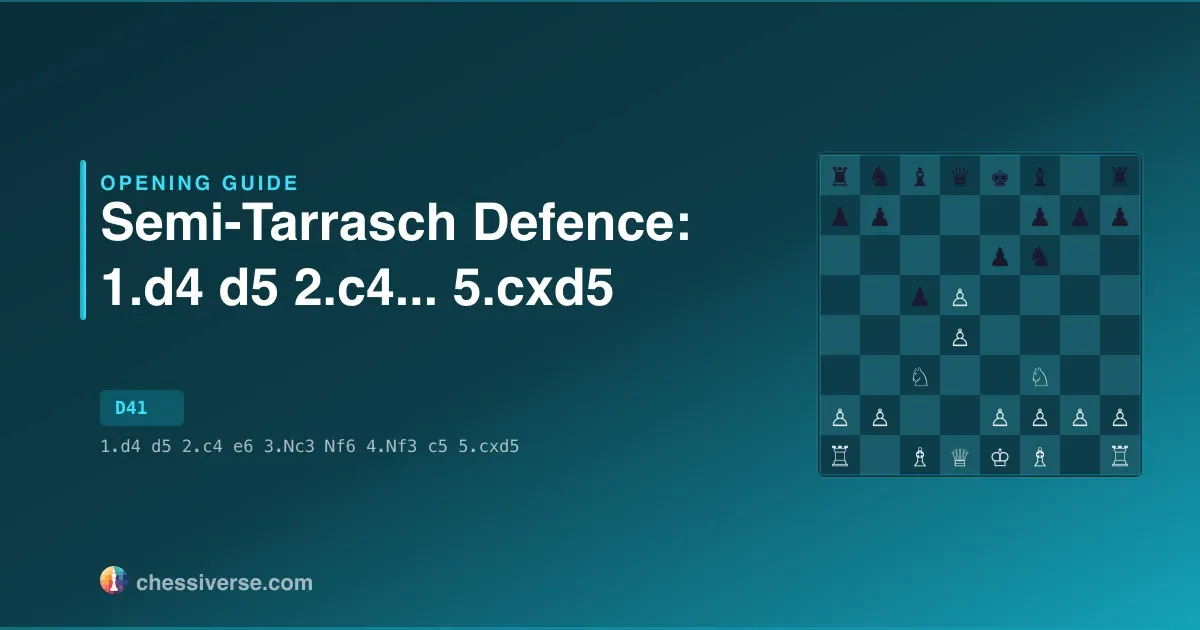
Starting from 1.d4 d5 2.c4 e6 3.Nc3 Nf6 4.Nf3 c5 5.cxd5, players enter the Queen's Gambit Declined: Semi-Tarrasch Defense — ECO D41. Across rating levels it shows up in 781,925 recorded games — enough data to map exactly where it succeeds and where it stalls.
History and Notable Players
It arises from the Semi-Tarrasch Defense. Among the most prolific White practitioners are Miguel Najdorf (20 games), Wolfgang Uhlmann (17 games), Shakhriyar Mamedyarov (14 games). Black-side regulars include Ivan Farago (33 games), Ludek Pachman (31 games), Viktor Korchnoi (27 games).
Performance Across Rating Levels
Popularity and results vary sharply by rating level. At 1200 Elo, the opening shows up in 0.01% of games (35,561 samples). White scores 48.1%, Black 47.7%, draws 4.2%. Move up to 1800 Elo and the share shifts to 0.02%, with White winning 51.5% versus Black's 42.2%. At the top end (2500+ Elo), popularity is 0.16% with 15% draws — a clear sign of how much theory rules the line at master level. White's edge erodes by 4.7pp from 1200 to 2500 Elo, suggesting Black's counterplay is easier to find with experience.
Time Control Patterns
Look at the same opening across time controls and blitz stands out. In bullet, it appears in 0.02% of games (428,483); White wins 48.6%. Blitz shows 0.02% adoption across 647,169 games, White scoring 49.5%. In rapid, the share rises to 0.01% — 133,184 games, White 50.2%.
Move Diversity and Theory Depth
What players actually play after the opening moves depends heavily on rating. At 1200 Elo (35,475 games), the top reply is exd5, played 56.3% of the time. Two other moves each take at least 5% of games, and the top three moves account for 99.5% of games. Entropy: 1.37. By 2500 (22,402 games), Nxd5 takes over as the top reply at 57.1%; two other moves reach 5% and the top three moves account for 100% of games. Entropy rises to 1.42.
Main Lines and Variations
The main branches off 1.d4 d5 2.c4 e6 3.Nc3 Nf6 4.Nf3 c5 5.cxd5 include:
Each branch leads to a different middlegame character — the resulting pawn structure decides what kind of game you get.
Common Mistakes
- Neglecting development — It can feel productive to make extra pawn moves early, but falling behind in piece development is what loses most amateur games — especially in open positions where active pieces find squares fast.
- Playing without a plan — Each Queen's Gambit Declined: Semi-Tarrasch Defense middlegame demands a specific approach. Decide whether the position calls for attack, manoeuvre, or simplification before reaching for a move.
Practice on Chessiverse
Ready to try the Queen's Gambit Declined: Semi-Tarrasch Defense against a bot? Pick an opponent at your level and play a game.