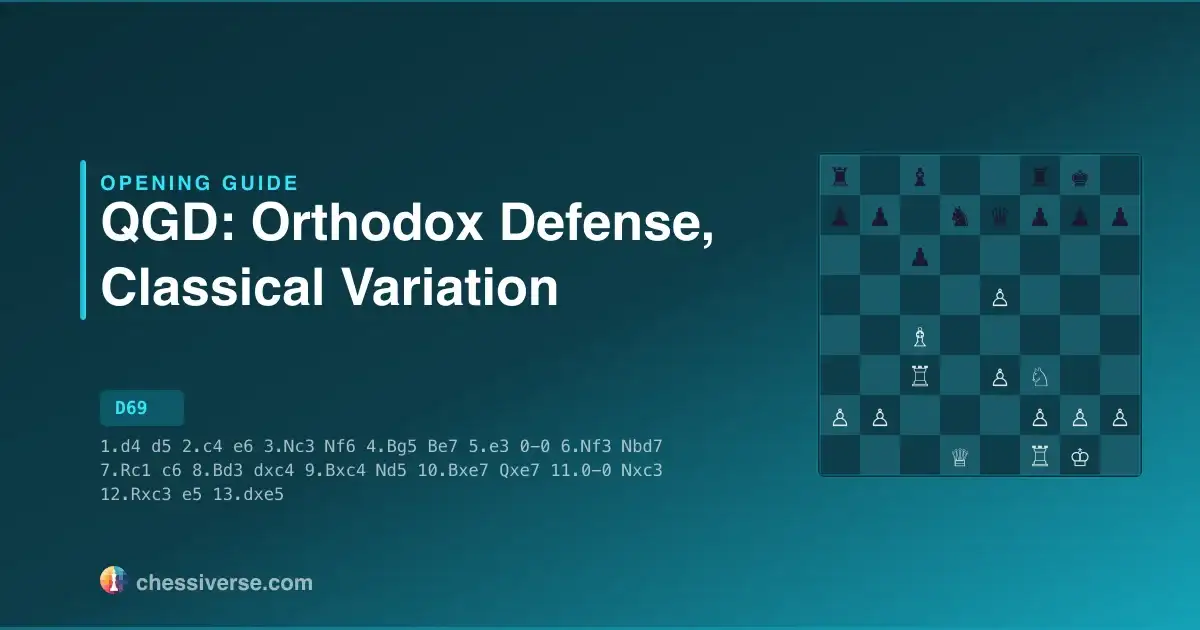


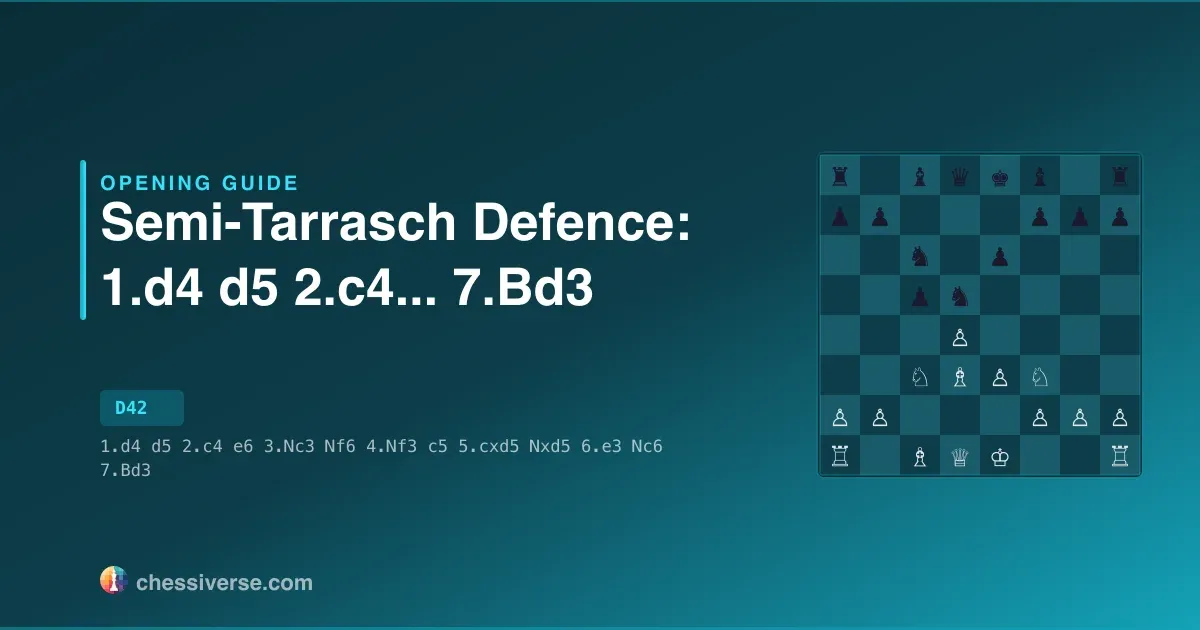
1.d4 d5 2.c4 e6 3.Nc3 Nf6 4.Nf3 c5 5.cxd5 Nxd5 6.e3 Nc6 7.Bd3 opens the Queen's Gambit Declined: Semi-Tarrasch Defense, Main Line, ECO D42. Lichess records 19,814 games in this line, which gives us a reliable view of how it actually performs in practice.
History and Notable Players
It arises from the Queen's Gambit Declined: Semi-Tarrasch Defense. Among the most prolific White practitioners are Yuri L Averbakh (8 games), Lajos Portisch (7 games), Wolfgang Uhlmann (7 games). Black-side regulars include Ludek Pachman (14 games), Ivan Farago (11 games), Arthur Bernard Bisguier (8 games).
Move Diversity and Theory Depth
Move choice is far from uniform in the Queen's Gambit Declined: Semi-Tarrasch Defense, Main Line. At 1200 Elo (755 games), the top reply is cxd4, played 38.6% of the time. Two other moves each take at least 5% of games, and the top three moves account for 71.6% of games. Entropy: 2.75. By 2500 (1,262 games), Be7 takes over as the top reply at 55.6%; only one other move still reaches 5% and the top three moves account for 98% of games. Entropy drops to 1.30. The narrowing is significant — strong players consolidate around a small set of best moves, while amateurs scatter across many plausible-looking options.
Common Mistakes
- Drifting away from main theory — At 1000 Elo, the three most-played moves cover 75.9% of games, against 91.5% at 2000. The most popular deviation is Nxc3 (played 31.6% of the time at 1000, much less so up top). It looks fine but quietly hands the better-prepared side an edge.
- Neglecting development — It can feel productive to make extra pawn moves early, but falling behind in piece development is what loses most amateur games — especially in open positions where active pieces find squares fast.
- Playing without a plan — Each Queen's Gambit Declined: Semi-Tarrasch Defense, Main Line middlegame demands a specific approach. Decide whether the position calls for attack, manoeuvre, or simplification before reaching for a move.
Practice on Chessiverse
Ready to try the Queen's Gambit Declined: Semi-Tarrasch Defense, Main Line against a bot? Pick an opponent at your level and play a game.