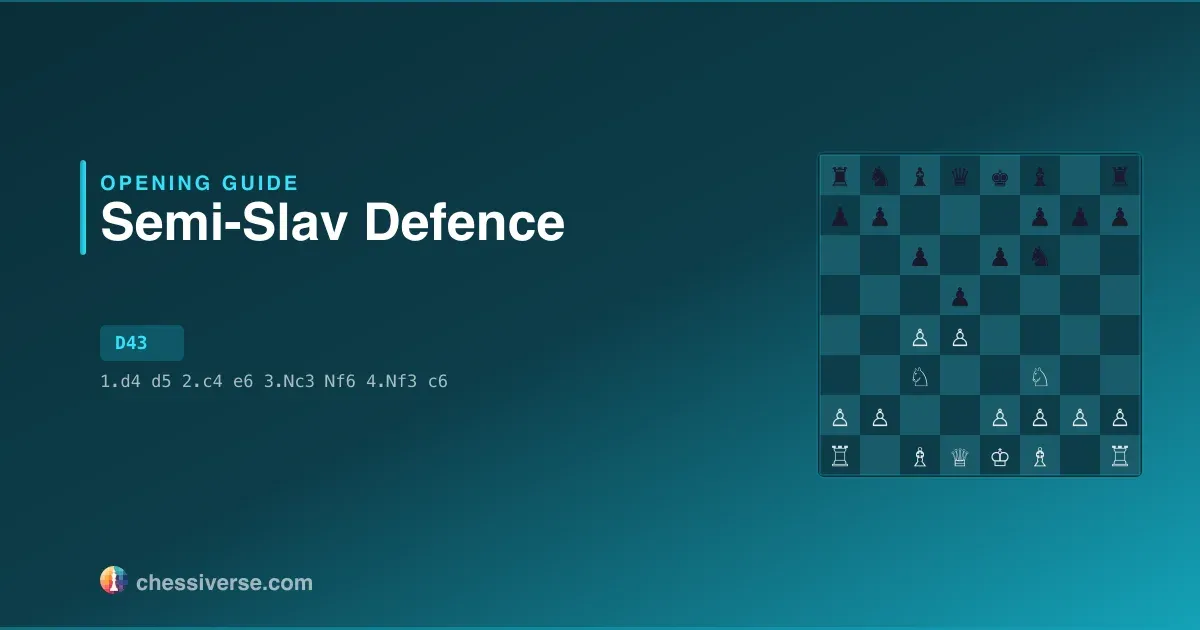
Starting from 1.d4 d5 2.c4 e6 3.Nc3 Nf6 4.Nf3 c6, players enter the Semi-Slav Defense — ECO D43. One of the deepest theoretical battlegrounds in modern chess, where Black voluntarily locks in the light-squared bishop in exchange for an ironclad centre and the promise of a well-timed ...e5 or ...c5 break.
Strategic Overview
The defining feature is that pawn triangle on c6, d5, e6. It looks passive, but it gives Black a centre that nothing immediately blows apart, plus two pawn breaks held in reserve. The bishop on c8 is the price, and freeing it is what most Semi-Slav plans are about. White's reply splits the system into two completely different games. 5.Bg5 leads into the Botvinnik and Moscow complexes, ferocious tactical territory where 5...dxc4 invites a pawn-grab race that has been analysed deep into endgames. The Moscow and Anti-Moscow lines with 5...h6 are calmer in name only; the resulting middlegames are dense with calculation. 5.e3 is the positional path. Here White usually picks between the main-line Meran with 6.Bd3 or one of the Anti-Meran setups, all aiming for a slow strategic squeeze. Sidelines have their own flavour: 5.cxd5 exchanges into Exchange Slav or QGD structures, and 5.g3 borrows the Catalan's fianchetto pressure. Across all of them the same themes recur: who gets the better minor pieces, when does ...e5 or ...c5 land cleanly, and who blinks first in the c-file or queenside scramble. Bring a fresh tank of theory.
Key Ideas
A few ideas come up again and again in this opening:
- The c6-d5-e6 triangle is the whole identity — Black sets up a triple pawn chain that defends the centre with pieces in reserve. It's solid, hard to undermine, and primes Black for either ...e5 or ...c5 once development is finished.
- Freeing the light-squared bishop is the long-term task — The bishop on c8 starts buried. Almost every Black plan revolves around eventually getting it out, usually via b7 after ...b5 or to f5/g4 once the centre opens.
- 5.Bg5 unleashes Botvinnik-style tactical chaos — After 5.Bg5 Black can grab the pawn with 5...dxc4 and enter the Botvinnik, or play the Moscow with 5...h6. Both are tactically loaded and require concrete preparation rather than general principles.
- 5.e3 is the positional Meran path — 5.e3 keeps things calmer. White often follows with 6.Bd3 for the main-line Meran or chooses an Anti-Meran to dodge Black's most analysed setups. The fight is for structure and minor-piece quality.
- Sideline 5.g3 borrows Catalan ideas — Fianchettoing the bishop sidesteps Semi-Slav theory entirely and pressures Black's queenside along the long diagonal. Expect Catalan-flavoured middlegames where Black still has to find a clean break.
History and Notable Players
It arises from the Queen's Gambit Declined: Three Knights Variation. On the White side, Loek Van Wely (85 games), Alexander G Beliavsky (74 games), Ivan Sokolov (72 games) top the database. Notable Black exponents: Aleksey Dreev (313 games), Evgeny Sveshnikov (222 games), Oleg Korneev (167 games).
The key Meran Variation dates back to the 1906 game Schlechter-Perlis, and it takes its name from the northern Italian town of Meran, where at a 1924 tournament Ernst Grünfeld beat Rubinstein with it and then Spielmann two rounds later. It still appears at the top level, notably in the 2008 world championship match between Kramnik and Anand.
Named after: Its pawn structure rather than a person: Black combines the Slav Defense move ...c6 with the Orthodox Queen's Gambit Declined move ...e6.
Notable players: Ernst Grünfeld
When Garry Kasparov faced the computer Deep Junior in 2003, he trusted the Semi-Slav's sharp Shirov-Shabalov Gambit (7.g4) — and won the game.
Performance Across Rating Levels
The picture changes a lot as you climb the rating ladder. Among 1200-rated players, it appears in 0.04% of games — 299,781 of them on record — with White winning 52% and Black 44.3%. Move up to 1800 Elo and the share shifts to 0.33%, with White winning 50.7% versus Black's 44%. At the top end (2500+ Elo), popularity is 0.65% with 9.7% draws — a clear sign of how much theory rules the line at master level. White's edge erodes by 3.2pp from 1200 to 2500 Elo, suggesting Black's counterplay is easier to find with experience.
Time Control Patterns
Time control matters here: bullet players reach for this opening more than others. In bullet, it appears in 0.23% of games (6,174,268); White wins 52.2%. Blitz shows 0.23% adoption across 8,158,721 games, White scoring 51.1%. In rapid, the share rises to 0.11% — 1,265,267 games, White 50.6%.
Move Diversity and Theory Depth
Looking at move selection shows how forcing — or not — the position really is. At 1200 Elo (299,159 games), the top reply is Bg5, played 47.5% of the time. Three other moves each take at least 5% of games, and the top three moves account for 79.1% of games. Entropy: 2.36. By 2500 (88,897 games), Bg5 is still the top reply, at 45.9%; three other moves reach 5% and the top three moves account for 88.3% of games. Entropy drops to 1.98.
Historical Trends
Year-over-year data tells you whether this opening is a contemporary fixture or a fading one. Adoption peaked in 2015 at 0.28% (63,276 games). By 2025 it sits at 0.18%, 38% below the peak and 13% under its 2013 level, leaving the line in decline.
Main Lines and Variations
The main branches off 1.d4 d5 2.c4 e6 3.Nc3 Nf6 4.Nf3 c6 include:
Each branch leads to a different middlegame character — the resulting pawn structure decides what kind of game you get.
Common Mistakes
- Drifting away from main theory — At 400 Elo, the three most-played moves cover 74.2% of games, against 82.4% at 2000. The most popular deviation is e3 (played 24.5% of the time at 400, less so up top). It looks fine but quietly hands the better-prepared side an edge.
- Neglecting development — Extra pawn moves in the opening are tempting, especially when you "know the moves". Developing a piece each turn is the simple correction.
- Releasing tension too early — The c4/d5 tension is the heart of these openings. Capturing or pushing prematurely usually surrenders the initiative.
Practice on Chessiverse
Ready to try the Semi-Slav Defense against a bot? Pick an opponent at your level and play a game.