



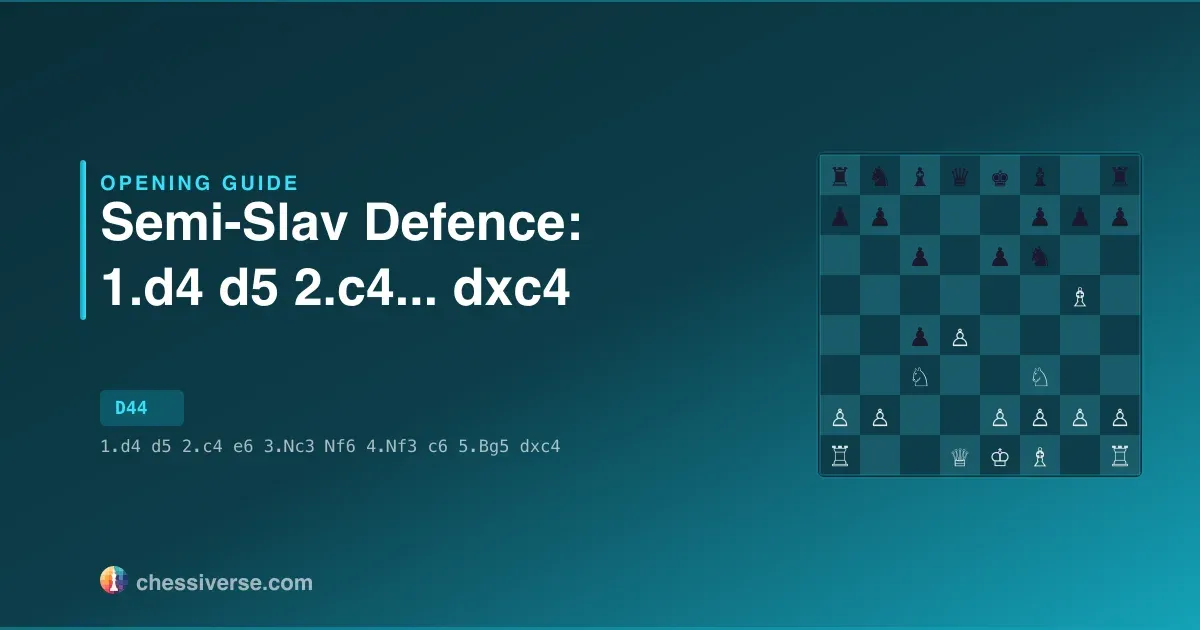
Starting from 1.d4 d5 2.c4 e6 3.Nc3 Nf6 4.Nf3 c6 5.Bg5 dxc4, players enter the Semi-Slav Defense Accepted — ECO D44. Lichess records 455,962 games in this line, which gives us a reliable view of how it actually performs in practice.
History and Notable Players
It arises from the Semi-Slav Defense. On the White side, Predrag Nikolic (17 games), Miso Cebalo (16 games), Loek Van Wely (15 games) top the database. Notable Black exponents: Oleg Korneev (33 games), Alexei Shirov (32 games), Peter Lukacs (27 games).
Performance Across Rating Levels
How well the Semi-Slav Defense Accepted works depends on what level you're playing at. At 1200 Elo, the opening shows up in 0.00% of games (7,867 samples). White scores 54.2%, Black 42.4%, draws 3.5%. At 1800 the opening surfaces in 0.01% of games; White wins 46.7%, Black 48.9%, draws 4.4%. Among 2500-rated players the line appears in 0.08% of games and draws spike to 7.4%, indicating tight preparation. White's edge erodes by 6.8pp from 1200 to 2500 Elo, suggesting Black's counterplay is easier to find with experience.
Time Control Patterns
Look at the same opening across time controls and bullet stands out. In bullet, it appears in 0.01% of games (332,924); White wins 50.8%. Blitz shows 0.01% adoption across 406,269 games, White scoring 47.2%. In rapid, the share rises to 0.00% — 48,894 games, White 45.9%. White's score swings 4.9pp across formats, so time control isn't just a stylistic choice here — it shifts the actual results.
Move Diversity and Theory Depth
Looking at move selection shows how forcing — or not — the position really is. At 1200 Elo (7,849 games), the top reply is e4, played 46% of the time. One other move takes at least 5% of games, and the top three moves account for 93.2% of games. Entropy: 1.62. By 2500 (10,722 games), e4 dominates at 77% of replies; one other move reaches 5% and the top three moves account for 98.6% of games. Entropy drops to 1.02. The narrowing is significant — strong players consolidate around a small set of best moves, while amateurs scatter across many plausible-looking options.
Historical Trends
Year-over-year data tells you whether this opening is a contemporary fixture or a fading one. Adoption peaked in 2015 at 0.013% (2,788 games). By 2025 it sits at 0.008%, 38% below the peak but still 42% above its 2013 level, so the line is up over the full period despite easing from the high.
Common Mistakes
- Neglecting development — Extra pawn moves in the opening are tempting, especially when you "know the moves". Developing a piece each turn is the simple correction.
- Releasing tension too early — The c4/d5 tension is the heart of these openings. Capturing or pushing prematurely usually surrenders the initiative.
Practice on Chessiverse
Ready to try the Semi-Slav Defense Accepted against a bot? Pick an opponent at your level and play a game.