



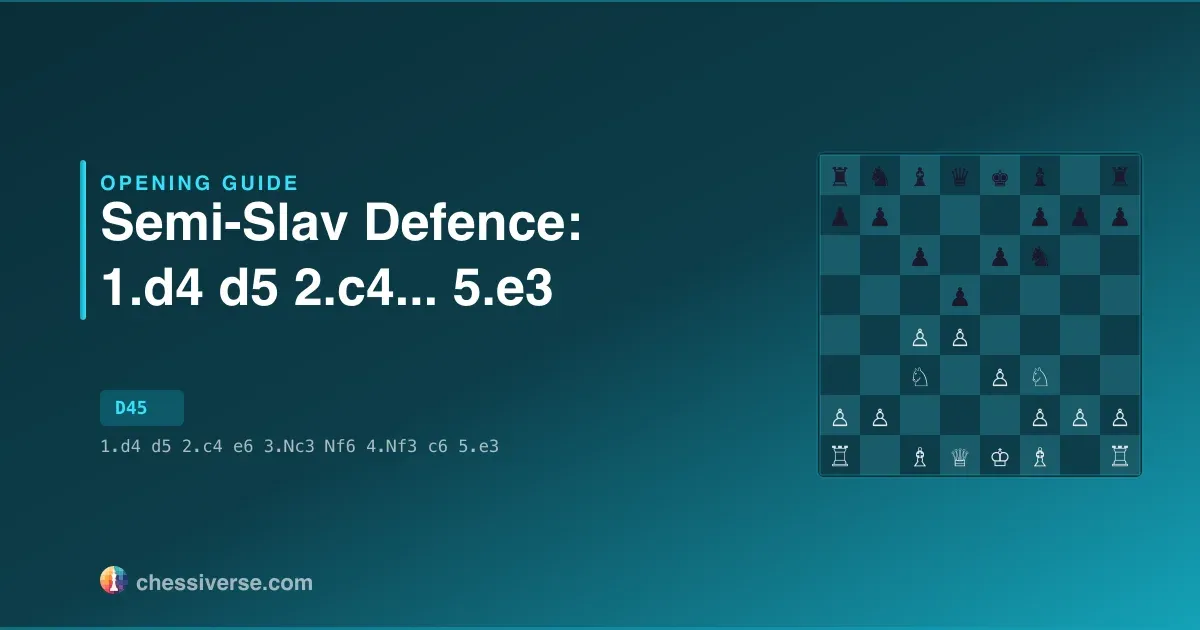
1.d4 d5 2.c4 e6 3.Nc3 Nf6 4.Nf3 c6 5.e3 opens the Semi-Slav Defense: Main Line, ECO D45. With 4,694,758 games on record, the patterns below come from the largest practical sample available.
History and Notable Players
It arises from the Semi-Slav Defense. On the White side, Ivan Farago (98 games), Boris Gelfand (91 games), Anatoly Karpov (89 games) top the database. Notable Black exponents: Aleksey Dreev (201 games), Alexei Shirov (121 games), Evgeny Sveshnikov (118 games).
Performance Across Rating Levels
How well the Semi-Slav Defense: Main Line works depends on what level you're playing at. The 1200 bracket has 230,919 games (0.03% of all games at that level); White wins 51.8%, Black 44.3%, 3.9% are drawn. At 1800 the opening surfaces in 0.15% of games; White wins 49.8%, Black 44.9%, draws 5.3%. Among 2500-rated players the line appears in 0.39% of games and draws spike to 10%, indicating tight preparation. Positions also become less sharp as level rises (sharpness 0.96 → 0.90).
Time Control Patterns
Look at the same opening across time controls and bullet stands out. In bullet, it appears in 0.11% of games (2,931,814); White wins 51.8%. Blitz shows 0.11% adoption across 3,946,317 games, White scoring 50.3%. In rapid, the share rises to 0.07% — 740,138 games, White 50.5%.
Move Diversity and Theory Depth
Looking at move selection shows how forcing — or not — the position really is. At 1200 Elo (230,519 games), the top reply is Bb4, played 42.9% of the time. Three other moves each take at least 5% of games, and the top three moves account for 69.8% of games. Entropy: 2.66. By 2500 (53,367 games), Nbd7 takes over as the top reply at 81.4%; only two other moves still reach 5% and the top three moves account for 93.1% of games. Entropy drops to 1.11. The narrowing is significant — strong players consolidate around a small set of best moves, while amateurs scatter across many plausible-looking options.
Historical Trends
Long-term, the trajectory of this opening is informative. Adoption peaked in 2015 at 0.18% (39,422 games). By 2025 it sits at 0.08%, 54% below the peak and 52% under its 2013 level, leaving the line in decline.
Main Lines and Variations
From the position after 1.d4 d5 2.c4 e6 3.Nc3 Nf6 4.Nf3 c6 5.e3, the recognised continuations are:
Each branch leads to a different middlegame character — the resulting pawn structure decides what kind of game you get.
Common Mistakes
- Drifting away from main theory — At 400 Elo, the three most-played moves cover 66.3% of games, against 80.1% at 2000. The most popular deviation is dxc4 (played 5.7% of the time at 400, much less so up top). It looks fine but quietly hands the better-prepared side an edge.
- Neglecting development — Extra pawn moves in the opening are tempting, especially when you "know the moves". Developing a piece each turn is the simple correction.
- Releasing tension too early — The c4/d5 tension is the heart of these openings. Capturing or pushing prematurely usually surrenders the initiative.
Practice on Chessiverse
Ready to try the Semi-Slav Defense: Main Line against a bot? Pick an opponent at your level and play a game.