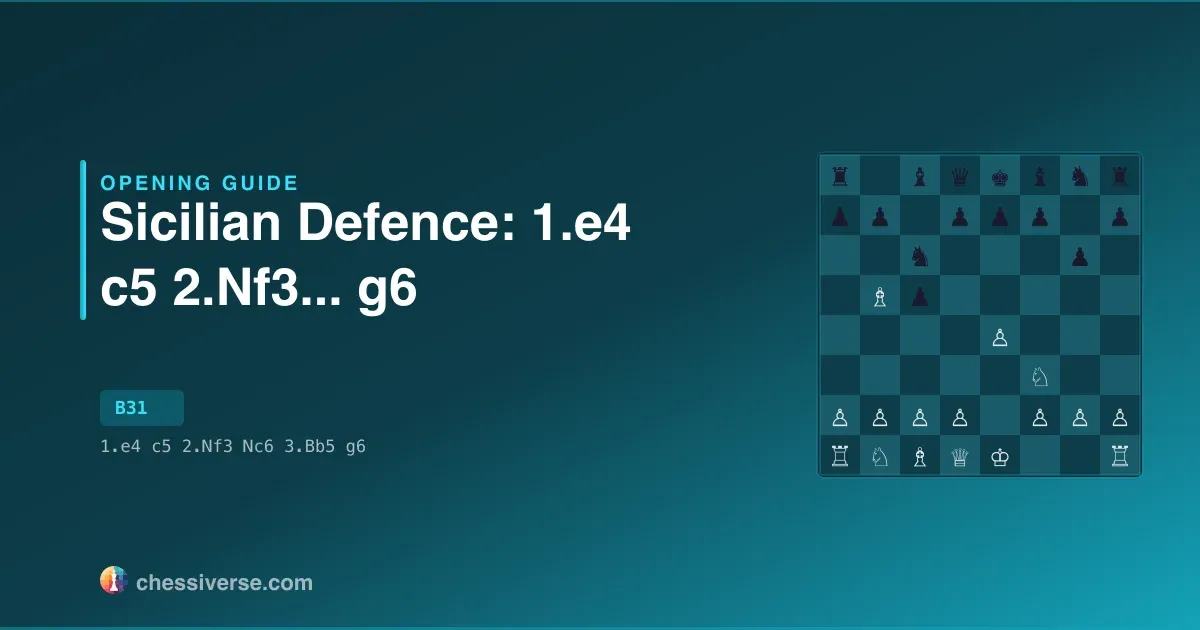
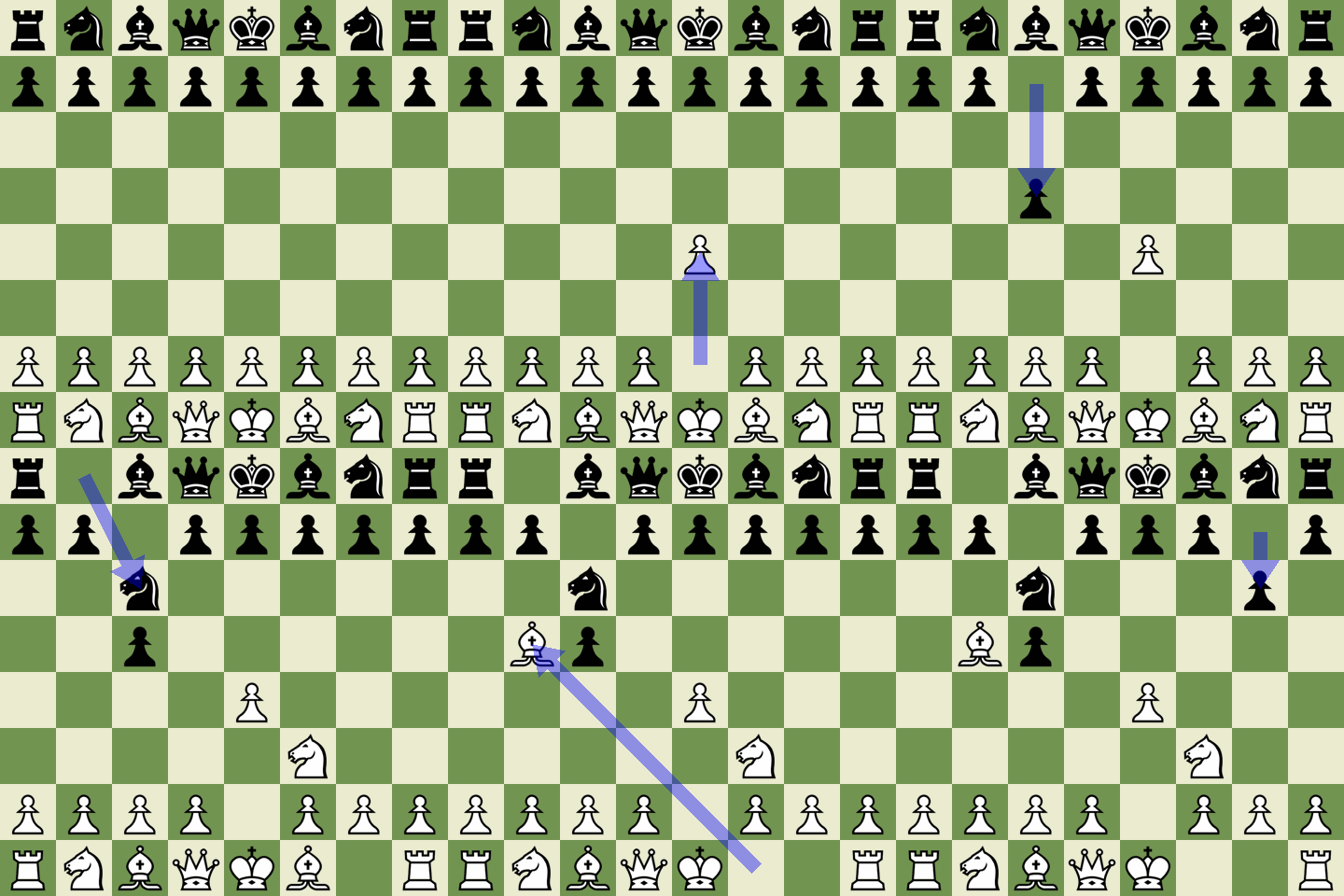
Starting from 1.e4 c5 2.Nf3 Nc6 3.Bb5 g6, players enter the Sicilian Defense: Nyezhmetdinov-Rossolimo Attack, Fianchetto Variation — ECO B31. Black fianchettoes the bishop and dares White to commit. The Rossolimo with ...g6 is the modern, flexible answer that keeps options open on both flanks.
Strategic Overview
The 3...g6 Rossolimo is one of the most respected ways to handle 3.Bb5, and it's been a staple at the top level for years. Black's plan is to develop quickly with ...Bg7, ...Nf6 (or sometimes a delayed knight development), and castle short, building a King's Indian style kingside while keeping the option to play ...a6 to question the bishop at the right moment. The strategic core is the d4 outpost: if Black can land a knight there, often after maneuvering, the position is comfortable. White's options are split — recapture on c6 immediately with Bxc6 to inflict doubled c-pawns and steer toward an endgame, or maintain the bishop and try to build a slow positional advantage. The doubled-pawn lines often turn into pure positional grinds where White has the cleaner structure and Black has the bishop pair and dynamic potential. The non-trade lines lead to more open middlegames where Black's flexible setup and queenside pawn play (often with ...a5, ...b5 ideas) provide real counterplay. The whole line is solid, theoretically deep, and gives Black a clear plan without needing to memorize a wall of sharp variations.
Key Ideas
The recurring motifs below distinguish a confident handler of this opening from a beginner:
- The d4 outpost is the strategic target — A Black knight on d4 is the dream square in this line. Maneuvering toward it — often with the c6-knight or a rerouted f6-knight — is one of Black's main long-term plans.
- Doubled c-pawns are a recurring theme — If White trades on c6, Black's doubled c-pawns are a structural concession but come with the bishop pair as compensation. The endgames are subtle and often favor White slightly, but with active play Black is fine.
- ...a6 is a tool, not a default — Black holds ...a6 in reserve to question the bishop at the right moment. Playing it too early commits, playing it too late lets White consolidate — timing is part of the strategic skill in this line.
- Queenside counterplay with ...a5 and ...b5 — Black often expands on the queenside to grab space and create pawn breaks. The combination of the g7-bishop and queenside pawn pressure makes for a balanced, two-sided middlegame.
History and Notable Players
It arises from the Sicilian Defense: Rossolimo Variation. Among the most prolific White practitioners are Vladislav Nevednichy (41 games), Eduardas Rozentalis (40 games), Petr Velicka (35 games). Black-side regulars include Vyacheslav Ikonnikov (49 games), Rauf Mamedov (47 games), Zigurds Lanka (45 games).
Performance Across Rating Levels
How well the Sicilian Defense: Nyezhmetdinov-Rossolimo Attack, Fianchetto Variation works depends on what level you're playing at. Among 1200-rated players, it appears in 0.03% of games — 180,793 of them on record — with White winning 48.2% and Black 48.1%. Move up to 1800 Elo and the share shifts to 0.08%, with White winning 48.8% versus Black's 46.2%. At the top end (2500+ Elo), popularity is 0.52% with 9.6% draws — a clear sign of how much theory rules the line at master level. White's score improves by 3.7pp from the 1200 bracket to the 2500 bracket — the line rewards preparation.
Time Control Patterns
Time control matters here: blitz players reach for this opening more than others. In bullet, it appears in 0.04% of games (1,144,722); White wins 50.1%. Blitz shows 0.08% adoption across 2,822,252 games, White scoring 49.5%. In rapid, the share rises to 0.05% — 510,990 games, White 47.7%. White's score swings 2.4pp across formats, so time control isn't just a stylistic choice here — it shifts the actual results.
Move Diversity and Theory Depth
Looking at move selection shows how forcing — or not — the position really is. At 1200 Elo (180,793 games), the top reply is Bxc6, played 44.6% of the time. Five other moves each take at least 5% of games, and the top three moves account for 77.1% of games. Entropy: 2.34. By 2500 (70,861 games), O-O takes over as the top reply at 51%; only two other moves still reach 5% and the top three moves account for 98.5% of games. Entropy drops to 1.38. The narrowing is significant — strong players consolidate around a small set of best moves, while amateurs scatter across many plausible-looking options.
Historical Trends
Year-over-year data tells you whether this opening is a contemporary fixture or a fading one. Adoption peaked in 2020 at 0.08% (486,774 games). By 2025 it sits at 0.07%, 17% below the peak but still 55% above its 2013 level, so the line is up over the full period despite easing from the high.
Common Mistakes
- Drifting away from main theory — At 400 Elo, the three most-played moves cover 76.6% of games, against 92.3% at 2000. The most popular deviation is Nc3 (played 10.8% of the time at 400, much less so up top). It looks fine but quietly hands the better-prepared side an edge.
- Neglecting development — It can feel productive to make extra pawn moves early, but falling behind in piece development is what loses most amateur games — especially in open positions where active pieces find squares fast.
- Ignoring the kingside attack — In sharp Sicilian lines, White typically castles long and pushes the h-pawn. Without your own counterplay on the queenside or in the centre, White's attack lands first.
Practice on Chessiverse
Ready to try the Sicilian Defense: Nyezhmetdinov-Rossolimo Attack, Fianchetto Variation against a bot? Pick an opponent at your level and play a game.