



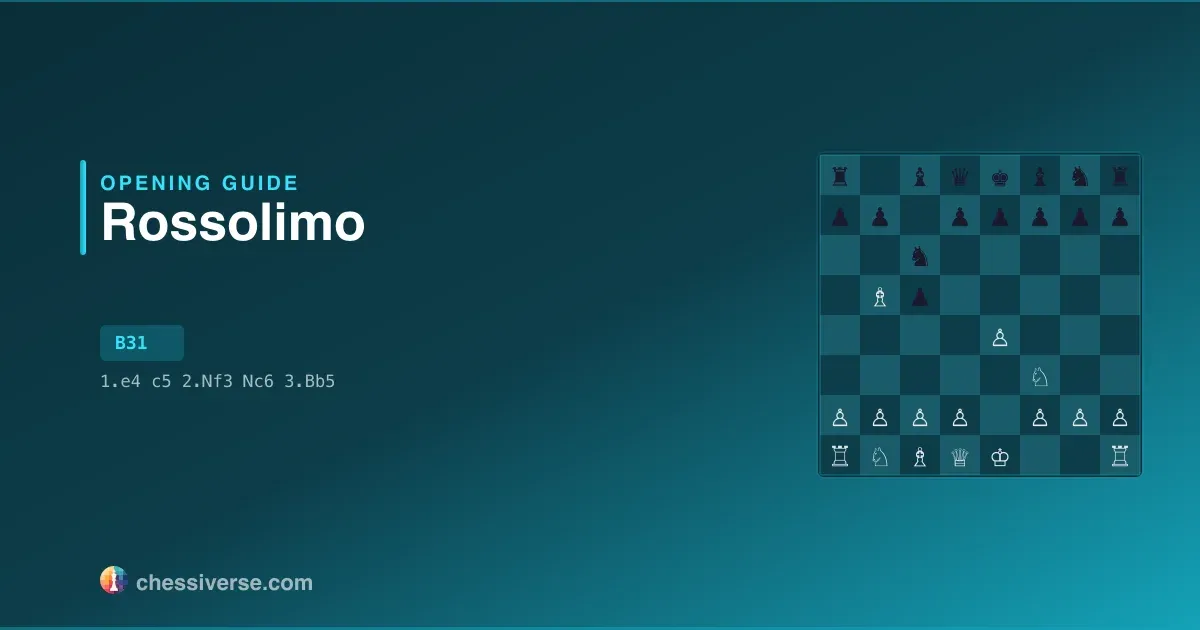
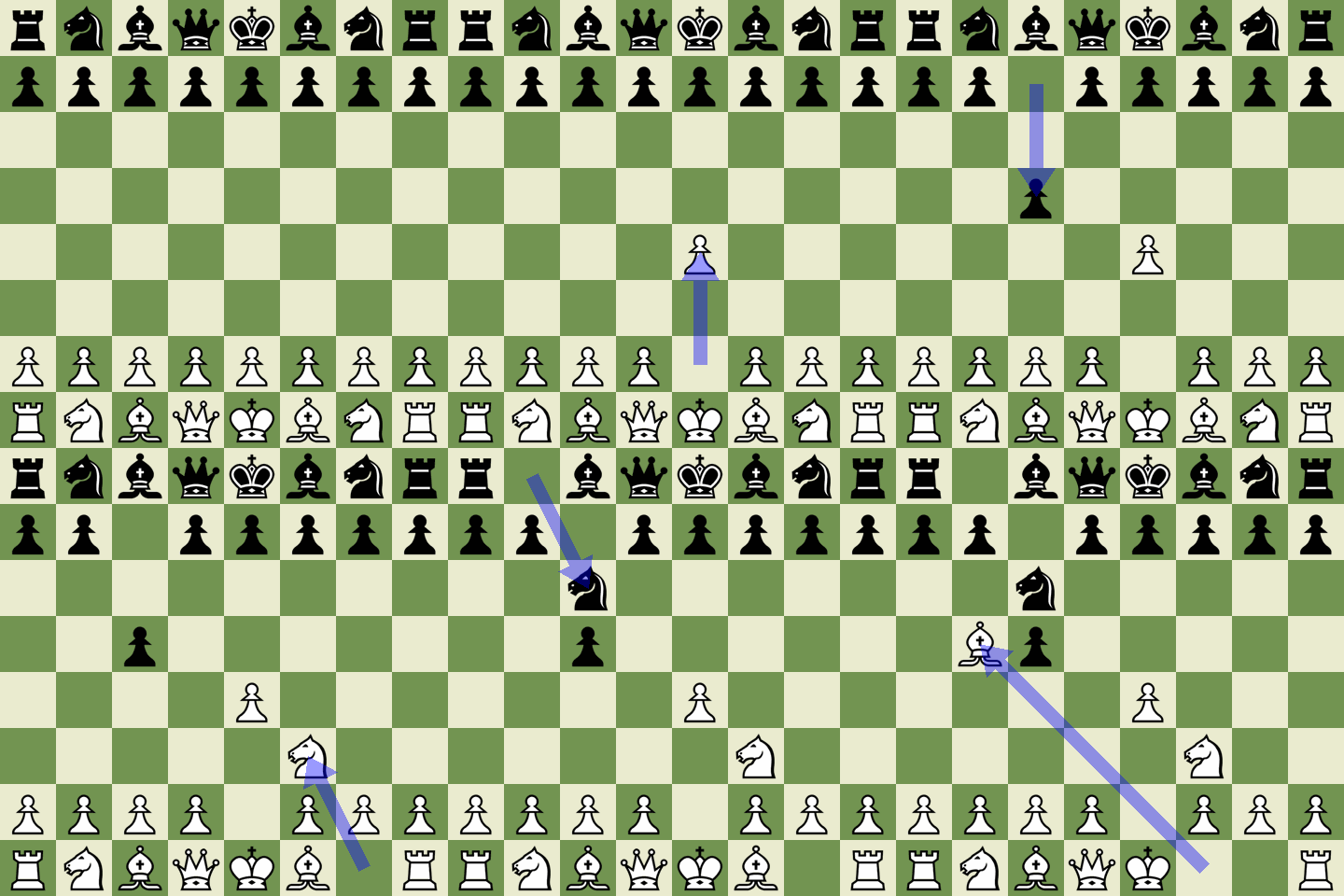
The Sicilian Defense: Rossolimo Variation arises after 1.e4 c5 2.Nf3 Nc6 3.Bb5 and falls under ECO code B30. By placing the bishop on b5, White targets the c6 knight in a manner reminiscent of the Ruy Lopez. The crucial distinction, however, is that in the Rossolimo, White frequently intends to capture the knight and inflict structural damage on Black's queenside, aiming for a long-term positional edge that often proves especially valuable in endgames. Black has several ways to respond to 3.Bb5. The most popular is 3...g6, preparing a Dragon-style fianchetto of the king's bishop. White then has a choice: 4. Bxc6 to immediately compromise Black's pawn structure, 4. O-O Bg7 5. c3 with plans to expand in the center via d4, or 4. c3 right away to prepare the same d4 advance. With 16.1 million Lichess games across all rating levels, it is a well-established opening choice.
- White is often happy to trade the b5-bishop for the c6-knight whenever that leaves Black with doubled pawns, either at once or after being provoked.
- White castles quickly and stays flexible in the centre, choosing between d3 or preparing d4 with Re1 and c3.
- It is a practical way to dodge the sharp, heavily analysed open Sicilians.
History and Notable Players
It arises from the Sicilian Defense (2.Nf3). Among the most prolific practitioners on the White side are Vladislav Nevednichy (41 games), Eduardas Rozentalis (40 games), Petr Velicka (35 games). On the Black side, notable exponents include Vyacheslav Ikonnikov (49 games), Rauf Mamedov (47 games), Zigurds Lanka (45 games).
Rossolimo first played 3.Bb5 against the 2...Nc6 Sicilian in 1948, and Rashid Nezhmetdinov took it up in 1956. It later became a respected top-level weapon because it offers White chances of an opening advantage without entering the wild complications of the open Sicilians, notably the sharp Sveshnikov.
Named after: Named for Nicolas Rossolimo (1910-1975), a Kyiv-born grandmaster who won the French Championship and the U.S. Open and championed 3.Bb5.
Notable players: Nicolas Rossolimo, Rashid Nezhmetdinov
Away from the board Rossolimo drove a New York taxi, sang Russian songs, held a judo brown belt and ran a Greenwich Village chess studio visited by Marcel Duchamp - and his artistry earned him many brilliancy prizes.
Statistics
Based on 16.1 million Lichess games across all rating levels:
- White wins: 50%
- Black wins: 45.2%
- Draws: 4.8%
The statistics show a roughly balanced opening where both sides have equal chances.
Main Lines and Variations
After 1.e4 c5 2.Nf3 Nc6 3.Bb5, the main continuations include:
Each of these lines leads to distinct types of positions and requires its own understanding of the resulting pawn structures and piece placements.
Practice on Chessiverse
The best way to learn the Sicilian Defense: Rossolimo Variation is through practice. On Chessiverse, you can play chess against computer opponents that specialize in this opening. Our AI bots range from beginner to grandmaster level, each with unique playing styles — from aggressive attackers to solid defenders. Choose a bot that matches your rating and work your way up as you master the opening's key ideas.
Performance Across Rating Levels
How well the Sicilian Defense: Rossolimo Variation works depends on what level you're playing at. The 1200 bracket has 1,364,895 games (0.20% of all games at that level); White wins 49.6%, Black 46.7%, 3.7% are drawn. Move up to 1800 Elo and the share shifts to 0.44%, with White winning 50.2% versus Black's 45%. Among 2500-rated players the line appears in 1.20% of games and draws spike to 9.5%, indicating tight preparation.
Time Control Patterns
Time control matters here: blitz players reach for this opening more than others. In bullet, it appears in 0.20% of games (5,439,013); White wins 49.8%. Blitz shows 0.36% adoption across 13,093,765 games, White scoring 50.1%. In rapid, the share rises to 0.27% — 2,975,216 games, White 49.7%.
Move Diversity and Theory Depth
Looking at move selection shows how forcing — or not — the position really is. At 1200 Elo (1,364,895 games), the top reply is a6, played 22.9% of the time. Eight other moves each take at least 5% of games, and the top three moves account for 54% of games. Entropy: 3.09. By 2500 (164,279 games), g6 takes over as the top reply at 43.3%; only four other moves still reach 5% and the top three moves account for 74.3% of games. Entropy drops to 2.48. The narrowing is significant — strong players consolidate around a small set of best moves, while amateurs scatter across many plausible-looking options.
Historical Trends
Year-over-year data tells you whether this opening is a contemporary fixture or a fading one. Adoption peaked in 2019 at 0.42% (1,190,632 games). By 2025 it sits at 0.32%, 23% below the peak and roughly back to its 2013 level, leaving the line flat over the full period.