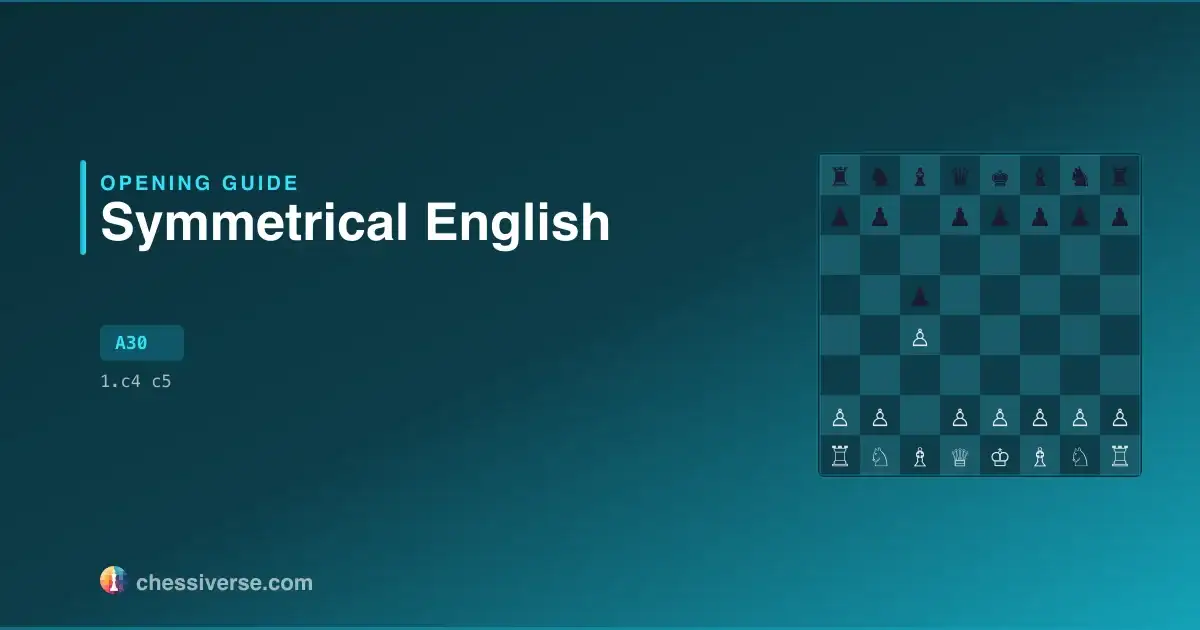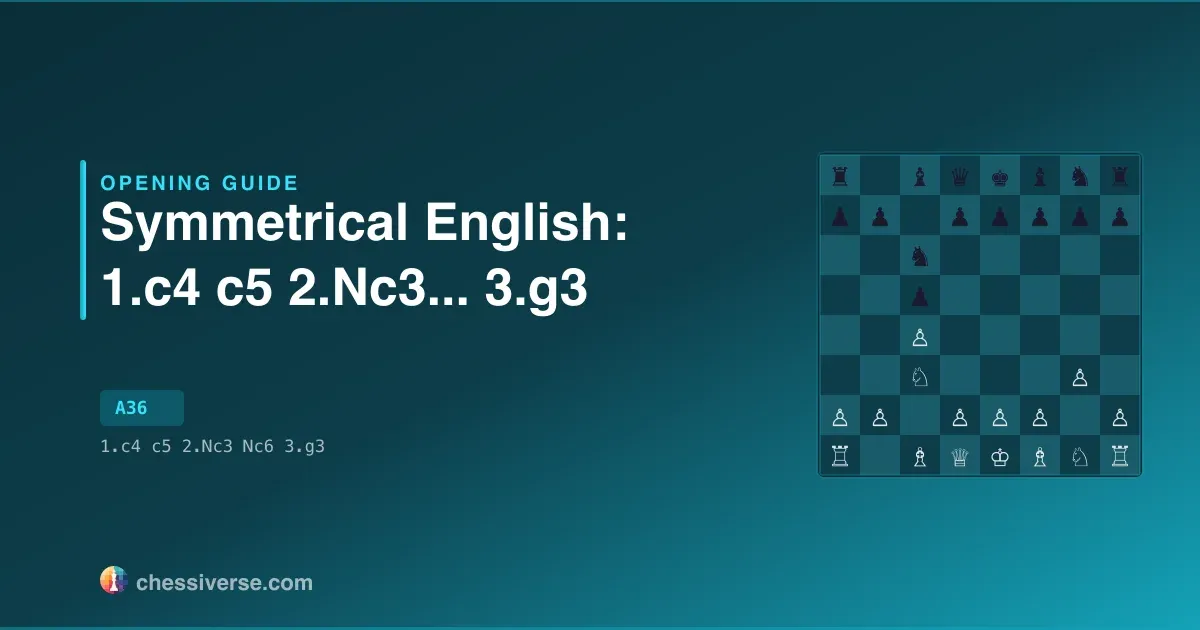
1.c4 c5 2.Nc3 Nc6 3.g3 opens the English Opening: Symmetrical Variation, Two Knights, Fianchetto Variation, ECO A36. White prepares the fianchetto and settles in for a long positional fight. The g2-bishop will pressure the long diagonal for the rest of the game, and both sides now play for slow improvements rather than quick breaks.
Strategic Overview
3.g3 commits White to the fianchetto setup that defines the best lines of the Symmetrical English. The plan is straightforward: Bg2, Nf3 (or sometimes Ne2 in Botvinnik-style positions), and 0-0, then choose between several pawn breaks based on Black's reply. The most common Black response is the matching ...g6 fianchetto, leading to a double-fianchetto structure where both bishops dominate the long diagonals. From there, both sides develop completely before any pawn break happens. White's plans include a4 followed by Rb1 and b4 for queenside expansion, or e3 and Nge2 preparing d4 for a central break. Black mirrors with similar ideas — ...a6 and ...Rb8 for queenside play, or ...e6 and ...d5 to challenge the center. The character of the middlegame is strategic and slow. Sharp tactics happen, but only after both sides have completed development and identified concrete targets. The tempo advantage gives White a small persistent edge, but Black has plenty of resources to hold the balance. This is an opening where understanding pawn structure and piece coordination matters far more than concrete preparation.
Key Ideas
The recurring motifs below distinguish a confident handler of this opening from a beginner:
- Fianchetto setup is the backbone — Bg2 and 0-0 form White's foundation. The g2-bishop pressures the long diagonal and will matter for the entire middlegame and often deep into the endgame.
- Choose between queenside expansion and central break — After full development, White picks between a4-Rb1-b4 for queenside play and e3-Nge2-d4 for a central break. Which one happens depends on Black's setup.
- Black mirrors with ...g6 most of the time — The double fianchetto is the cleanest equalizer. Both sides get balanced piece coordination and the game becomes about who can outmaneuver whom in the long game.
- Patience pays off in this structure — Premature attacks usually fail because both sides have solid pawn structures. The side that better understands when to commit to a pawn break wins the strategic battle.
History and Notable Players
It arises from the English Opening: Symmetrical Variation, Two Knights Variation. Among the most prolific White practitioners are Normunds Miezis (51 games), Karol Ruckschloss (12 games), Vladimir Volosin (11 games). Black-side regulars include Keith C Arkell (17 games), Normunds Miezis (12 games), Gyozo V Forintos (10 games).
Performance Across Rating Levels
The picture changes a lot as you climb the rating ladder. The 1200 bracket has 132,230 games (0.02% of all games at that level); White wins 52.8%, Black 43.3%, 3.9% are drawn. Move up to 1800 Elo and the share shifts to 0.07%, with White winning 51.3% versus Black's 43.1%. At 2500, 0.06% of games go into this opening; draws sit at 10.6% — the line is well-mapped at this level. White's edge erodes by 6.8pp from 1200 to 2500 Elo, suggesting Black's counterplay is easier to find with experience.
Time Control Patterns
Look at the same opening across time controls and blitz stands out. In bullet, it appears in 0.05% of games (1,291,887); White wins 52.4%. Blitz shows 0.05% adoption across 1,833,170 games, White scoring 51.4%. In rapid, the share rises to 0.03% — 361,449 games, White 51.7%.
Move Diversity and Theory Depth
Looking at move selection shows how forcing — or not — the position really is. At 1200 Elo (132,230 games), the top reply is g6, played 31.5% of the time. Five other moves each take at least 5% of games, and the top three moves account for 64.9% of games. Entropy: 2.69. By 2500 (8,100 games), g6 dominates at 79% of replies; only two other moves still reach 5% and the top three moves account for 93.8% of games. Entropy drops to 1.20. That entropy collapse is the signature of a line where preparation pays off: at the top, players know the best move and play it.
Historical Trends
Tracking the English Opening: Symmetrical Variation, Two Knights, Fianchetto Variation year over year shows a clear story. Adoption peaked in 2020 at 0.06% (315,860 games). By 2025 it sits at 0.05%, 17% below the peak but still 86% above its 2013 level, so the line is up over the full period despite easing from the high.
Main Lines and Variations
After 1.c4 c5 2.Nc3 Nc6 3.g3, the established follow-ups are:
Each branch leads to a different middlegame character — the resulting pawn structure decides what kind of game you get.
Common Mistakes
- Drifting away from main theory — At 400 Elo, the three most-played moves cover 62.2% of games, against 76.2% at 2000. The most popular deviation is e5 (played 15.9% of the time at 400, much less so up top). It looks fine but quietly hands the better-prepared side an edge.
- Neglecting development — It can feel productive to make extra pawn moves early, but falling behind in piece development is what loses most amateur games — especially in open positions where active pieces find squares fast.
- Playing without a plan — Each English Opening: Symmetrical Variation, Two Knights, Fianchetto Variation middlegame demands a specific approach. Decide whether the position calls for attack, manoeuvre, or simplification before reaching for a move.
Practice on Chessiverse
Ready to try the English Opening: Symmetrical Variation, Two Knights, Fianchetto Variation against a bot? Pick an opponent at your level and play a game.