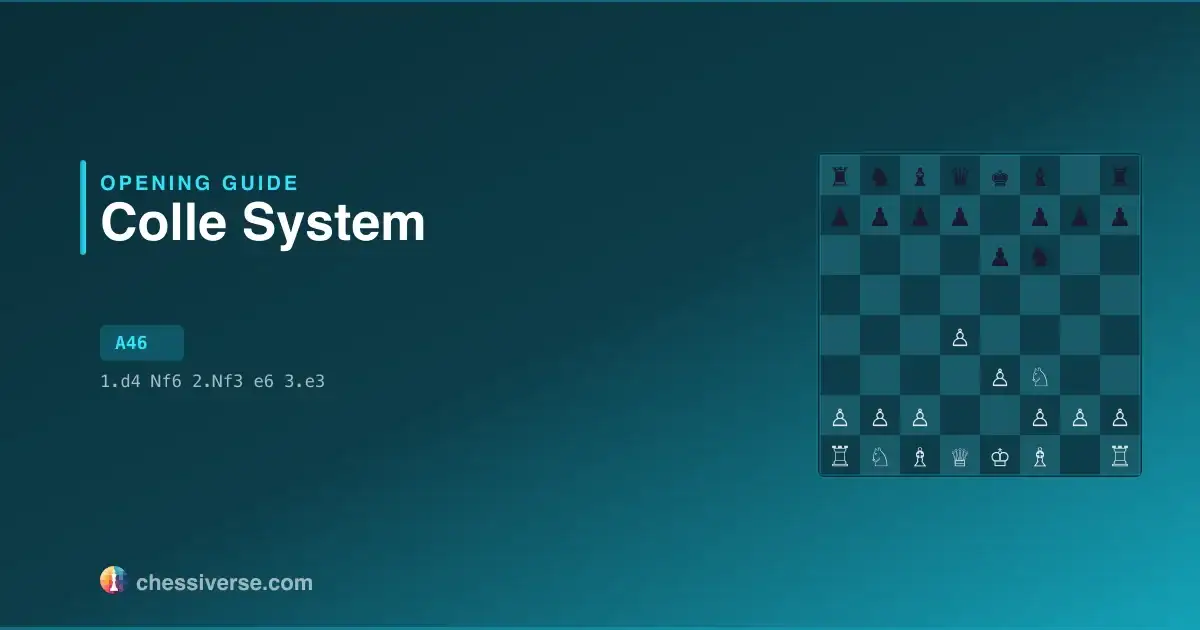


Symmetrical English: 1.c4 c5 2.Nc3...... 5.Nf3

+93%
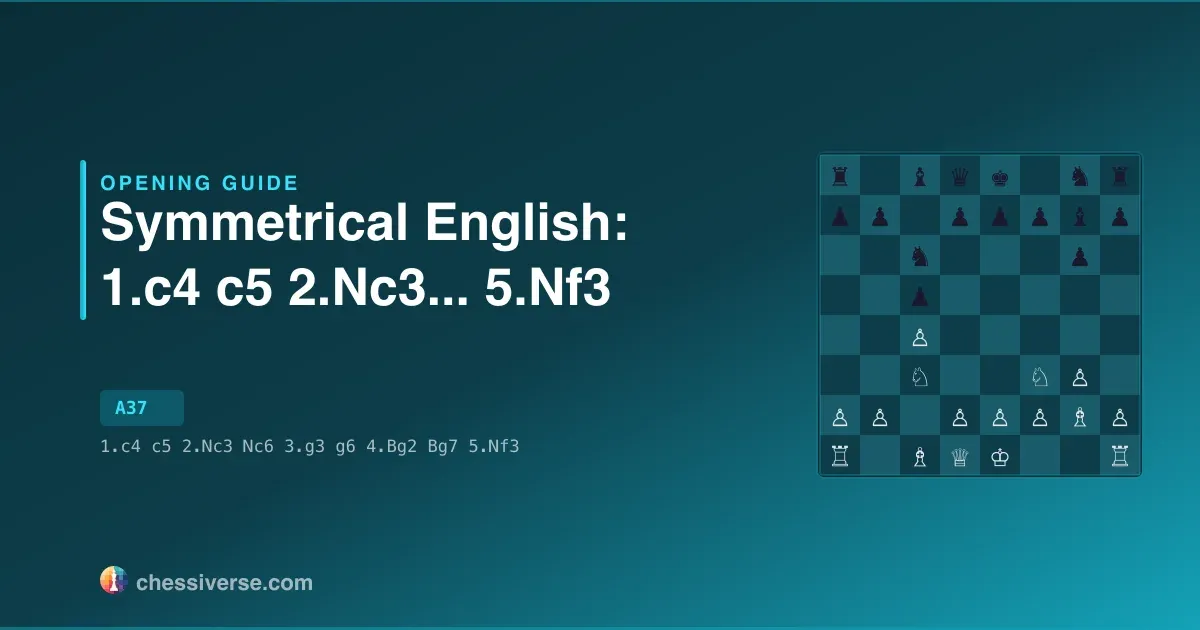
A371.c4 c5 2.Nc3 Nc6 3.g3 g6 4.Bg2 Bg7 5.Nf3
Sep 29, 2027
TL;DR

Nearly identical fianchetto setups stare across the board, and the next pawn break decides everything. White picks between d4, b4, or f4; Black mirrors with ...d5, ...b5, or ...f5. White's tempo edge is small but persistent — at master level, the line balances at 48.5%.

Reviewed by

IM John Bartholomew
IM John BartholomewCo-Founder & Chess Educator

International Master and chess educator. Co-founded Chessable and joined Chessiverse as co-founder. Best known for his "Climbing the Rating Ladder" YouTube series and structured opening courses.

Symmetrical English: 1.c4 c5 2.Nc3...... 5.Nf3: A Complete Guide
Symmetrical English: 1.c4 c5 2.Nc3...... 5.Nf3 - Opening Moves
Summary

The Symmetrical English: 1.c4 c5 2.Nc3... 5.Nf3 begins with 1.c4 c5 2.Nc3 Nc6 3.g3 g6 4.Bg2 Bg7 5.Nf3 (ECO A37). Both sides have fianchettoed and the structure is set — now it's about which side blinks first and commits to a pawn break. White's tempo advantage is real but small, and Black has every resource to hold the balance.

Strategic Overview

By move five both sides have nearly identical setups: knight on c-something, bishop on the long diagonal, kings about to castle short. The structural mirror is the whole point. What matters now is the order in which the remaining pieces come out and which side gets their pawn break in first and on better terms. White's main candidate breaks are d4 (after e3 and Nge2 in some lines, or directly in others), b4 (preceded by a3 and Rb1), and sometimes f4 in setups where the king's knight goes to e2 instead of f3. Black has matching counterplays: ...d5 to challenge the center, ...b5 for queenside expansion, or sometimes ...f5 in lines where Black plays a sharper kingside game. The tempo advantage from playing first is small but real — White can often execute the central break one move earlier than Black, which compounds into a slight strategic edge. The character of the middlegame is patient and positional. The side that better understands which pieces to keep, which to trade, and when to commit to a pawn break tends to come out on top.

Key Ideas

When players succeed in this line, they usually do so by leaning on the following themes:

  • Double fianchetto sets the long-term structure — Both bishops on the long diagonals will matter for the entire game. Trades on these diagonals often decide who has the better minor pieces in the endgame.
  • Pawn breaks decide the middlegame — d4 or b4 for White; ...d5 or ...b5 for Black. Whoever commits first and on better terms keeps the initiative for the rest of the game.
  • Tempo matters more than it looks — Having moved first lets White execute pawn breaks one tempo earlier than Black. In a symmetric structure, that single tempo compounds into a small but persistent edge.
  • Strategic understanding beats memorization — Both sides have natural development and few forcing lines. The side that understands pawn structure dynamics and piece coordination better wins the long game.

History and Notable Players

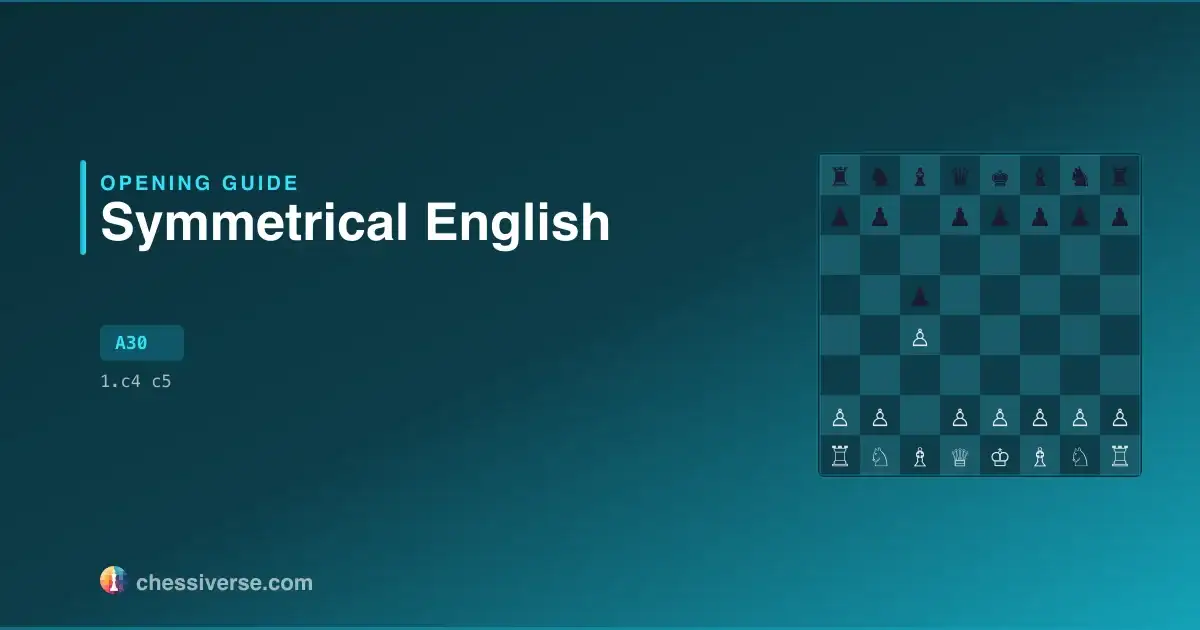
It arises from the Symmetrical English: 1.c4 c5 2.Nc3... 3.g3. Among the most prolific White practitioners are Valery A Loginov (34 games), Colin Anderson McNab (31 games), Tomasz Markowski (29 games). Black-side regulars include Wlodzimierz Schmidt (18 games), Vlastimil Jansa (17 games), Florin Gheorghiu (17 games).

Performance Across Rating Levels

The picture changes a lot as you climb the rating ladder. The 1200 bracket has 25,195 games (0.00% of all games at that level); White wins 49.9%, Black 45.9%, 4.2% are drawn. Move up to 1800 Elo and the share shifts to 0.03%, with White winning 49.1% versus Black's 44.8%. At 2500, 0.17% of games go into this opening; draws sit at 11.5% — the line is well-mapped at this level. White's edge erodes by 5.9pp from 1200 to 2500 Elo, suggesting Black's counterplay is easier to find with experience.

Time Control Patterns

Look at the same opening across time controls and blitz stands out. In bullet, it appears in 0.02% of games (470,645); White wins 49.6%. Blitz shows 0.02% adoption across 808,946 games, White scoring 48.5%. In rapid, the share rises to 0.01% — 120,511 games, White 48.5%.

Move Diversity and Theory Depth

What players actually play after the opening moves depends heavily on rating. At 1200 Elo, the top reply is Nf6, played 56.8% of the time. There are 4 other moves seeing meaningful share, and 86.3% of games stick to established theory. Entropy: 2.00. By 2500, d6 dominates at 35.1% of replies; only 5 viable alternatives remain and 76.8% of moves are theory. Entropy drops to 2.38. Move diversity stays high even at master level, suggesting the opening doesn't force one specific response.

Tracking the Symmetrical English: 1.c4 c5 2.Nc3... 5.Nf3 year over year shows a clear story. Adoption peaked in 2020 at 0.02% (142,553 games). By 2025 it sits at 0.02% — a 93% shift overall, leaving the line on the rise.

Main Lines and Variations

From the position after 1.c4 c5 2.Nc3 Nc6 3.g3 g6 4.Bg2 Bg7 5.Nf3, the recognised continuations are:

Each branch leads to a different middlegame character — the resulting pawn structure decides what kind of game you get.

Common Mistakes

  • Neglecting development — It can feel productive to make extra pawn moves early, but falling behind in piece development is what loses most amateur games — especially in open positions where active pieces find squares fast.
  • Playing without a plan — Each Symmetrical English: 1.c4 c5 2.Nc3... 5.Nf3 middlegame demands a specific approach. Decide whether the position calls for attack, manoeuvre, or simplification before reaching for a move.

Practice on Chessiverse

Ready to try the Symmetrical English: 1.c4 c5 2.Nc3... 5.Nf3 against a bot? Pick an opponent at your level and play a game.

Quick Facts

Main Line1.c4 c5 2.Nc3 Nc6 3.g3 g6 4.Bg2 Bg7 5.Nf3
DifficultyAdvanced
Style

Solid Defender openings aim for a rock-solid pawn structure and safe piece placement. They resist aggression, minimize weaknesses, and seek to outplay the opponent in the long run.

929,457games on Lichess
48.5%
6.7%
44.8%
White wins Draws Black wins

Top Players

Data from Lichess opening explorer (blitz & rapid)

Most Popular At2500
SharpnessCalm

Popularity by Rating

Percentage of all games at each rating bracket that feature this opening.

Data from Lichess opening explorer (blitz & rapid games)

Theory Adherence by Rating

How often players choose the single most popular move at this position. Higher = more predictable play.

Black to move after the opening line

Popularity Over Time

Share of all Lichess blitz + rapid games featuring this opening, by year.

Top Moves by Rating

Black to move after the opening line

RatingMost Popular2nd3rd
400Nf667.1%e610.3%d66.6%
1000Nf658.8%e616.5%d69%
1200Nf656.8%e619.1%d610.4%
1400Nf655.2%e620.2%d612.6%
1600Nf652%e622.2%d614.5%
1800Nf645.1%e624.6%d617.5%
2000Nf634.5%e626.5%d620.8%
2200d625.3%e625%Nf623%
2500d635.1%e625.7%e516.1%

Popularity by Time Control

Bullet
0.02%471K
Blitz
0.02%809K
Rapid
0.01%121K
3% more decisive in bullet
Raw data tables (Lichess blitz + rapid)
Symmetrical English: 1.c4 c5 2.Nc3...... 5.Nf3: popularity and win rates by player rating
Rating (Elo)Share %GamesWhite win %Black win %Draw %Sharpness
4000.001,84851.543.15.40.946
10000.007,55751.643.94.50.955
12000.0025,19549.945.94.20.958
14000.0167,53750.045.64.40.956
16000.01143,10449.445.55.10.949
18000.03226,66649.144.86.10.939
20000.05240,28548.444.67.00.930
22000.12194,19746.944.38.80.912
25000.1723,06844.044.411.50.885
Symmetrical English: 1.c4 c5 2.Nc3...... 5.Nf3: move-choice theory adherence by rating
Rating (Elo)Top moveTop move %Viable movesTheory %Entropy
400Nf667.1484.01.803
1000Nf658.8484.31.990
1200Nf656.8486.31.995
1400Nf655.2388.01.989
1600Nf652.0388.62.011
1800Nf645.1487.12.109
2000Nf634.5481.82.264
2200d625.3473.32.419
2500d635.1576.82.384
Symmetrical English: 1.c4 c5 2.Nc3...... 5.Nf3: popularity over time
YearShare %GamesWhite win %Black win %Draw %
20130.0128448.945.16.0
20140.021,43346.647.06.4
20150.024,58447.746.26.1
20160.0211,78147.745.66.7
20170.0222,50948.644.86.5
20180.0239,42948.545.46.1
20190.0266,04948.745.26.1
20200.02142,55348.244.77.1
20210.02151,59348.244.96.8
20220.02135,38648.644.96.5
20230.02141,10648.544.96.6
20240.02137,15848.844.56.7
20250.02141,51648.644.76.7
Symmetrical English: 1.c4 c5 2.Nc3...... 5.Nf3: popularity by time control
FormatShare %GamesWhite win %Black win %Draw %Sharpness
bullet0.02470,64549.646.04.40.956
blitz0.02808,94648.544.96.60.934
rapid0.01120,51148.544.47.10.929
Symmetrical English: 1.c4 c5 2.Nc3...... 5.Nf3: top candidate moves by rating bracket
Rating (Elo)1st move1st %2nd move2nd %3rd move3rd %
400Nf667.1e610.3d66.6
1000Nf658.8e616.5d69.0
1200Nf656.8e619.1d610.4
1400Nf655.2e620.2d612.6
1600Nf652.0e622.2d614.5
1800Nf645.1e624.6d617.5
2000Nf634.5e626.5d620.8
2200d625.3e625.0Nf623.0
2500d635.1e625.7e516.1
Symmetrical English: 1.c4 c5 2.Nc3...... 5.Nf3: top practitioners by side
SidePlayerGames
WhiteValery A Loginov34
WhiteColin Anderson McNab31
WhiteTomasz Markowski29
BlackWlodzimierz Schmidt18
BlackVlastimil Jansa17
BlackFlorin Gheorghiu17

Frequently Asked Questions

What is the Symmetrical English: 1.c4 c5 2.Nc3... 5.Nf3?

The Symmetrical English: 1.c4 c5 2.Nc3... 5.Nf3 begins with 1.c4 c5 2.Nc3 Nc6 3.g3 g6 4.Bg2 Bg7 5.Nf3 and is classified under ECO code A37. 1.c4 c5 2.Nc3 Nc6 3.g3 g6 4.Bg2 Bg7 5.

Is the Symmetrical English: 1.c4 c5 2.Nc3... 5.Nf3 good for beginners?

The Symmetrical English: 1.c4 c5 2.Nc3... 5.Nf3 can be played at any level. Beginners should focus on understanding the key strategic ideas rather than memorizing long theoretical lines. Our AI bots at various rating levels provide a great way to practice the opening concepts.

What are the main variations of the Symmetrical English: 1.c4 c5 2.Nc3... 5.Nf3?

The main continuations include: Symmetrical English: 1.c4 c5 2.Nc3... Nf6. Each variation leads to distinct types of positions with their own strategic themes.

What are the win rates for the Symmetrical English: 1.c4 c5 2.Nc3... 5.Nf3?

In a database of 929,457 master games, White wins 48.5% of the time, Black wins 44.8%, and 6.7% are drawn. Notable players on the White side include Valery A Loginov and Colin Anderson McNab. On the Black side, Wlodzimierz Schmidt and Vlastimil Jansa are among the most frequent practitioners.

Reviewed by

IM John Bartholomew
IM John BartholomewCo-Founder & Chess Educator

International Master and chess educator. Co-founded Chessable and joined Chessiverse as co-founder. Best known for his "Climbing the Rating Ladder" YouTube series and structured opening courses.

Practice This Opening on Chessiverse

Play against 1000+ AI bots with unique personalities and opening repertoires. From beginner-friendly to grandmaster-level opponents, find the perfect sparring partner for any opening.

Play Now

Not sure which opening fits you? Take the free chess personality test — your style determines which openings will work with you.

Back to Articles