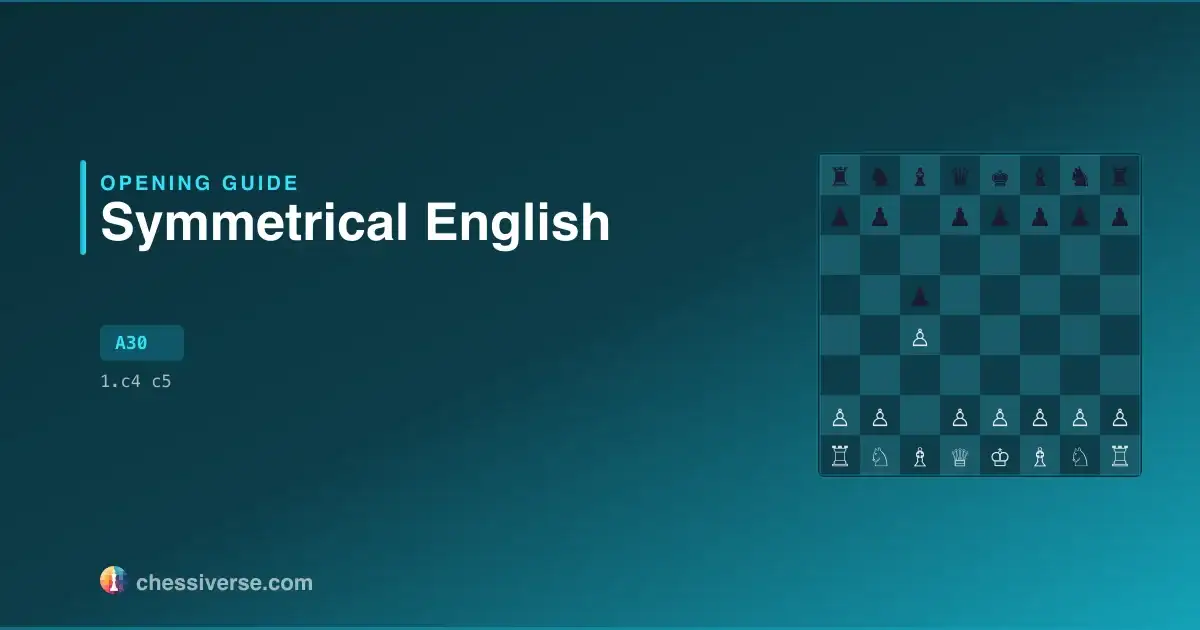


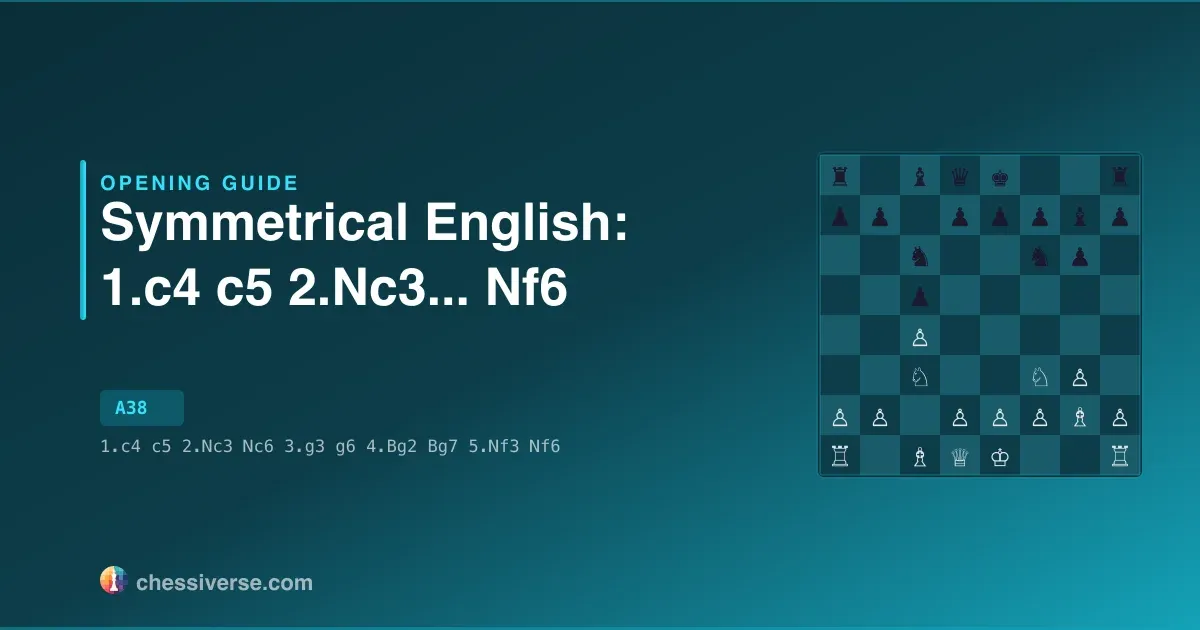
Starting from 1.c4 c5 2.Nc3 Nc6 3.g3 g6 4.Bg2 Bg7 5.Nf3 Nf6, players enter the English Opening: Symmetrical Variation, Full Symmetry Line — ECO A38. Full symmetry through six moves on each side — both sides have fianchettoed and developed every knight to its natural square. The mirror finally has to break, and the side that breaks it well takes the initiative.
Strategic Overview
By this point the position is the textbook double-fianchetto Symmetrical English. All four knights are developed, both bishops are on the long diagonals, and both sides are about to castle. The structural ideas are well-understood: White aims for d4 or b4 as the main pawn breaks, Black mirrors with ...d5 or ...b5. The tempo advantage matters here — White can usually get a pawn break in one move earlier than Black, which compounds into a small persistent edge. White's typical setup continues with 0-0, then choosing between e3 followed by d4 (a central break that opens the position) and a3 followed by Rb1 and b4 (a queenside expansion that gains space without forcing trades). Black has matching plans: ...0-0, then either ...d6 and ...Bf5 for piece play or ...a6 and ...Rb8 for queenside symmetry. The middlegame becomes a contest of strategic understanding rather than concrete preparation. Both sides know the structures; the side that better grasps which pieces to keep and trade, and when to commit to a pawn break, gets the better game. White's small edge from the extra tempo translates to slightly better practical chances, but Black is fundamentally solid.
Key Ideas
When players succeed in this line, they usually do so by leaning on the following themes:
- Full symmetry sets up a strategic battle — With every piece on a mirror square, the fight becomes about who can break symmetry well. Both sides have the same plans; the side that executes them on better terms wins.
- d4 or b4 — pick your pawn break — After 0-0, White chooses between a central break with d4 and a queenside expansion with b4. The choice depends on Black's piece placement and which side of the board has more potential.
- Tempo translates to a small edge — White can usually push their pawn break one move earlier than Black. In symmetric structures, that one tempo is the difference between equality and a slight White advantage.
- Strategic understanding wins the long game — There's no concrete forcing line here. Both sides need to understand which pieces matter most, when to trade, and how to read the structural cues — that understanding decides the game.
History and Notable Players
It arises from the English Opening: Symmetrical Variation, Three Knights, Fianchetto Variation. On the White side, Sandor Farago (12 games), Wolfgang Uhlmann (10 games), Heikki Lehtinen (9 games) top the database. Notable Black exponents: Bartlomiej Macieja (17 games), Keith C Arkell (16 games), Emil Szalanczy (12 games).
Performance Across Rating Levels
The picture changes a lot as you climb the rating ladder. Among 1200-rated players, it appears in 0.00% of games — 24,391 of them on record — with White winning 51.4% and Black 44.1%. At 1800 the opening surfaces in 0.02% of games; White wins 50.7%, Black 42.9%, draws 6.4%. Among 2500-rated players the line appears in 0.05% of games and draws spike to 12%, indicating tight preparation. White's edge erodes by 3.9pp from 1200 to 2500 Elo, suggesting Black's counterplay is easier to find with experience.
Time Control Patterns
Time control matters here: blitz players reach for this opening more than others. In bullet, it appears in 0.01% of games (328,335); White wins 51.5%. Blitz shows 0.02% adoption across 620,305 games, White scoring 50.9%. In rapid, the share rises to 0.01% — 119,155 games, White 50.6%.
Move Diversity and Theory Depth
Looking at move selection shows how forcing — or not — the position really is. At 1200 Elo (24,391 games), the top reply is O-O, played 63.8% of the time. Three other moves each take at least 5% of games, and the top three moves account for 83.9% of games. Entropy: 1.89. By 2500 (7,380 games), O-O dominates at 65.6% of replies; only one other move still reaches 5% and the top three moves account for 98.5% of games. Entropy drops to 1.17. The narrowing is significant — strong players consolidate around a small set of best moves, while amateurs scatter across many plausible-looking options.
Historical Trends
Tracking the English Opening: Symmetrical Variation, Full Symmetry Line year over year shows a clear story. Adoption peaked in 2020 at 0.02% (117,049 games). By 2025 it sits at 0.01%, 28% below the peak but still 60% above its 2013 level, so the line is up over the full period despite easing from the high.
Main Lines and Variations
After 1.c4 c5 2.Nc3 Nc6 3.g3 g6 4.Bg2 Bg7 5.Nf3 Nf6, the established follow-ups are:
Each branch leads to a different middlegame character — the resulting pawn structure decides what kind of game you get.
Common Mistakes
- Drifting away from main theory — At 400 Elo, the three most-played moves cover 84% of games, against 94.4% at 2000. The most popular deviation is d3 (played 10.6% of the time at 400, less so up top). It looks fine but quietly hands the better-prepared side an edge.
- Neglecting development — Extra pawn moves in the opening are tempting, especially when you "know the moves". Developing a piece each turn is the simple correction.
- Playing without a plan — Each English Opening: Symmetrical Variation, Full Symmetry Line middlegame demands a specific approach. Decide whether the position calls for attack, manoeuvre, or simplification before reaching for a move.
Practice on Chessiverse
Ready to try the English Opening: Symmetrical Variation, Full Symmetry Line against a bot? Pick an opponent at your level and play a game.