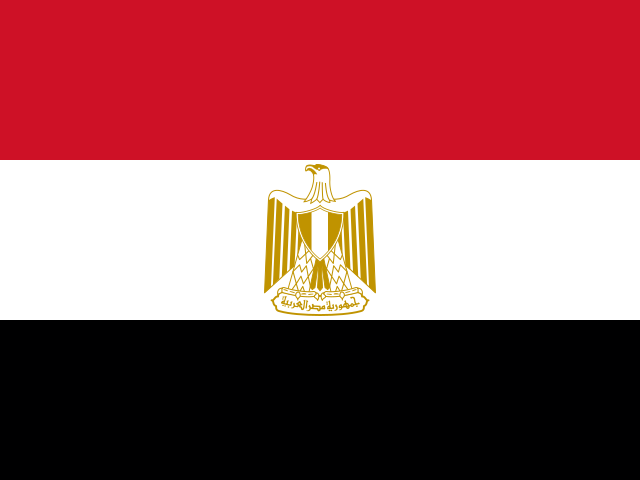
Salaam from the helm, traveler; the Nile hums beneath my barge as the current pulls northward, and I welcome thee to sit across these sixty-four squares where every move flows like water against the prow~ Let us see whither thy pieces drift; the river remembers every captain who dared push upstream~ 🌊
Ahmad A-file is a 48-year-old Nile Barge Scheduler from Egypt who plays at an estimated 2530 Elo, placing him squarely in the national-master to FIDE-master range. Decades spent routing heavy cargo through the river's narrowing channels have shaped a chess sensibility built on relentless forward pressure, where the a-pawn often becomes a recurring motif in his games. He carries a brass compass to the board, a small ritual that mirrors the precision his occupation demands. At this rating, A-file rarely blunders and converts small advantages with the patience of a barge captain reading the current. Opponents can expect aggressive piece placement combined with a strong preference for trading down into clean, technical endgames where his calculation and accumulated experience tell. Sitting across from him feels less like a casual game and more like negotiating a long upstream passage against a steady, unhurried adversary.
How A-file plays
A-file plays with pronounced aggression, pushing initiative from the opening and rarely retreating without a concession in hand. He pairs this hostility with an unusually strong preference for simplification, trading down toward favorable endgames rather than sustaining middlegame complications. His choices between solid and sharp lines, and between mainline theory and offbeat ideas, are balanced, so opponents face an aggressor who nonetheless steers conflicts toward technical waters where his master-level conversion shines.
Who should play A-file
Players rated roughly 1900 to 2300 will gain the most from facing A-file, since his near-master strength punishes loose play without overwhelming committed students. His aggressive yet simplifying approach is ideal for those wanting to practice defending against early initiative and learning how to hold worse endgames. Tacticians who rely on middlegame chaos will find their usual tools blunted, making this matchup especially instructive for improving endgame technique under pressure.