

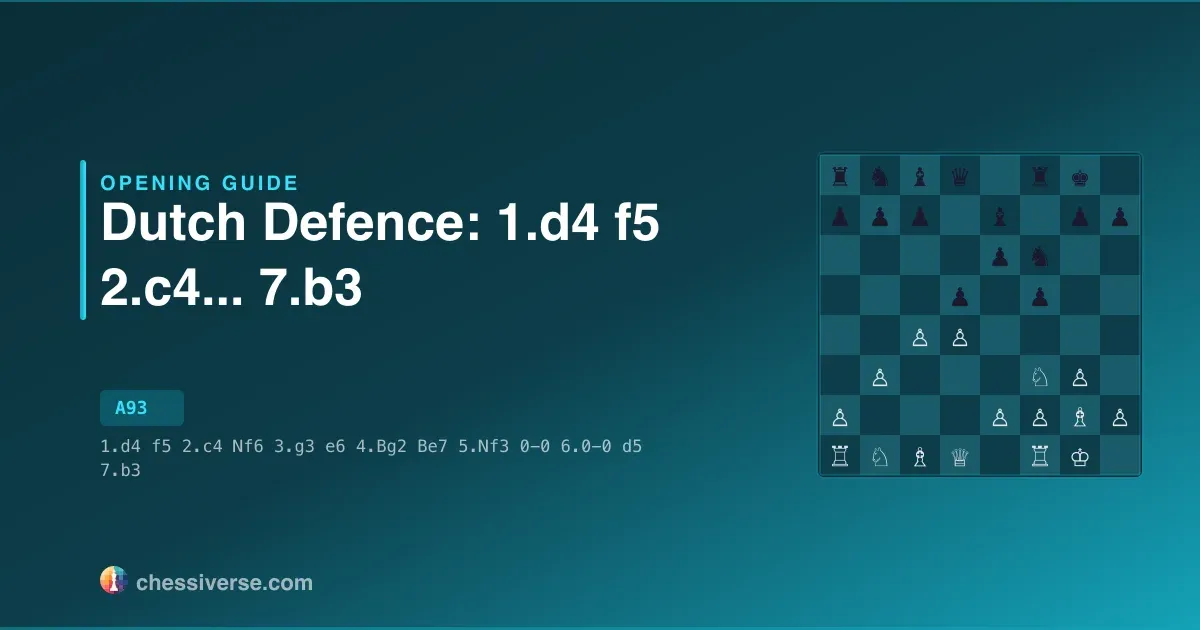
1.d4 f5 2.c4 Nf6 3.g3 e6 4.Bg2 Be7 5.Nf3 0-0 6.0-0 d5 7.b3 opens the Dutch Defense: Stonewall Variation, Botvinnik Variation, ECO A93. With 11,646 games on record, the patterns below come from the largest practical sample available.
History and Notable Players
It arises from the Dutch Defense: Classical Variation (5...0-0). On the White side, Istvan Bilek (3 games), Joel Lautier (3 games), Joerg Gruenenwald (3 games) top the database. Notable Black exponents: Lars Karlsson (12 games), Carlos Enrique Guimard (8 games), Grigorij Pres (7 games).
Move Diversity and Theory Depth
What players actually play after the opening moves depends heavily on rating. Below 1400 the samples are small (45 games at 1200), so the comparison starts at 1400, with 184 games. There, the top reply is c6, played 51.1% of the time. Four other moves each take at least 5% of games, and the top three moves account for 70.1% of games. Entropy: 2.44. By 2500 (292 games), c6 dominates at 60.3% of replies; only two other moves still reach 5% and the top three moves account for 89% of games. Entropy drops to 1.82. The narrowing is significant — strong players consolidate around a small set of best moves, while amateurs scatter across many plausible-looking options.
Main Lines and Variations
The main branches off 1.d4 f5 2.c4 Nf6 3.g3 e6 4.Bg2 Be7 5.Nf3 0-0 6.0-0 d5 7.b3 include:
Each branch leads to a different middlegame character — the resulting pawn structure decides what kind of game you get.
Common Mistakes
- Neglecting development — Extra pawn moves in the opening are tempting, especially when you "know the moves". Developing a piece each turn is the simple correction.
- Playing without a plan — Each Dutch Defense: Stonewall Variation, Botvinnik Variation middlegame demands a specific approach. Decide whether the position calls for attack, manoeuvre, or simplification before reaching for a move.
Practice on Chessiverse
Ready to try the Dutch Defense: Stonewall Variation, Botvinnik Variation against a bot? Pick an opponent at your level and play a game.