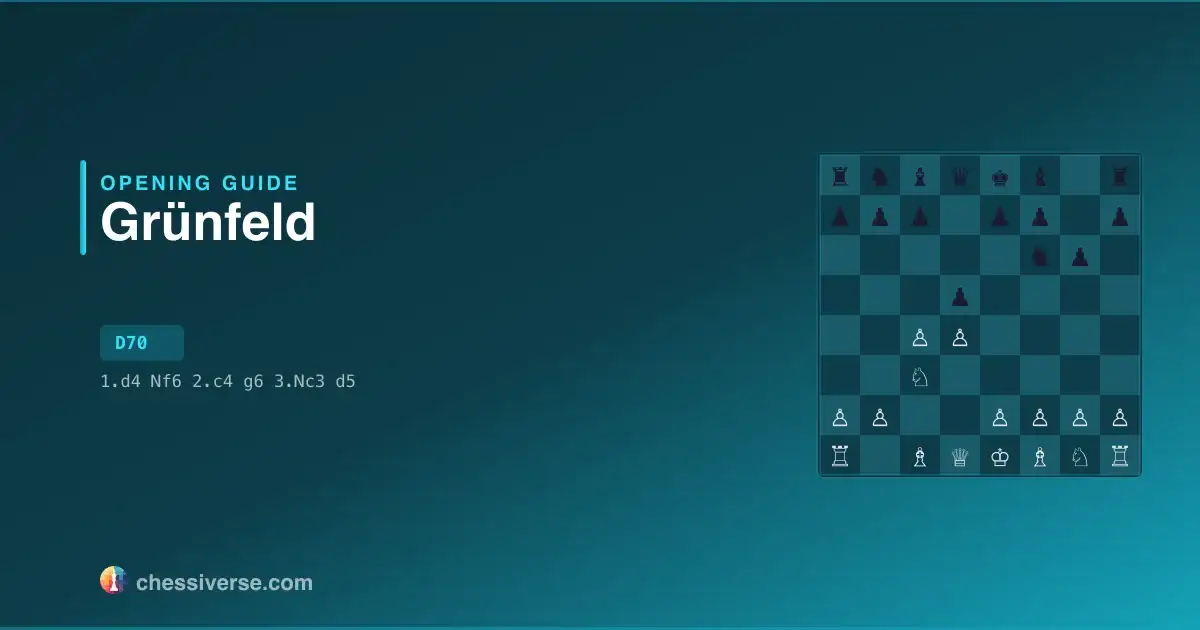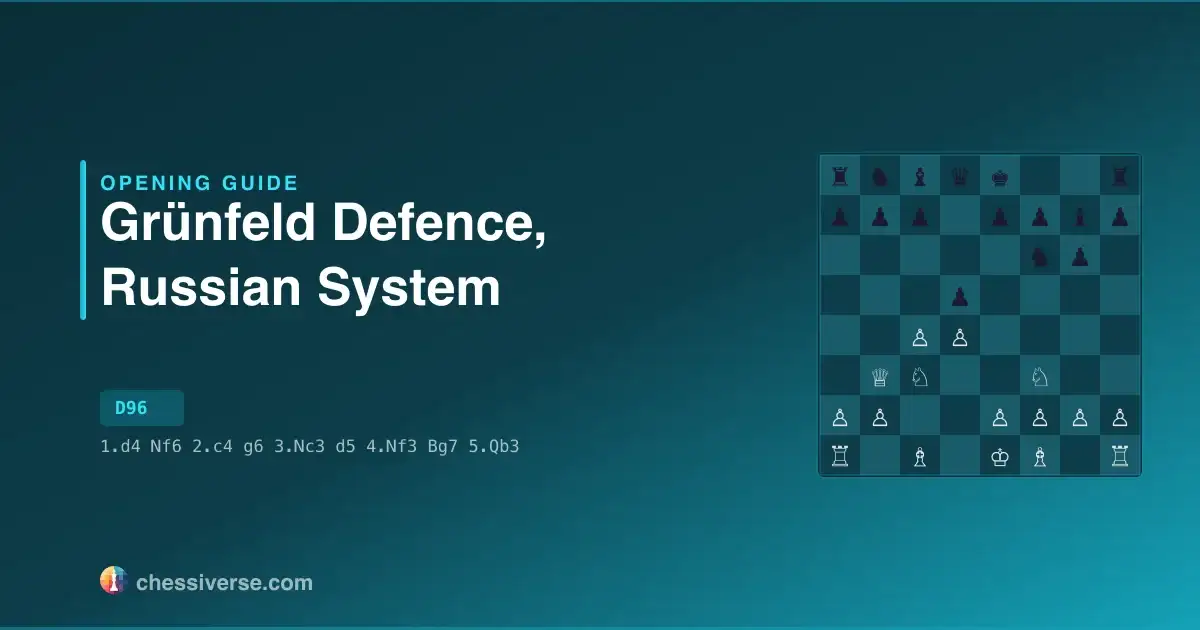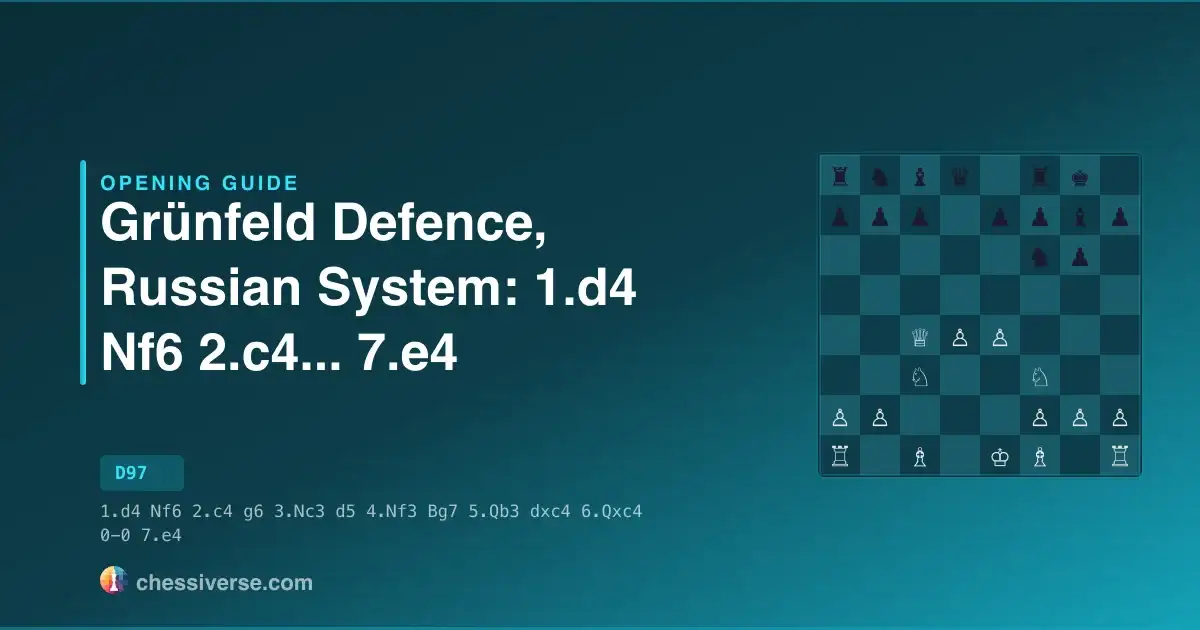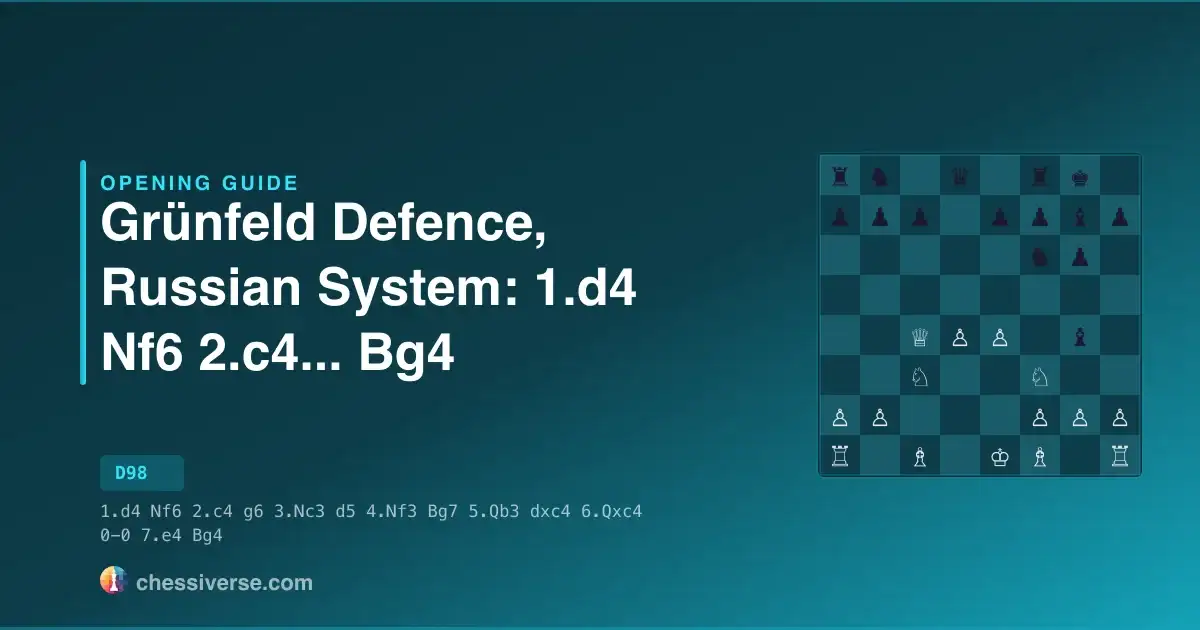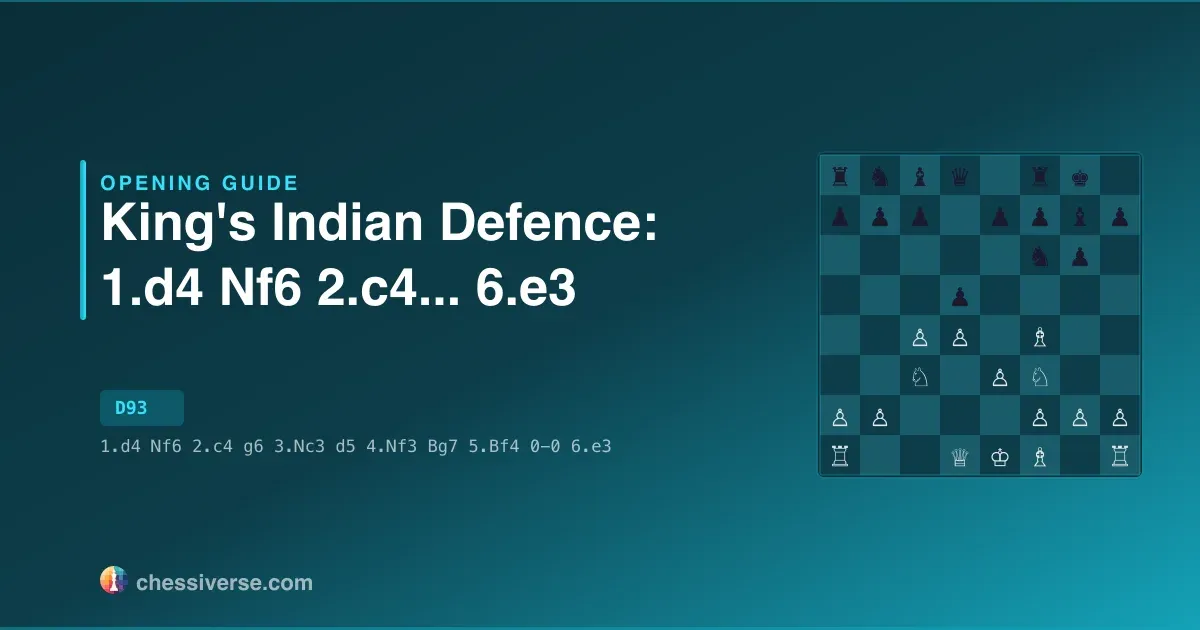
1.d4 Nf6 2.c4 g6 3.Nc3 d5 4.Nf3 Bg7 5.Bf4 0-0 6.e3 opens the Grünfeld Defense: Three Knights Variation, Hungarian Variation, ECO D93. With 503,490 games on record, the patterns below come from the largest practical sample available.
History and Notable Players
It arises from the Grünfeld Defense: Three Knights Variation, Hungarian Attack. On the White side, Ivan Farago (25 games), Peter Lukacs (22 games), Peter Sinkovics (17 games) top the database. Notable Black exponents: Lubomir Ftacnik (10 games), Vlastimil Jansa (9 games), Svetozar Gligoric (8 games).
Performance Across Rating Levels
How well the Grünfeld Defense: Three Knights Variation, Hungarian Variation works depends on what level you're playing at. The 1200 bracket has 17,860 games (0.00% of all games at that level); White wins 50.6%, Black 45.4%, 4% are drawn. By 1800, popularity is 0.02% and White's score is 46.9% to Black's 47.5%. At the top end (2500+ Elo), popularity is 0.04% with 11.2% draws — a clear sign of how much theory rules the line at master level. Positions also become less sharp as level rises (sharpness 0.96 → 0.89).
Time Control Patterns
Look at the same opening across time controls and blitz stands out. In bullet, it appears in 0.01% of games (248,657); White wins 48.1%. Blitz shows 0.01% adoption across 432,236 games, White scoring 47.4%. In rapid, the share rises to 0.01% — 70,354 games, White 45.7%. White's score swings 2.4pp across formats, so time control isn't just a stylistic choice here — it shifts the actual results.
Move Diversity and Theory Depth
Move choice is far from uniform in the Grünfeld Defense: Three Knights Variation, Hungarian Variation. At 1200 Elo (17,817 games), the top reply is c6, played 20.8% of the time. Six other moves each take at least 5% of games, and the top three moves account for 50.8% of games. Entropy: 3.25. By 2500 (5,548 games), c5 takes over as the top reply at 81.8%; only one other move still reaches 5% and the top three moves account for 94.9% of games. Entropy drops to 1.08. The narrowing is significant — strong players consolidate around a small set of best moves, while amateurs scatter across many plausible-looking options.
Historical Trends
Tracking the Grünfeld Defense: Three Knights Variation, Hungarian Variation year over year shows a clear story. Adoption peaked in 2020 at 0.014% (78,345 games). By 2025 it sits at 0.009%, 34% below the peak but still 44% above its 2013 level, so the line is up over the full period despite easing from the high.
Common Mistakes
- Drifting away from main theory — At 400 Elo, the three most-played moves cover 54.1% of games, against 84.4% at 2000. The most popular deviation is Nc6 (played 13.7% of the time at 400, much less so up top). It looks fine but quietly hands the better-prepared side an edge.
- Neglecting development — Extra pawn moves in the opening are tempting, especially when you "know the moves". Developing a piece each turn is the simple correction.
- Playing without a plan — Each Grünfeld Defense: Three Knights Variation, Hungarian Variation middlegame demands a specific approach. Decide whether the position calls for attack, manoeuvre, or simplification before reaching for a move.
Practice on Chessiverse
Ready to try the Grünfeld Defense: Three Knights Variation, Hungarian Variation against a bot? Pick an opponent at your level and play a game.