



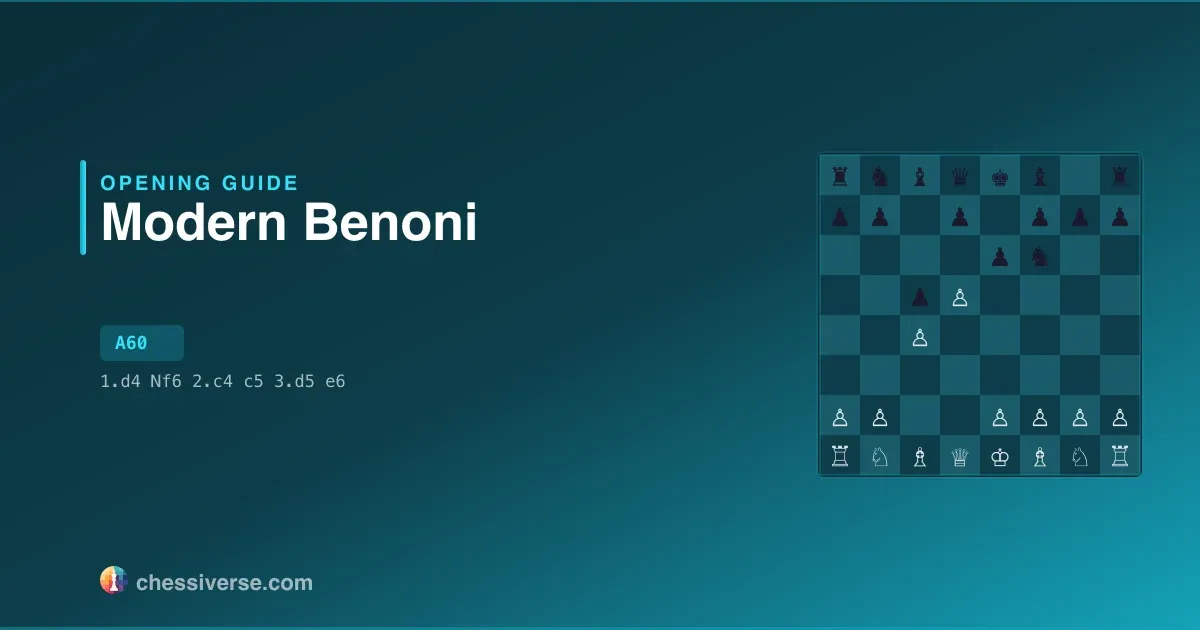
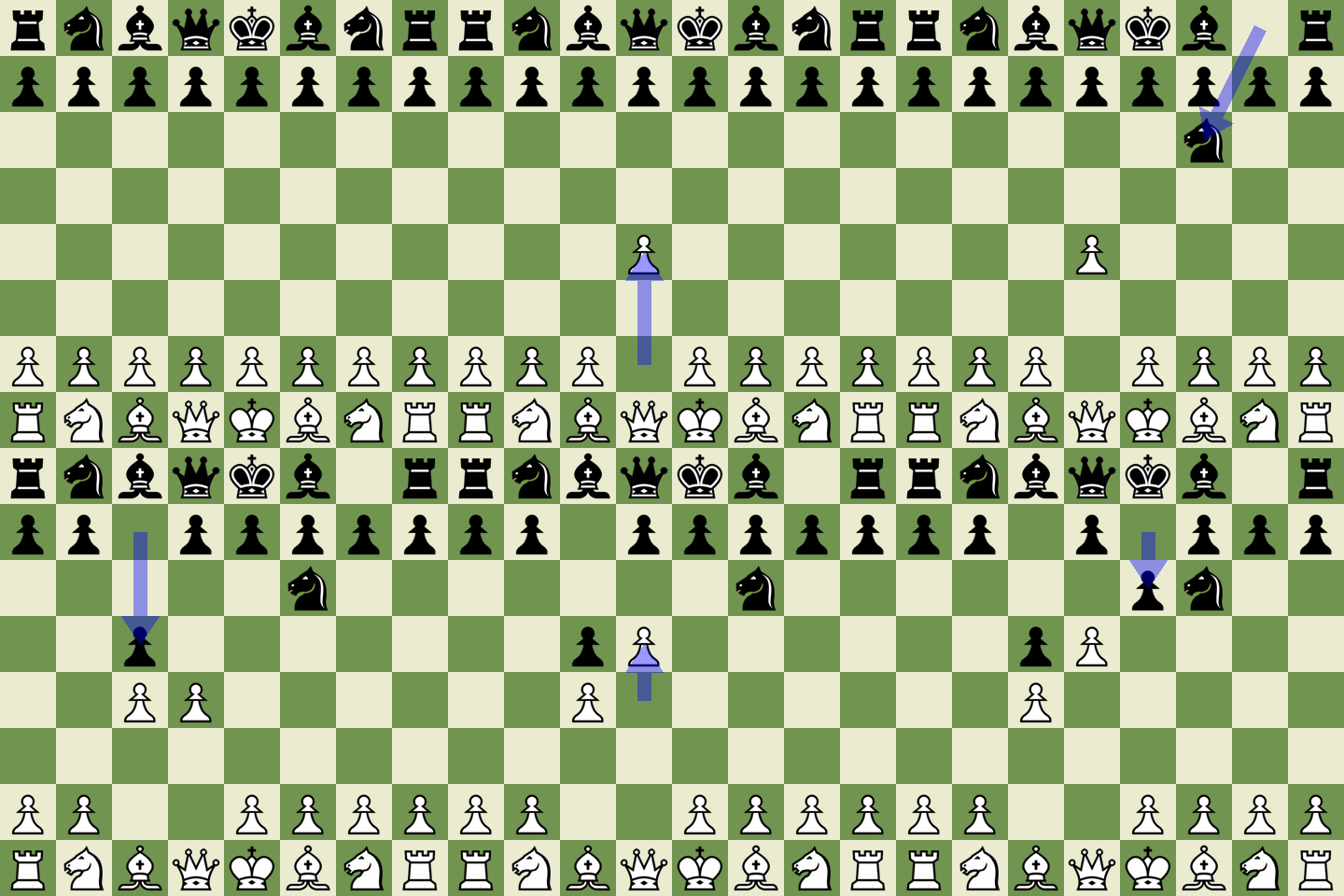
The Modern Benoni Defense arises after 1.d4 Nf6 2.c4 c5 3.d5 e6 and falls under ECO code A60. Popularized by Mikhail Tal in the 1950s and embraced by counterattacking specialists throughout the 1980s and 1990s, the Modern Benoni sees Black accept a structural weakness on d6 in exchange for dynamic compensation that surpasses what the King's Indian typically offers. The key advantage is that the long diagonal is opened for the dark-squared bishop, and Black obtains a mobile queenside pawn majority that, supported by a bishop on g7 and a knight frequently anchored on e5, can generate a dangerous queenside advance capable of queening a pawn if White is not vigilant. The modern main line continues with 4. Nc3 exd5 5. cxd5 d6 6. Nf3 g6 7. h3, where White pursues a restrictive strategy, developing classically to secure a modest but stable space edge while limiting Black's kingside activity. Black can exploit the tempo spent on h3 by launching immediate operations on the queenside. The Fianchetto Variation with 7.g3 offers White a simpler, positional alternative. The older main line, 7. e4 Bg7 8. Be2 O-O 9. O-O, sees White develop ambitiously and target the d6 weakness through maneuvers like Nf3-d2-c4 and Bc1-f4, while Black can counter with plans involving ...a6 and ...b5, ...Re8 to pressure e4, or the ...Nb8-d7-e5 regrouping combined with ...g5 to cement control of e5. White also has aggressive options involving early f-pawn advances and a rapid e4-e5 break, which can be devastating against slow development; Black can neutralize these by choosing the move order 1.d4 Nf6 2.c4 e6 3.Nf3 c5, blocking the f-pawn in advance. With 2.6 million Lichess games across all rating levels, it is a well-established opening choice.
History and Notable Players
The earliest known analysis of this opening dates back to Capablanca–Marshall, New York 1927 (by transposition). The opening is named after Benoni Defense. It arises from the Indian Defense Systems. Among the most prolific practitioners on the White side are Ivan Farago (35 games), Jan Hein Donner (22 games), Svetozar Gligoric (19 games). On the Black side, notable exponents include Pavel Simacek (102 games), Normunds Miezis (68 games), Levan Pantsulaia (65 games).
Statistics
Based on 2.6 million Lichess games across all rating levels:
- White wins: 48.6%
- Black wins: 47%
- Draws: 4.4%
The statistics show a roughly balanced opening where both sides have equal chances.
Main Lines and Variations
After 1.d4 Nf6 2.c4 c5 3.d5 e6, the main continuations include:
Each of these lines leads to distinct types of positions and requires its own understanding of the resulting pawn structures and piece placements.
Common Mistakes to Avoid
- Allowing White to build an overwhelming center: Hypermodern openings allow White space in the center, but you need to strike back at the right moment. Delaying the counterattack too long can leave you without active play.
Practice on Chessiverse
The best way to learn the Modern Benoni Defense is through practice. On Chessiverse, you can play chess against computer opponents that specialize in this opening. Our AI bots range from beginner to grandmaster level, each with unique playing styles — from aggressive attackers to solid defenders. Choose a bot that matches your rating and work your way up as you master the opening's key ideas.
Performance Across Rating Levels
Popularity and results vary sharply by rating level. Among 1200-rated players, it appears in 0.01% of games — 91,839 of them on record — with White winning 52.3% and Black 44.7%. Move up to 1800 Elo and the share shifts to 0.08%, with White winning 47.2% versus Black's 48.7%. At 2500, 0.30% of games go into this opening; draws sit at 7.7% — the line is well-mapped at this level. White's edge erodes by 3.5pp from 1200 to 2500 Elo, suggesting Black's counterplay is easier to find with experience.
Time Control Patterns
Time control matters here: blitz players reach for this opening more than others. In bullet, it appears in 0.04% of games (1,162,162); White wins 49.1%. Blitz shows 0.06% adoption across 2,187,421 games, White scoring 48.5%. In rapid, the share rises to 0.03% — 381,433 games, White 49.1%.
Move Diversity and Theory Depth
Move choice is far from uniform in the Modern Benoni Defense. At 1200 Elo (91,839 games), the top reply is Nc3, played 63.4% of the time. Two other moves each take at least 5% of games, and the top three moves account for 87.4% of games. Entropy: 1.82. By 2500 (40,435 games), Nc3 dominates at 96.1% of replies; no other move reaches 5% and the top three moves account for 99.4% of games. Entropy drops to 0.30. That entropy collapse is the signature of a line where preparation pays off: at the top, players know the best move and play it.
Historical Trends
Year-over-year data tells you whether this opening is a contemporary fixture or a fading one. Adoption peaked in 2015 at 0.08% (17,891 games). By 2025 it sits at 0.05%, 39% below the peak but still 29% above its 2013 level, so the line is up over the full period despite easing from the high.