Queen's Gambit Declined: 1.d4 d5 2.c4... 8.Bd3

-24%
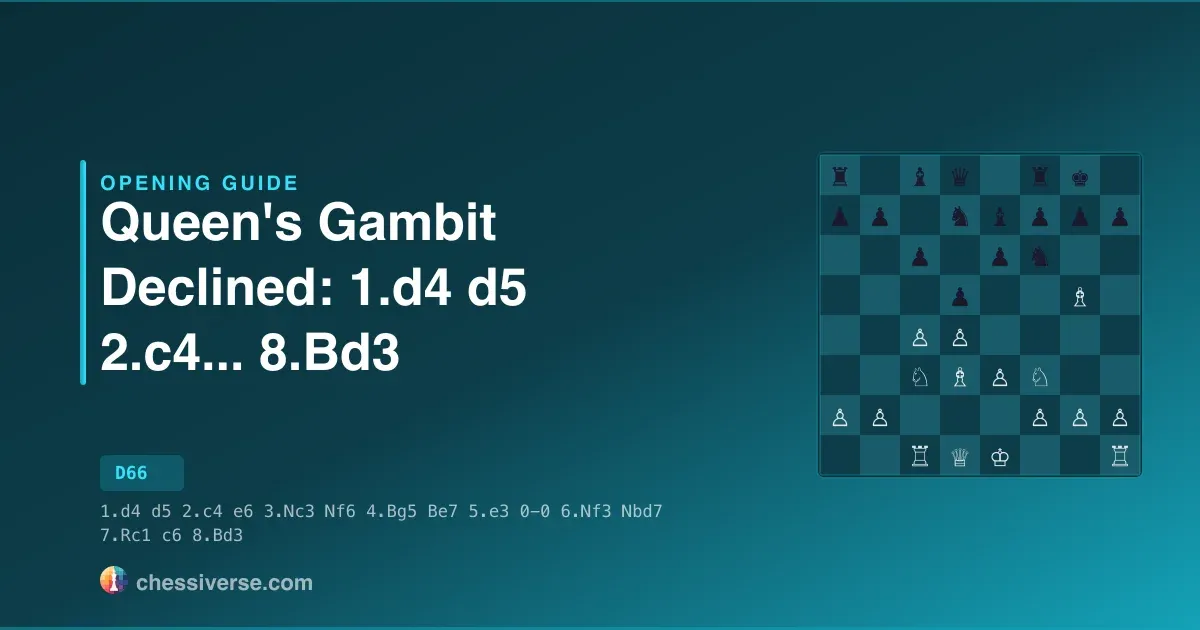
D661.d4 d5 2.c4 e6 3.Nc3 Nf6 4.Bg5 Be7 5.e3 0-0 6.Nf3 Nbd7 7.Rc1 c6 8.Bd3
Feb 20, 2026
Play this opening as...
TL;DR

The Orthodox QGD with ...Be7 leads to classical positions where deep strategic understanding is essential. The battle centers on pawn breaks, piece activity, and the fight for control of key central squares.

Written by

Chessiverse
Chessiverse TeamOpening Guides

Expert chess content backed by opening theory and our database of 600+ AI bots with unique playing styles and opening repertoires.

Queen's Gambit Declined: 1.d4 d5 2.c4... 8.Bd3: A Complete Guide
Queen's Gambit Declined: 1.d4 d5 2.c4... 8.Bd3 - Opening Moves
Summary

The Queen's Gambit Declined: 1.d4 d5 2.c4... 8.Bd3 arises after 1.d4 d5 2.c4 e6 3.Nc3 Nf6 4.Bg5 Be7 5.e3 0-0 6.Nf3 Nbd7 7.Rc1 c6 8.Bd3 and falls under ECO code D66. With 189,682 Lichess games across all rating levels, it is a specialized opening choice.

History and Notable Players

It arises from the Queen's Gambit Declined: 1.d4 d5 2.c4... 7.Rc1. Among the most prolific practitioners on the White side are Alexander Alekhine (30 games), Max Euwe (21 games), Ernst Gruenfeld (19 games). On the Black side, notable exponents include Gideon Stahlberg (16 games), Bela Lengyel (15 games), Geza Maroczy (13 games).

Statistics

Based on 189,276 Lichess games across all rating levels:

  • White wins: 52.5%
  • Black wins: 41%
  • Draws: 6.5%

The statistics show a roughly balanced opening where both sides have equal chances.

Main Lines and Variations

After 1.d4 d5 2.c4 e6 3.Nc3 Nf6 4.Bg5 Be7 5.e3 0-0 6.Nf3 Nbd7 7.Rc1 c6 8.Bd3, the main continuations include:

Each of these lines leads to distinct types of positions and requires its own understanding of the resulting pawn structures and piece placements.

Common Mistakes to Avoid

  • Overextending without backup: When playing a gambit, each attacking move should have a purpose. Random checks and threats without coordination can leave your own position exposed once the initiative fades.
  • Releasing central tension too early: The tension between the d5 and c4 pawns is a central feature of this opening. Capturing or pushing too early can give your opponent a free hand in the center.

Practice on Chessiverse

The best way to learn the Queen's Gambit Declined: 1.d4 d5 2.c4... 8.Bd3 is through practice. On Chessiverse, you can play chess against computer opponents from any opening or custom position. Our AI bots range from beginner to grandmaster level, each with unique playing styles — from aggressive attackers to solid defenders. Choose a bot that matches your rating and work your way up as you master the opening's key ideas.

Quick Facts

Main Line1.d4 d5 2.c4 e6 3.Nc3 Nf6 4.Bg5 Be7 5.e3 0-0 6.Nf3 Nbd7 7.Rc1 c6 8.Bd3
FENr1bq1rk1/pp1nbppp/2p1pn2/3p2B1/2PP4/2NBPN2/PP3PPP/2RQK2R b K - 1 8
DifficultyExpert
Style

Theoretician openings have deep, well-studied lines where knowledge of specific variations gives a significant advantage. Preparation and memorization of key lines are essential.

189,682games on Lichess
52.5%
6.5%
41%
White wins Draws Black wins

Top Players

As White
As Black

Data from Lichess opening explorer (blitz & rapid)

Most Popular At2200
SharpnessCalm

Popularity by Rating

Percentage of all games at each rating bracket that feature this opening.

Data from Lichess opening explorer (blitz & rapid games)

Theory Adherence by Rating

How often players choose the single most popular move at this position. Higher = more predictable play.

Black to move after the opening line

Popularity Over Time

Share of all Lichess blitz + rapid games featuring this opening, by year.

Top Moves by Rating

Black to move after the opening line

RatingMost Popular2nd3rd
400dxc475%Ne48.3%Qa58.3%
1000dxc430.9%h617.6%b614.7%
1200h628.5%dxc421.2%b610.5%
1400h626.4%dxc426.2%b611.5%
1600dxc433.5%h627.4%b69.4%
1800dxc437.4%h626.8%Re811.5%
2000dxc439.6%h624.3%Re813.9%
2200dxc443.6%h620.1%Re814.1%
2500dxc450%h620.7%b612.9%

Popularity by Time Control

Bullet
<0.01%73K
Blitz
<0.01%169K
Rapid
<0.01%21K
4% more decisive in bullet
Play this opening as...

Frequently Asked Questions

What is the Queen's Gambit Declined: 1.d4 d5 2.c4... 8.Bd3?

The Queen's Gambit Declined: 1.d4 d5 2.c4... 8.Bd3 begins with 1.d4 d5 2.c4 e6 3.Nc3 Nf6 4.Bg5 Be7 5.e3 0-0 6.Nf3 Nbd7 7.Rc1 c6 8.Bd3 and is classified under ECO code D66.

Is the Queen's Gambit Declined: 1.d4 d5 2.c4... 8.Bd3 good for beginners?

The Queen's Gambit Declined: 1.d4 d5 2.c4... 8.Bd3 can be played at any level. Beginners should focus on understanding the key strategic ideas rather than memorizing long theoretical lines. Our AI bots at various rating levels provide a great way to practice the opening concepts.

What are the main variations of the Queen's Gambit Declined: 1.d4 d5 2.c4... 8.Bd3?

The main continuations include: Queen's Gambit Declined: 1.d4 d5 2.c4 e6 3.Nc3 Nf6 4.Bg5 Be7 5.e3 0-0 6.Nf3 Nbd7 7.Rc1 c6 8.Bd3 dxc4 9.Bxc4 Nd5. Each variation leads to distinct types of positions with their own strategic themes.

What are the win rates for the Queen's Gambit Declined: 1.d4 d5 2.c4... 8.Bd3?

Across 189,682 Lichess games, White wins 52.5% of the time, Black wins 41%, and 6.5% are drawn. Notable master practitioners on the White side include Alexander Alekhine and Max Euwe. On the Black side, Gideon Stahlberg and Bela Lengyel are among the most frequent practitioners.

Written by

Chessiverse
Chessiverse TeamOpening Guides

Expert chess content backed by opening theory and our database of 600+ AI bots with unique playing styles and opening repertoires.

Practice This Opening on Chessiverse

Play against 600+ AI bots with unique personalities and opening repertoires. From beginner-friendly to grandmaster-level opponents, find the perfect sparring partner for any opening.

Play Now
Back to Articles