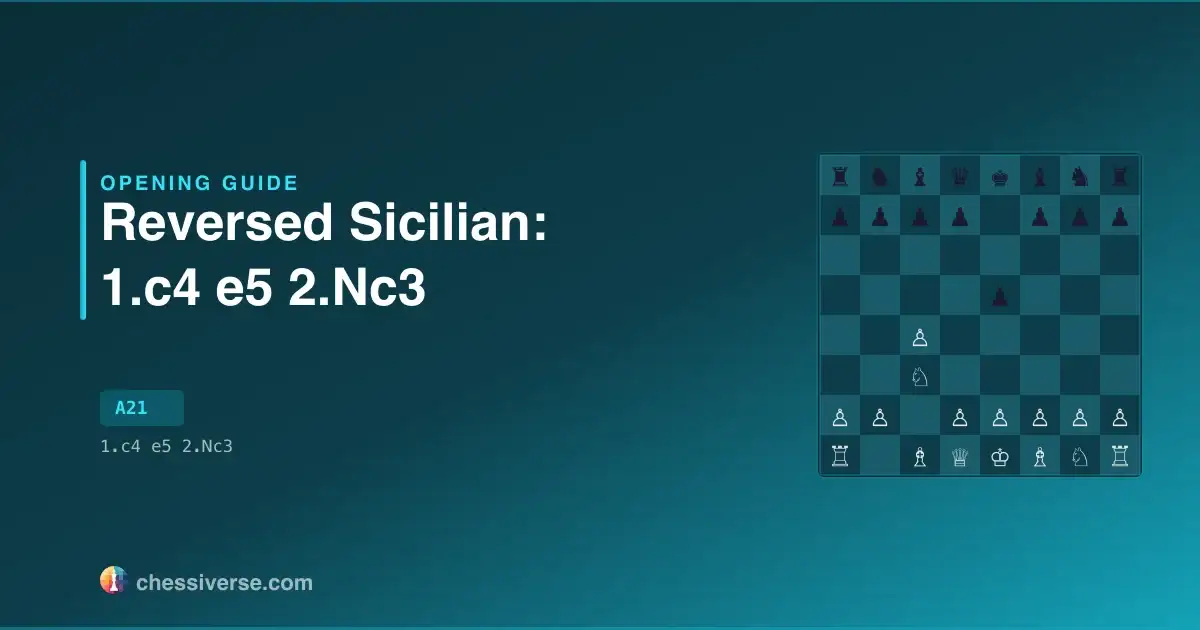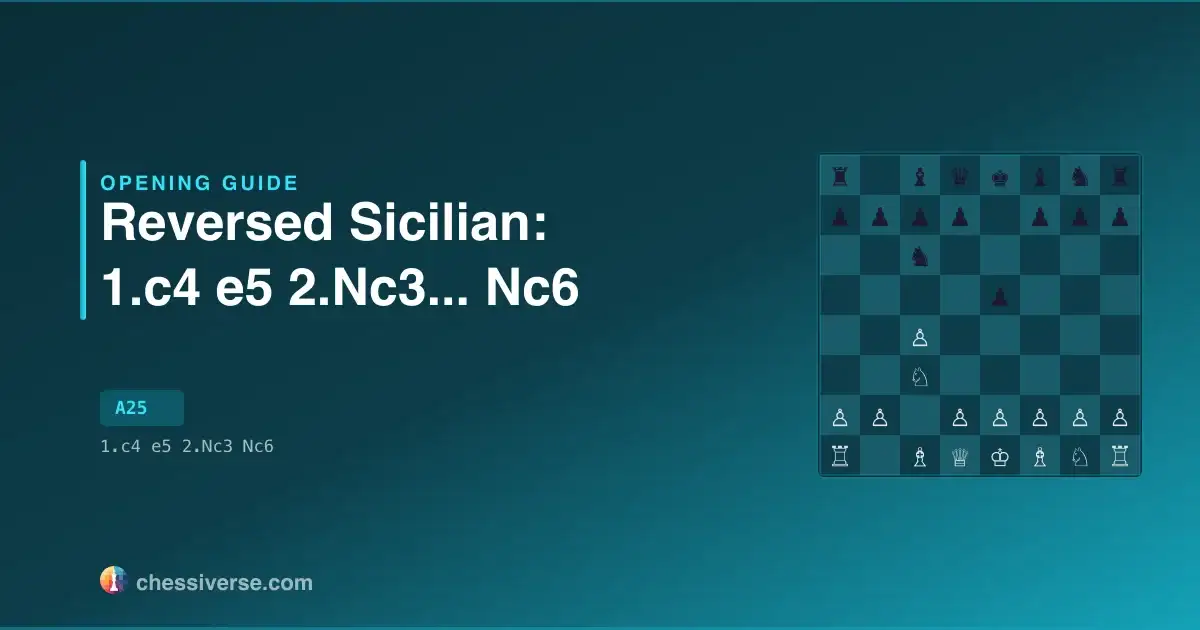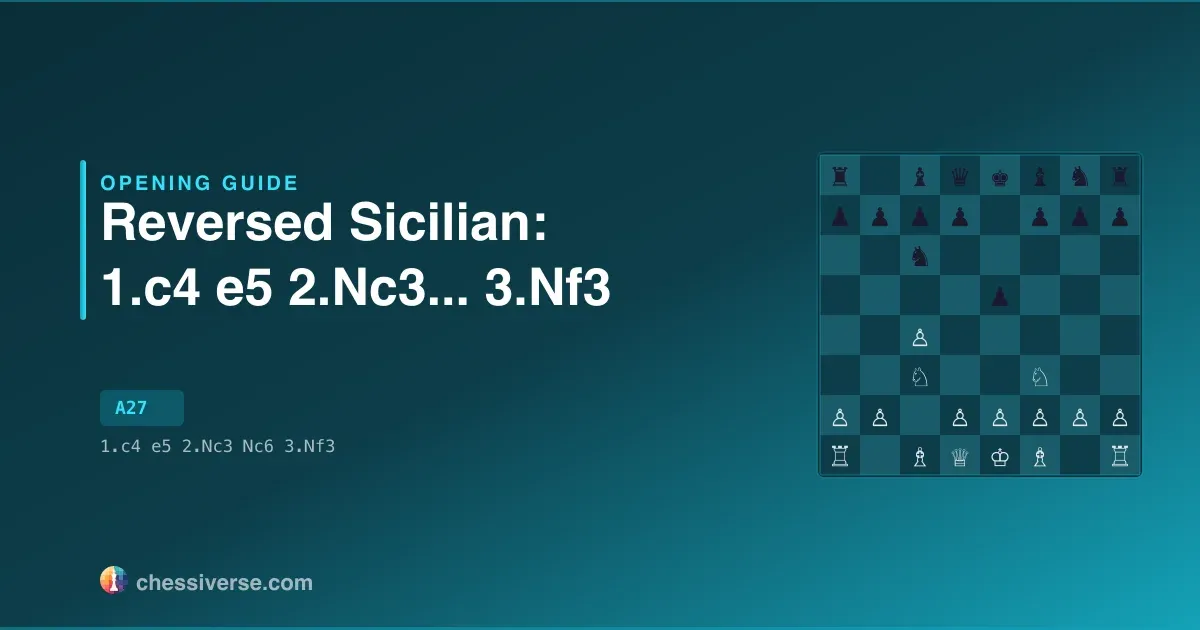
The English Opening: King's English Variation, Three Knights System begins with 1.c4 e5 2.Nc3 Nc6 3.Nf3 (ECO A27). White attacks e5 and forces Black to make a choice — defend the pawn or counterpunch. The English Four Knights structure looms one move away.
Strategic Overview
3.Nf3 is the natural developing move that puts the question to Black: how do you intend to defend e5? The most common reply is 3...Nf6, leading to the English Four Knights, where both sides have all their knights on natural squares and the fight shifts to bishop placement and pawn breaks. Black can also try 3...g6 with a King's Indian-style fianchetto, or 3...f5 for sharp kingside play. White's plan in the Four Knights is straightforward: fianchetto with g3 and Bg2, castle short, and pressure d5 from distance. Black's main counter is the ...Bb4 pin, threatening doubled c-pawns and weakening White's grip on d5. The middlegame becomes a fight over central squares with both sides looking for pawn breaks — d4 for White, ...d5 for Black. The tempo advantage is small but real; White typically gets a slight edge in development and space. This is one of the most theoretically respected English lines and shows up regularly at every level from club play to elite tournaments. Both sides need to know the main plans, but the structures are familiar enough that good understanding goes a long way.
Key Ideas
When players succeed in this line, they usually do so by leaning on the following themes:
- Attack e5 and force a defensive choice — By hitting the e-pawn directly, White makes Black commit to a piece setup. The most common defense is ...Nf6, leading to the Four Knights.
- Fianchetto and pressure d5 from distance — After the Four Knights structure, White's standard plan is g3, Bg2, and 0-0. The fianchettoed bishop pressures d5 for the entire middlegame.
- Watch for the ...Bb4 pin — Black's main equalizing idea: pin the c3-knight, threaten doubled pawns, and weaken White's hold on d5. White's piece coordination has to account for this throughout.
- Pawn breaks decide the middlegame — White aims for d4, Black for ...d5. Whoever lands their break first and on better terms takes the initiative. The tempo advantage usually gives White the slight edge here.
History and Notable Players
It arises from the English Opening: King's English Variation, Reversed Closed Sicilian. On the White side, Wolfgang Uhlmann (40 games), Colin Anderson McNab (21 games), Dirk Poldauf (16 games) top the database. Notable Black exponents: Predrag Nikolic (14 games), Vlastimil Hort (13 games), Ryszard Bernard (12 games).
Performance Across Rating Levels
How well the English Opening: King's English Variation, Three Knights System works depends on what level you're playing at. At 1200 Elo, the opening shows up in 0.03% of games (215,403 samples). White scores 52.6%, Black 43.7%, draws 3.7%. By 1800, popularity is 0.04% and White's score is 52.4% to Black's 42.8%. At the top end (2500+ Elo), popularity is 0.16% with 9% draws — a clear sign of how much theory rules the line at master level. Positions also become less sharp as level rises (sharpness 0.96 → 0.91).
Time Control Patterns
Time control matters here: blitz players reach for this opening more than others. In bullet, it appears in 0.04% of games (943,537); White wins 51.7%. Blitz shows 0.04% adoption across 1,479,458 games, White scoring 52%. In rapid, the share rises to 0.04% — 428,179 games, White 53%.
Move Diversity and Theory Depth
What players actually play after the opening moves depends heavily on rating. At 1200 Elo (215,403 games), the top reply is Nf6, played 50% of the time. Three other moves each take at least 5% of games, and the top three moves account for 80.2% of games. Entropy: 2.22. By 2500 (21,503 games), Nf6 is still the top reply, at 39.8%; five other moves reach 5% and the top three moves account for 78.4% of games. Entropy rises to 2.35. Even elite players don't fully agree on the best continuation here, which keeps the position dynamic.
Historical Trends
Year-over-year data tells you whether this opening is a contemporary fixture or a fading one. Adoption peaked in 2020 at 0.05% (277,309 games). By 2025 it sits at 0.04%, 23% below the peak and roughly back to its 2013 level, leaving the line flat over the full period.
Main Lines and Variations
The main branches off 1.c4 e5 2.Nc3 Nc6 3.Nf3 include:
Each branch leads to a different middlegame character — the resulting pawn structure decides what kind of game you get.
Common Mistakes
- Neglecting development — Extra pawn moves in the opening are tempting, especially when you "know the moves". Developing a piece each turn is the simple correction.
- Ignoring the kingside attack — In sharp Sicilian lines, White typically castles long and pushes the h-pawn. Without your own counterplay on the queenside or in the centre, White's attack lands first.
Practice on Chessiverse
Ready to try the English Opening: King's English Variation, Three Knights System against a bot? Pick an opponent at your level and play a game.