

Reversed Sicilian: 1.c4 e5 2.Nc3...... Nf6

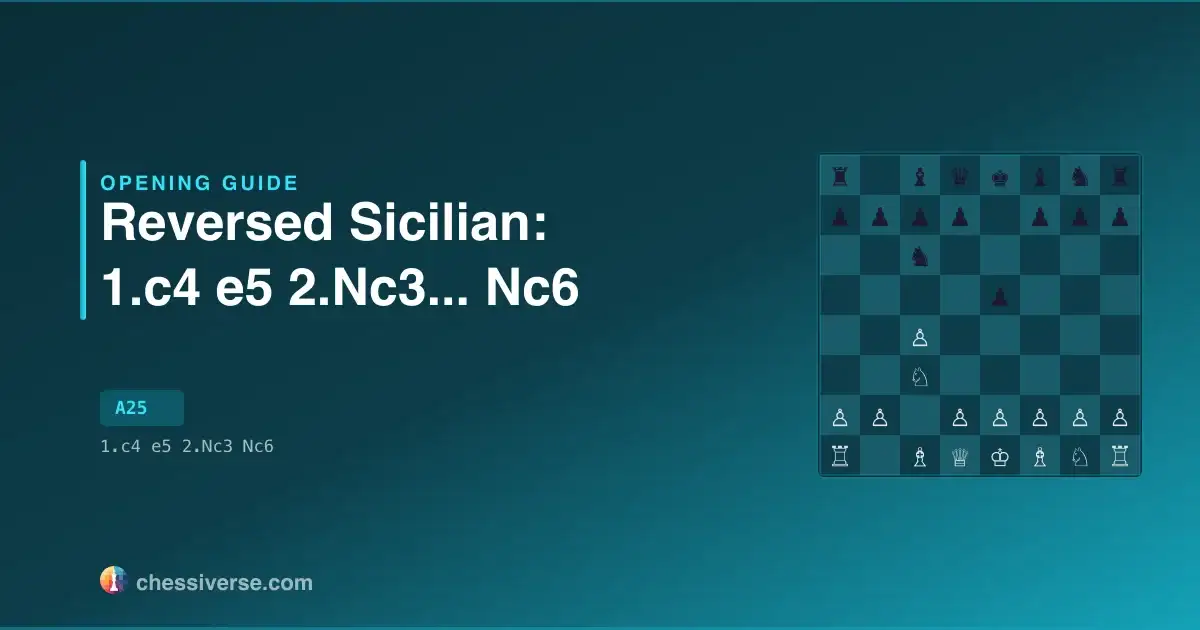
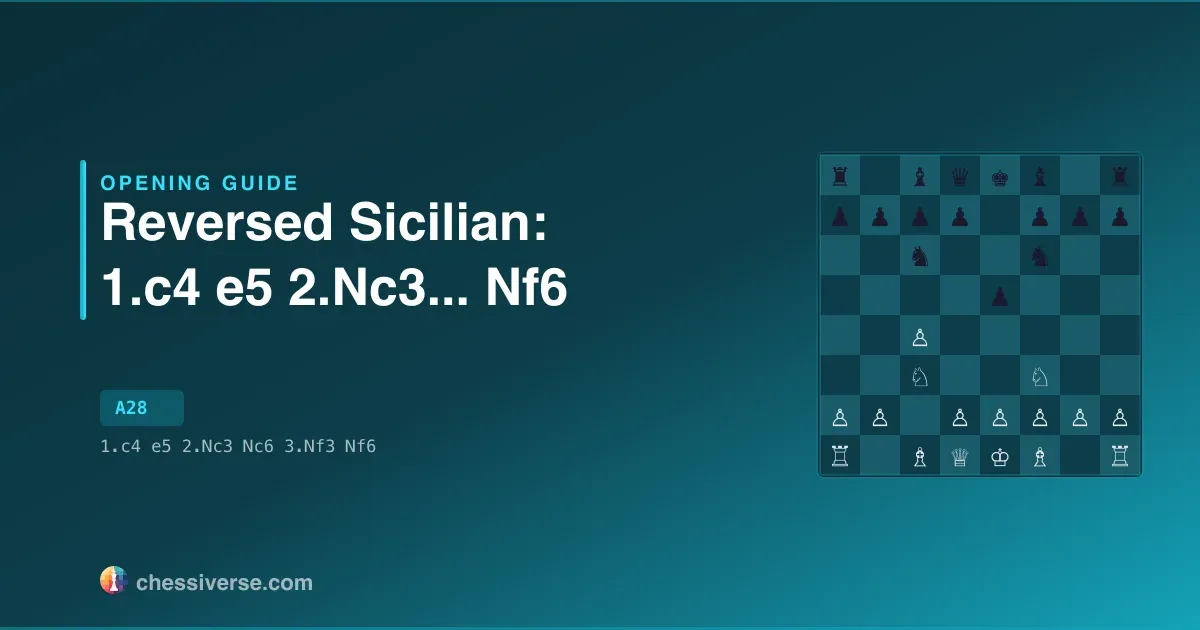
A281.c4 e5 2.Nc3 Nc6 3.Nf3 Nf6
Sep 20, 2027
TL;DR

The full English Four Knights — both sides develop all knights to natural squares and the real questions become bishop placement and pawn breaks. Black's main equalizer is the ...Bb4 pin on c3; White's plan is g3-Bg2 and a timely d4 push. Theory respects it at every level.

Reviewed by

IM John Bartholomew
IM John BartholomewCo-Founder & Chess Educator

International Master and chess educator. Co-founded Chessable and joined Chessiverse as co-founder. Best known for his "Climbing the Rating Ladder" YouTube series and structured opening courses.

Reversed Sicilian: 1.c4 e5 2.Nc3...... Nf6: A Complete Guide
Reversed Sicilian: 1.c4 e5 2.Nc3...... Nf6 - Opening Moves
Summary

Starting from 1.c4 e5 2.Nc3 Nc6 3.Nf3 Nf6, players enter the Reversed Sicilian: 1.c4 e5 2.Nc3... Nf6 — ECO A28. All four knights are out and the English Four Knights is fully on the board. Both sides have natural development, balanced central tension, and a long strategic game ahead.

Strategic Overview

The English Four Knights is one of the most respected structures in the entire opening. Both sides have developed all their knights to natural squares, and the real questions become bishop placement and pawn breaks. White's standard plan is g3, Bg2, and 0-0, putting the fianchettoed bishop on the long diagonal pressuring d5. Black's main equalizing idea is the ...Bb4 pin on the c3-knight, which threatens doubled pawns and weakens White's central grip. After Black's pin, White often plays Nd5 to break the pin or accepts the structural concession and aims for piece activity. The middlegame typically revolves around the d4 break for White and the ...d5 break for Black. Whichever side gets their break first and on better terms keeps a small but persistent edge. The structures that arise are familiar — sometimes reminiscent of an Open Sicilian with colors reversed, sometimes more like a Catalan or Reti hybrid depending on how the bishops resolve. This is an opening that rewards positional understanding and rewards patience. Sharp tactics happen, but only after both sides have completed development and identified concrete weaknesses to attack.

Key Ideas

When players succeed in this line, they usually do so by leaning on the following themes:

  • Bishop placement decides the structure — After natural knight development, where the bishops go determines the character of the middlegame. White's Bg2 versus Black's ...Bb4 is the central tension.
  • The ...Bb4 pin is Black's main equalizer — Pinning the c3-knight threatens doubled pawns and weakens d5. White has to either accept structural concessions or play Nd5 to break the pin.
  • Pawn breaks are the long-term plan — White wants d4; Black wants ...d5. Both sides spend the opening preparing their break and trying to prevent the opponent's. The timing matters enormously.
  • Patience and positional understanding win here — Sharp tactics are rare in the opening phase. The side that better understands which pieces to keep, which to trade, and when to break wins the middlegame.

History and Notable Players

It arises from the Reversed Sicilian: 1.c4 e5 2.Nc3... 3.Nf3. Among the most prolific White practitioners are Wolfgang Uhlmann (110 games), Viktor Korchnoi (57 games), Klaus Bischoff (56 games). Black-side regulars include Oleg M Romanishin (52 games), Anatoly Karpov (42 games), Jan H Timman (39 games).

Performance Across Rating Levels

The picture changes a lot as you climb the rating ladder. The 1200 bracket has 238,382 games (0.04% of all games at that level); White wins 51.4%, Black 44.8%, 3.8% are drawn. By 1800, popularity is 0.06% and White's score is 52.4% to Black's 42.4%. At 2500, 0.27% of games go into this opening; draws sit at 10% — the line is well-mapped at this level. Positions also become less sharp as level rises (sharpness 0.96 → 0.90).

Time Control Patterns

Look at the same opening across time controls and rapid stands out. In bullet, it appears in 0.03% of games (823,376); White wins 52.4%. Blitz shows 0.05% adoption across 1,902,980 games, White scoring 51.9%. In rapid, the share rises to 0.05% — 605,636 games, White 51.9%.

Move Diversity and Theory Depth

Looking at move selection shows how forcing — or not — the position really is. At 1200 Elo, the top reply is g3, played 27% of the time. There are 5 other moves seeing meaningful share, and 64.9% of games stick to established theory. Entropy: 2.60. By 2500, e3 dominates at 32% of replies; only 5 viable alternatives remain and 76.2% of moves are theory. Entropy drops to 2.39.

Main Lines and Variations

After 1.c4 e5 2.Nc3 Nc6 3.Nf3 Nf6, the established follow-ups are:

Each branch leads to a different middlegame character — the resulting pawn structure decides what kind of game you get.

Common Mistakes

  • Drifting away from main theory — At 400 Elo, theory adherence sits at 62.7% — versus 75% at 2000. The most popular deviation is d3 (played 13.2% of the time at 400, much less so up top). It looks fine but quietly hands the better-prepared side an edge.
  • Neglecting development — It can feel productive to make extra pawn moves early, but falling behind in piece development is what loses most amateur games — especially in open positions where active pieces find squares fast.
  • Ignoring the kingside attack — In sharp Sicilian lines, White typically castles long and pushes the h-pawn. Without your own counterplay on the queenside or in the centre, White's attack lands first.

Practice on Chessiverse

Ready to try the Reversed Sicilian: 1.c4 e5 2.Nc3... Nf6 against a bot? Pick an opponent at your level and play a game.

Quick Facts

Main Line1.c4 e5 2.Nc3 Nc6 3.Nf3 Nf6
DifficultyAdvanced
Style

Theoretician openings have deep, well-studied lines where knowledge of specific variations gives a significant advantage. Preparation and memorization of key lines are essential.

2,508,616games on Lichess
51.9%
5.2%
42.9%
White wins Draws Black wins

Top Players

As White
As Black

Data from Lichess opening explorer (blitz & rapid)

Most Popular At2500
SharpnessSharp

Popularity by Rating

Percentage of all games at each rating bracket that feature this opening.

Data from Lichess opening explorer (blitz & rapid games)

Theory Adherence by Rating

How often players choose the single most popular move at this position. Higher = more predictable play.

White to move after the opening line

Popularity Over Time

Share of all Lichess blitz + rapid games featuring this opening, by year.

Top Moves by Rating

White to move after the opening line

RatingMost Popular2nd3rd
400e424.5%g321.1%e317.1%
1000g323.6%e420.6%e320.1%
1200g327%e321.4%e416.5%
1400g329.8%e322.3%d415.7%
1600g333.8%e322.7%d414.6%
1800g336.8%e321.8%d415.9%
2000g336.1%e324%d415%
2200g331.8%e327.7%e418.2%
2500e332%g323.1%e421.2%

Popularity by Time Control

Bullet
0.03%823K
Blitz
0.05%1.9M
Rapid
0.05%606K
2% more decisive in bullet
Raw data tables (Lichess blitz + rapid)
Reversed Sicilian: 1.c4 e5 2.Nc3...... Nf6: popularity and win rates by player rating
Rating (Elo)Share %GamesWhite win %Black win %Draw %Sharpness
4000.0242,79348.946.84.30.957
10000.03116,09250.645.53.90.961
12000.04238,38251.444.83.80.962
14000.04369,13252.543.63.90.961
16000.05459,93152.742.94.40.956
18000.06492,86152.442.45.10.949
20000.10440,02051.942.06.20.938
22000.18312,40950.741.57.70.923
25000.2736,99649.340.710.00.900
Reversed Sicilian: 1.c4 e5 2.Nc3...... Nf6: move-choice theory adherence by rating
Rating (Elo)Top moveTop move %Viable movesTheory %Entropy
400e424.5562.72.694
1000g323.6564.32.626
1200g327.0564.92.600
1400g329.8567.82.557
1600g333.8571.22.451
1800g336.8574.42.355
2000g336.1575.02.346
2200g331.8677.82.354
2500e332.0576.22.393
Reversed Sicilian: 1.c4 e5 2.Nc3...... Nf6: popularity over time
YearShare %GamesWhite win %Black win %Draw %
20130.051,35750.845.14.1
20140.054,12851.544.34.3
20150.0512,09253.541.64.9
20160.0634,45553.441.65.0
20170.0561,61852.342.55.1
20180.06105,54951.943.24.9
20190.06173,63352.043.14.9
20200.06370,67352.542.05.5
20210.06439,68251.942.95.2
20220.05393,78051.743.15.2
20230.05397,09951.643.25.2
20240.05355,06351.743.15.2
20250.05348,21451.743.15.2
Reversed Sicilian: 1.c4 e5 2.Nc3...... Nf6: popularity by time control
FormatShare %GamesWhite win %Black win %Draw %Sharpness
bullet0.03823,37652.444.23.40.966
blitz0.051,902,98051.942.95.20.948
rapid0.05605,63651.942.85.30.947
Reversed Sicilian: 1.c4 e5 2.Nc3...... Nf6: top candidate moves by rating bracket
Rating (Elo)1st move1st %2nd move2nd %3rd move3rd %
400e424.5g321.1e317.1
1000g323.6e420.6e320.1
1200g327.0e321.4e416.5
1400g329.8e322.3d415.7
1600g333.8e322.7d414.6
1800g336.8e321.8d415.9
2000g336.1e324.0d415.0
2200g331.8e327.7e418.2
2500e332.0g323.1e421.2
Reversed Sicilian: 1.c4 e5 2.Nc3...... Nf6: top practitioners by side
SidePlayerGames
WhiteWolfgang Uhlmann110
WhiteViktor Korchnoi57
WhiteKlaus Bischoff56
BlackOleg M Romanishin52
BlackAnatoly Karpov42
BlackJan H Timman39

Frequently Asked Questions

What is the Reversed Sicilian: 1.c4 e5 2.Nc3... Nf6?

The Reversed Sicilian: 1.c4 e5 2.Nc3... Nf6 begins with 1.c4 e5 2.Nc3 Nc6 3.Nf3 Nf6 and is classified under ECO code A28.

Is the Reversed Sicilian: 1.c4 e5 2.Nc3... Nf6 good for beginners?

The Reversed Sicilian: 1.c4 e5 2.Nc3... Nf6 can be played at any level. Beginners should focus on understanding the key strategic ideas rather than memorizing long theoretical lines. Our AI bots at various rating levels provide a great way to practice the opening concepts.

What are the main variations of the Reversed Sicilian: 1.c4 e5 2.Nc3... Nf6?

The main continuations include: Reversed Sicilian: 1.c4 e5 2.Nc3... 4.g3. Each variation leads to distinct types of positions with their own strategic themes.

What are the win rates for the Reversed Sicilian: 1.c4 e5 2.Nc3... Nf6?

In a database of 2,508,616 master games, White wins 51.9% of the time, Black wins 42.9%, and 5.2% are drawn. Notable players on the White side include Wolfgang Uhlmann and Viktor Korchnoi. On the Black side, Oleg M Romanishin and Anatoly Karpov are among the most frequent practitioners.

Reviewed by

IM John Bartholomew
IM John BartholomewCo-Founder & Chess Educator

International Master and chess educator. Co-founded Chessable and joined Chessiverse as co-founder. Best known for his "Climbing the Rating Ladder" YouTube series and structured opening courses.

Practice This Opening on Chessiverse

Play against 1000+ AI bots with unique personalities and opening repertoires. From beginner-friendly to grandmaster-level opponents, find the perfect sparring partner for any opening.

Play Now

Not sure which opening fits you? Take the free chess personality test — your style determines which openings will work with you.

Back to Articles