



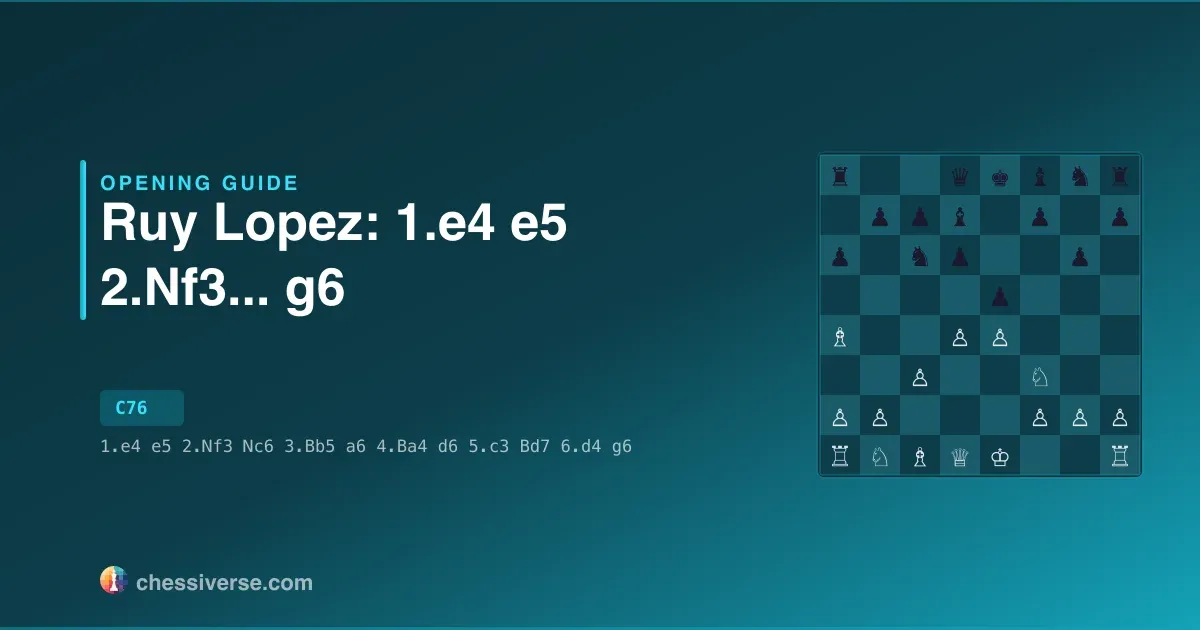
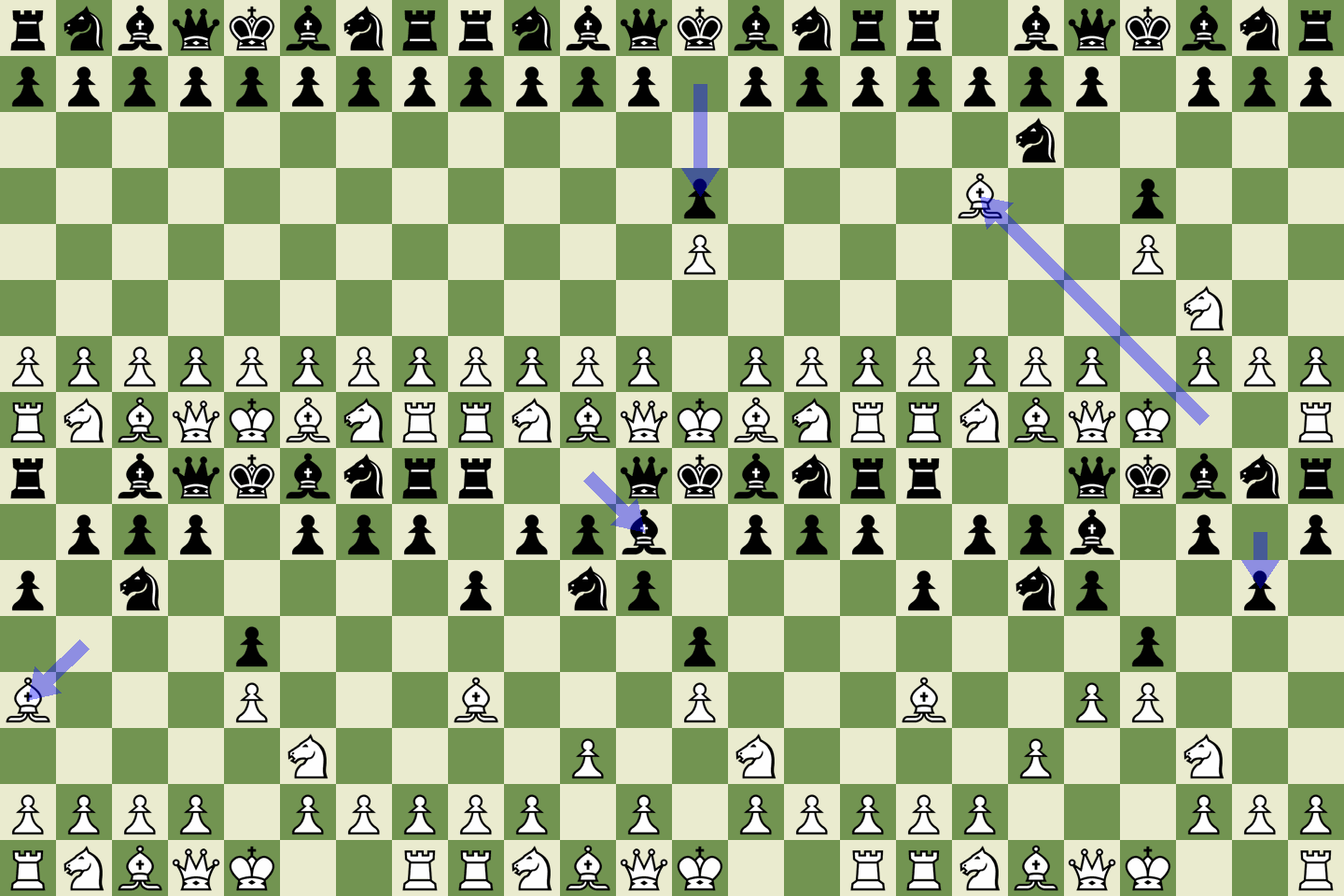
1.e4 e5 2.Nf3 Nc6 3.Bb5 a6 4.Ba4 d6 5.c3 Bd7 6.d4 g6 opens the Ruy Lopez: Morphy Defense, Modern Steinitz Defense, Fianchetto Variation, ECO C76. Across rating levels it shows up in 9,068 recorded games — enough data to map exactly where it succeeds and where it stalls.
History and Notable Players
It arises from the Ruy Lopez: Morphy Defense, Modern Steinitz Defense (5.c3 5...Bd7). On the White side, Efim Geller (7 games), Vlastimil Jansa (6 games), Igor Yagupov (6 games) top the database. Notable Black exponents: Vladimir P Malaniuk (33 games), Laszlo Zsinka (23 games), Vassily Smyslov (17 games).
Move Diversity and Theory Depth
What players actually play after the opening moves depends heavily on rating. At 1200 Elo (195 games), the top reply is d5, played 34.4% of the time. Three other moves each take at least 5% of games, and the top three moves account for 78.5% of games. Entropy: 2.50. By 2500 (1,195 games), O-O takes over as the top reply at 56.2%; three other moves reach 5% and the top three moves account for 83.9% of games. Entropy drops to 2.08.
Common Mistakes
- Neglecting development — Extra pawn moves in the opening are tempting, especially when you "know the moves". Developing a piece each turn is the simple correction.
- Playing without a plan — Each Ruy Lopez: Morphy Defense, Modern Steinitz Defense, Fianchetto Variation middlegame demands a specific approach. Decide whether the position calls for attack, manoeuvre, or simplification before reaching for a move.
Practice on Chessiverse
Ready to try the Ruy Lopez: Morphy Defense, Modern Steinitz Defense, Fianchetto Variation against a bot? Pick an opponent at your level and play a game.