

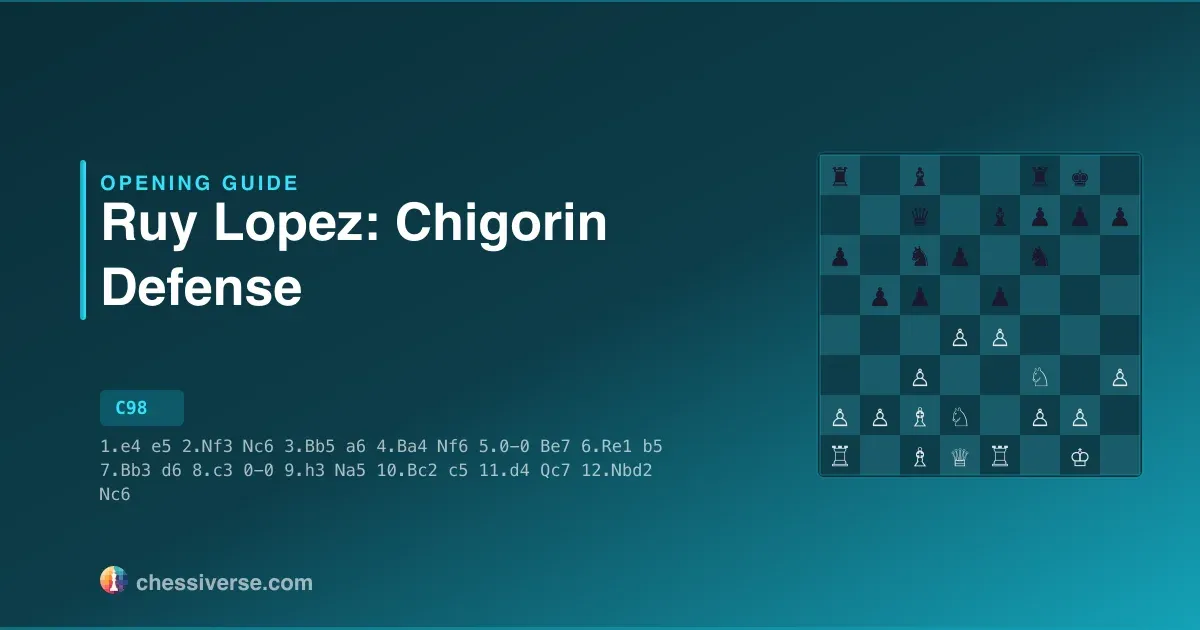
The Ruy Lopez: Chigorin Defense begins with 1.e4 e5 2.Nf3 Nc6 3.Bb5 a6 4.Ba4 Nf6 5.0-0 Be7 6.Re1 b5 7.Bb3 d6 8.c3 0-0 9.h3 Na5 10.Bc2 c5 11.d4 Qc7 12.Nbd2 Nc6 (ECO C98). One of the deepest systems in the Closed Ruy Lopez. The knight makes its trademark loop from a5 back to c6, and Black sets up a balanced position designed for long-term central counterplay.
Strategic Overview
The Chigorin Defense is one of the cornerstones of Closed Ruy Lopez theory. Black accepts the slightly awkward-looking ...Na5 to kick the bishop off the a2-g8 diagonal, then reroutes the knight back to c6 after the bishop retreats to c2. The detour costs a couple of tempi, but it brings a tangible payoff: the bishop is sidelined on c2, and Black builds a solid pawn structure with ...c5 and ...Qc7 supporting the centre and the kingside simultaneously. The Chigorin position itself is one of the most balanced in the entire Ruy Lopez. White retains the classical attacking chances with d4 and Nbd2 to f1 to g3, aiming at the kingside. Black has the manoeuvring resources of the knight pair, the latent ...exd4 or ...cxd4 central break, and the long-term reliability of the ...Qc7 queen that defends the kingside and supports queenside development. The Chigorin demands patience from both sides; flashy tactics are rare, and the game often resolves only deep into the middlegame when one side finds the right pawn break.
Key Ideas
A few ideas come up again and again in this opening:
- Na5-c6 manoeuvre redeploys the knight — The detour through a5 forces the white bishop back to c2, blunting its long diagonal. The knight then returns to c6 where it supports the centre and the standard ...exd4 or ...cxd4 breaks.
- ...c5 stakes a claim in the centre — The pawn push hits d4 and opens the c-file for Black's queen and rook. Together with ...Qc7, it gives Black both central counterplay and a solid kingside defence.
- ...Qc7 defends the kingside and the centre — Placing the queen on c7 covers the e5 pawn after central exchanges, supports a queenside development with ...Nd7, and gives Black flexible options for ...Bd7 and a8 rook moves.
- Long manoeuvring battle — The position rewards understanding over calculation. Both sides reorganise pieces patiently, looking for the moment when one of the typical pawn breaks (d4, ...d5, ...f5) becomes favourable.
History and Notable Players
It arises from the Ruy Lopez: Closed (7.Bb3).
Move Diversity and Theory Depth
What players actually play after the opening moves depends heavily on rating. Below 1600 the samples are small (3 games at 1200, 58 at 1400), so the comparison starts at 1600, with 690 games. There, the top reply is Nf1, played 52.9% of the time. One other move takes at least 5% of games, and the top three moves account for 95.8% of games. Entropy: 1.43. By 2500 (879 games), d5 takes over as the top reply at 79.9%; one other move reaches 5% and the top three moves account for 93.9% of games. Entropy drops to 1.14.
Common Mistakes
- Neglecting development — It can feel productive to make extra pawn moves early, but falling behind in piece development is what loses most amateur games — especially in open positions where active pieces find squares fast.
- Playing without a plan — Each Ruy Lopez: Chigorin Defense middlegame demands a specific approach. Decide whether the position calls for attack, manoeuvre, or simplification before reaching for a move.
Practice on Chessiverse
Ready to try the Ruy Lopez: Chigorin Defense against a bot? Pick an opponent at your level and play a game.