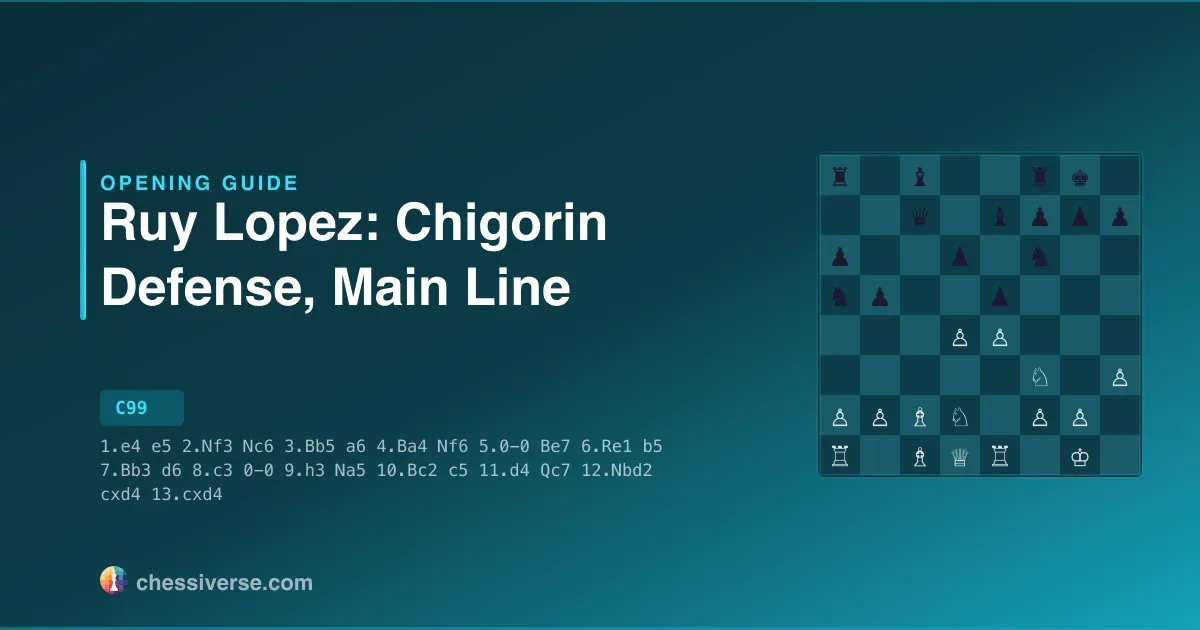
The Ruy Lopez: Chigorin Defense, Main Line begins with 1.e4 e5 2.Nf3 Nc6 3.Bb5 a6 4.Ba4 Nf6 5.0-0 Be7 6.Re1 b5 7.Bb3 d6 8.c3 0-0 9.h3 Na5 10.Bc2 c5 11.d4 Qc7 12.Nbd2 cxd4 13.cxd4 (ECO C99). Black resolves the central tension by trading on d4, leaving White with a classical pawn duo on c3-d4 and Black with the piece activity to undermine it.
Strategic Overview
After 12...cxd4 13.cxd4 the structural battleground is set. White now owns a classical centre — pawns on d4 and e4 — and a half-open c-file, but the c-pawn has been traded so Black no longer has to worry about queenside pawn pressure on c5. Black's task is to convert piece activity into pressure against d4. Standard plans involve doubling rooks on the c-file, repositioning the knight from c6 to a more aggressive square via d7 or via b4, and prompting trades that magnify the weakness of an isolated or hanging d-pawn. White's plan is more direct: complete development, get the queen's knight to f1 and then to g3, and either build a kingside attack with Nh4-Nf5 ideas or use the d4 pawn as the basis for a slow squeeze across the whole board. The Chigorin Main Line is positional in flavour but it isn't slow — the centre is open enough that one inaccurate move can let either side find a tactic. It's been played at world championship level multiple times because both sides have real chances and the strategic content is rich.
Key Ideas
When players succeed in this line, they usually do so by leaning on the following themes:
- White gets a classical pawn centre — Pawns on d4 and e4 give White space and central control. The structure is a textbook classical centre and supports natural development of the knight to g3 with attacking ideas on the kingside.
- Black targets the d4 pawn — Without queenside pawn levers, Black focuses on piece pressure against d4. Doubling rooks on the c-file, rerouting the c6 knight, and timing ...d5 are the recurring themes.
- White aims at the kingside — The standard Nbd2-Nf1-Ng3 manoeuvre brings a knight to the attacking flank. Combined with Nh4 or f4 ideas, White generates a kingside initiative that runs parallel to the central tension.
- Both plans depend on precise piece placement — Neither side has an obvious tactical breakthrough. Success comes from coordinating pieces to enforce a favourable trade or to create one decisive weakness in the opponent's camp.
History and Notable Players
It arises from the Ruy Lopez: Closed (7.Bb3).
Move Diversity and Theory Depth
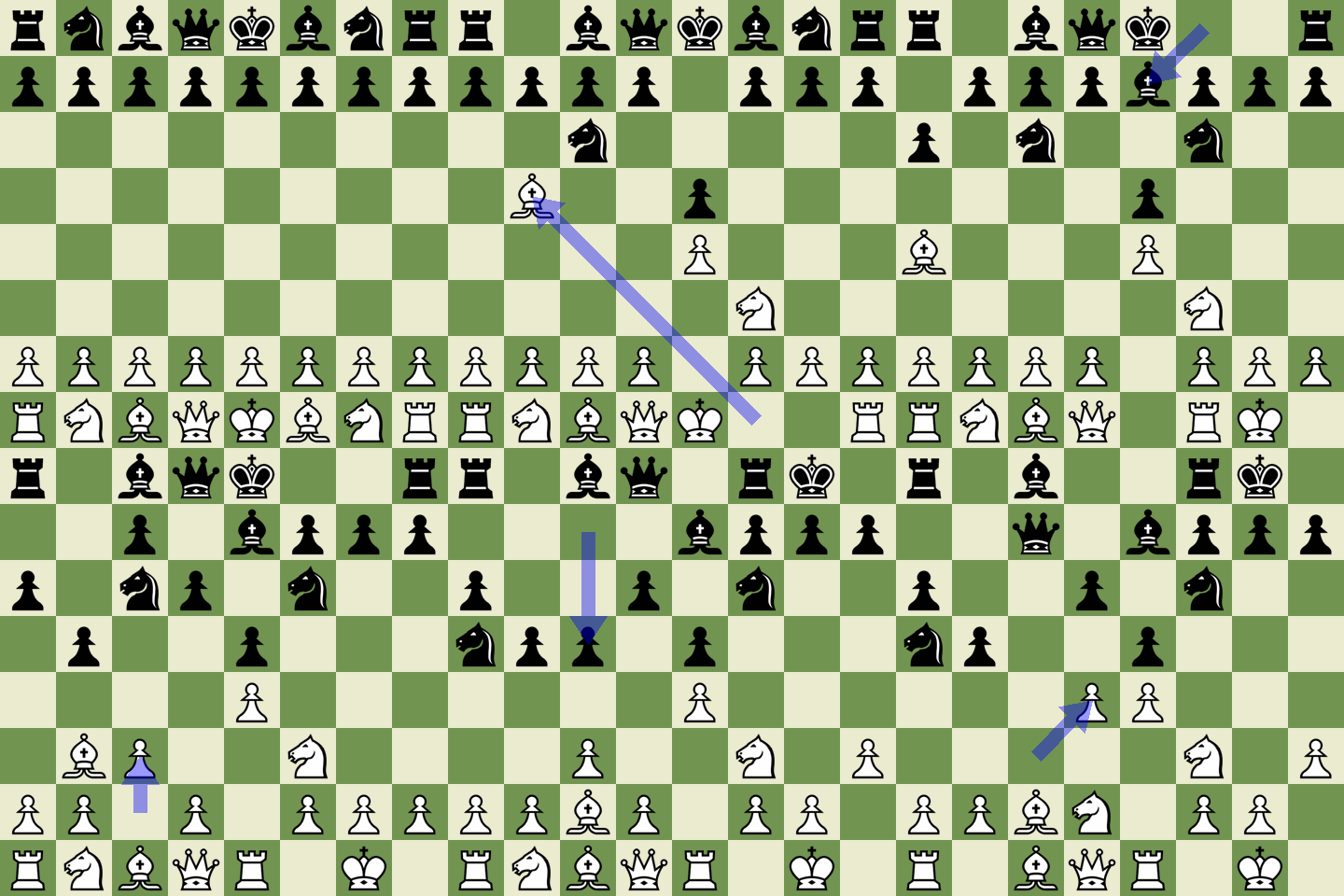
Looking at move selection shows how forcing — or not — the position really is. Below 1400 the samples are small (86 games at 1200), so the comparison starts at 1400, with 336 games. There, the top reply is Nc6, played 33.3% of the time. Four other moves each take at least 5% of games, and the top three moves account for 73.5% of games. Entropy: 2.50. By 2500 (1,248 games), Nc6 dominates at 57.2% of replies; four other moves reach 5% and the top three moves account for 81.1% of games. Entropy drops to 2.03.
Common Mistakes
- Neglecting development — It can feel productive to make extra pawn moves early, but falling behind in piece development is what loses most amateur games — especially in open positions where active pieces find squares fast.
- Playing without a plan — Each Ruy Lopez: Chigorin Defense, Main Line middlegame demands a specific approach. Decide whether the position calls for attack, manoeuvre, or simplification before reaching for a move.
Practice on Chessiverse
Ready to try the Ruy Lopez: Chigorin Defense, Main Line against a bot? Pick an opponent at your level and play a game.