



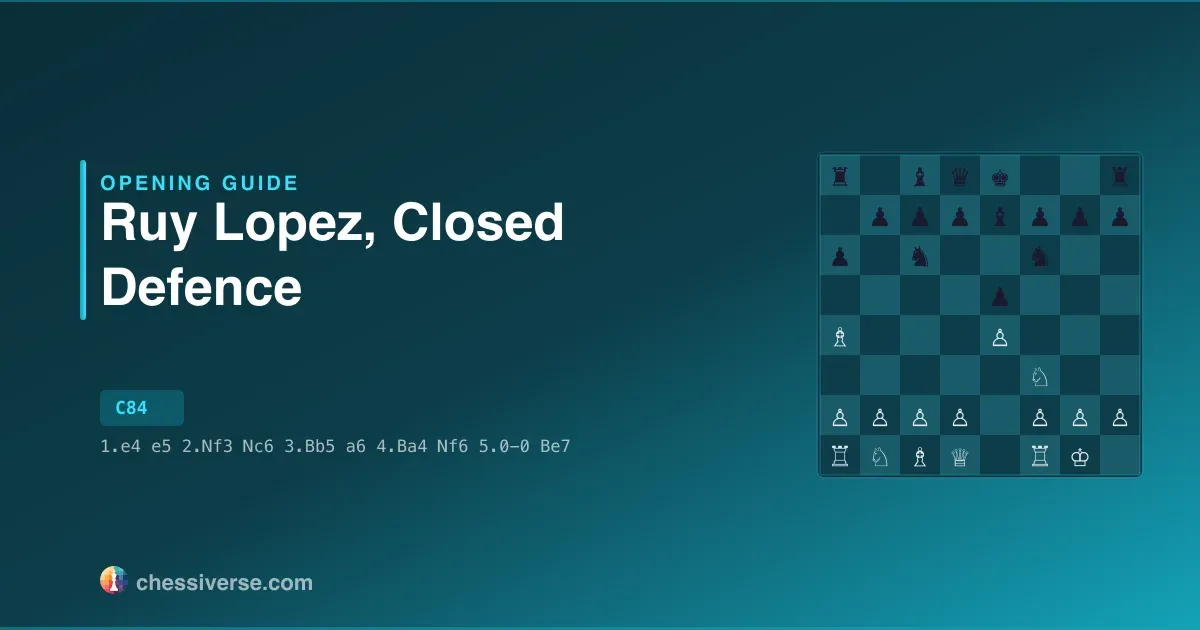
Starting from 1.e4 e5 2.Nf3 Nc6 3.Bb5 a6 4.Ba4 Nf6 5.0-0 Be7, players enter the Ruy Lopez, Closed Defense — ECO C84. With 2,434,087 games on record, the patterns below come from the largest practical sample available.
History and Notable Players
It arises from the Ruy Lopez: Morphy Defense (5.0-0). Among the most prolific White practitioners are Viswanathan Anand (186 games), Vlastimil Jansa (152 games), Mikhail Tal (141 games). Black-side regulars include Svetozar Gligoric (259 games), Oleg M Romanishin (245 games), Alexander G Beliavsky (202 games).
Performance Across Rating Levels
The picture changes a lot as you climb the rating ladder. At 1200 Elo, the opening shows up in 0.01% of games (39,205 samples). White scores 50.6%, Black 46%, draws 3.4%. Move up to 1800 Elo and the share shifts to 0.08%, with White winning 47.4% versus Black's 47.6%. At the top end (2500+ Elo), popularity is 0.49% with 10.3% draws — a clear sign of how much theory rules the line at master level. Positions also become less sharp as level rises (sharpness 0.97 → 0.90).
Time Control Patterns
The Ruy Lopez, Closed Defense skews toward blitz chess. In bullet, it appears in 0.02% of games (621,569); White wins 49.4%. Blitz shows 0.06% adoption across 2,038,306 games, White scoring 48.1%. In rapid, the share rises to 0.04% — 395,781 games, White 46.5%. White's score swings 2.9pp across formats, so time control isn't just a stylistic choice here — it shifts the actual results.
Move Diversity and Theory Depth
What players actually play after the opening moves depends heavily on rating. At 1200 Elo (39,205 games), the top reply is Re1, played 57.7% of the time. Four other moves each take at least 5% of games, and the top three moves account for 80.2% of games. Entropy: 2.03. By 2500 (67,255 games), Re1 dominates at 75.9% of replies; only one other move still reaches 5% and the top three moves account for 95.4% of games. Entropy drops to 1.21. That entropy collapse is the signature of a line where preparation pays off: at the top, players know the best move and play it.
Historical Trends
Year-over-year data tells you whether this opening is a contemporary fixture or a fading one. Adoption peaked in 2016 at 0.09% (55,142 games). By 2025 it sits at 0.04%, 57% below the peak and 42% under its 2013 level, leaving the line in decline.
Main Lines and Variations
The main branches off 1.e4 e5 2.Nf3 Nc6 3.Bb5 a6 4.Ba4 Nf6 5.0-0 Be7 include:
- Ruy Lopez: Closed, Worrall Attack
- Ruy Lopez: Closed, Delayed Exchange
- Ruy Lopez: Closed, Averbakh Variation
- Ruy Lopez: Closed (7.Bb3)
Each branch leads to a different middlegame character — the resulting pawn structure decides what kind of game you get.
Common Mistakes
- Drifting away from main theory — At 400 Elo, the three most-played moves cover 76.4% of games, against 91.5% at 2000. The most popular deviation is Nc3 (played 11.9% of the time at 400, much less so up top). It looks fine but quietly hands the better-prepared side an edge.
- Neglecting development — It can feel productive to make extra pawn moves early, but falling behind in piece development is what loses most amateur games — especially in open positions where active pieces find squares fast.
- Playing without a plan — Each Ruy Lopez, Closed Defense middlegame demands a specific approach. Decide whether the position calls for attack, manoeuvre, or simplification before reaching for a move.
Practice on Chessiverse
Ready to try the Ruy Lopez, Closed Defense against a bot? Pick an opponent at your level and play a game.